
South Korea's Manufacturing Sector Turnaround: Strategic Entry Points for Investors
A Fragile but Noteworthy Recovery
The latest Purchasing Managers Index (PMI) data for September 2025 signals a critical shift: South Korea's factory activity expanded for the first time in eight months, rising to 50.7, a threshold indicating growth, according to the Korean Economic Outlook. This rebound was fueled by renewed overseas demand and new product launches, particularly in semiconductors and automotive exports. A Reuters report noted output and new orders both increased after months of decline, offering a glimmer of hope for a sector that had been battered by weak global demand and aggressive competition from Chinese manufacturers.
However, the broader economic context remains cautious. The Korea Institute for Industrial Economics and Trade projects a 1.9% year-over-year decline in exports for 2025, driven by global uncertainties. The Bank of Korea (BOK) has warned of potential simultaneous downturns in key industries such as semiconductors, automobiles, and steel, citing U.S. tariff risks and price wars in a BOK warning. Yet, within this macroeconomic fragility, certain high-value sectors are defying the trend.
Sector-Specific Strength: Semiconductors and Beyond
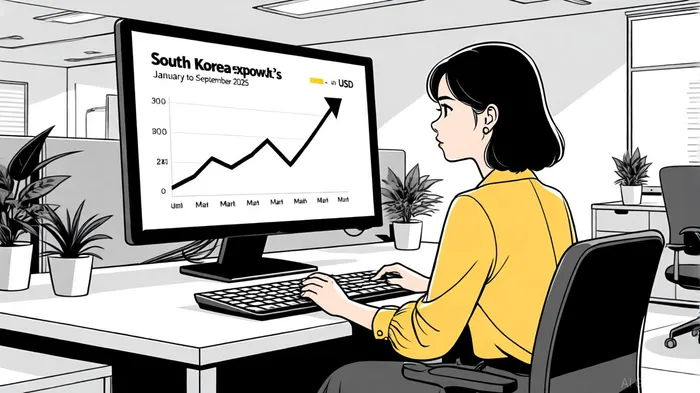
The AI boom has emerged as a lifeline for South Korea's export-dependent economy. In September 2025, semiconductor exports hit a record $16.61 billion, propelling overall exports to $65.95 billion-a 12.7% year-on-year increase, the Korean Economic Outlook noted. This surge was further amplified by August's performance, where exports rose 1.3% to $58.4 billion, driven by strong demand for chips, automobiles, and ships, according to Asia Business Outlook.
Automotive exports, particularly hybrid and electric vehicles, also showed resilience, rising 17% year-on-year despite U.S. tariff pressures. Meanwhile, shipbuilding and mobile phone manufacturing remain bright spots, with the BOK noting their potential to offset declines in other industries. These sectors underscore a broader trend: South Korea's ability to pivot toward high-margin, technology-driven exports amid global volatility.
Strategic Entry Points for Investors
For investors, the path forward hinges on identifying sectors with structural advantages rather than cyclical momentum. Three areas stand out:
Semiconductor and AI-Related Technologies: The global AI race has created a tailwind for South Korean firms, particularly those supplying advanced chips. Companies with exposure to AI infrastructure-such as memory chips and logic semiconductors-are well-positioned to benefit from sustained demand, the Korean Economic Outlook suggests.
Automotive Innovation: The shift toward hybrid and electric vehicles (EVs) offers long-term growth potential. South Korean automakers and battery manufacturers are gaining traction in markets like Europe and Southeast Asia, where EV adoption is accelerating.
Shipbuilding and Industrial Equipment: With global shipping demand rebounding and green energy projects driving new vessel orders, shipbuilders like Hyundai Heavy Industries and Samsung Heavy Industries are seeing robust order books.
Navigating Risks and Uncertainties
Investors must remain vigilant about external risks. The U.S. tariff environment under the Trump administration remains a wildcard, with potential hikes on South Korean steel and automotive exports. Additionally, China's aggressive pricing strategies in sectors like solar panels and EVs could erode margins for South Korean exporters.
Data from Trading Economics indicates that South Korea's import costs are rising, squeezing profit margins in manufacturing. However, the recent PMI expansion suggests that companies are adapting-through cost optimization, innovation, and diversification into higher-margin markets.
Conclusion: Balancing Caution and Opportunity
South Korea's manufacturing sector is at a crossroads. While the broader economic outlook remains cautious, the resilience of high-value export industries offers a compelling case for selective investment. For investors, the key lies in capitalizing on structural trends-such as the AI-driven semiconductor boom and the global shift to green energy-while hedging against geopolitical and trade policy risks.
As the BOK and industry analysts emphasize, the path to recovery will not be linear. But for those who can navigate the volatility, South Korea's manufacturing sector may yet deliver outsized returns in the coming years.







Comentarios
Aún no hay comentarios