
South Korea's Crypto Renaissance: How Entertainment-Driven Financial Literacy is Fueling Market Adoption
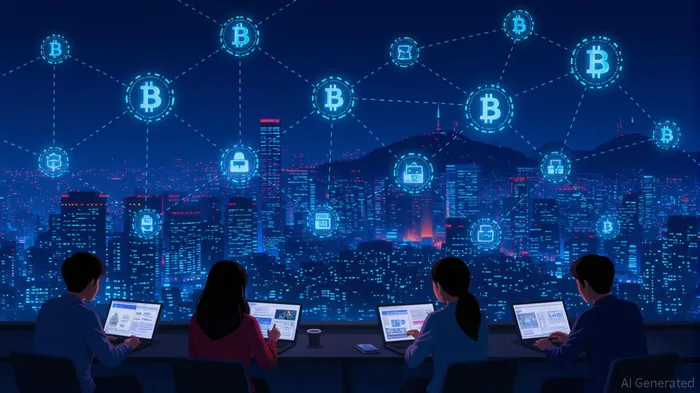
South Korea has emerged as a global leader in cryptocurrency adoption, with over 30% of its population owning digital assets by late 2025[1]. This surge is not merely a function of speculative fervor but a calculated convergence of entertainment-driven innovation, regulatory modernization, and a growing emphasis on financial literacy. The country's unique blend of tech-savvy culture, institutional support, and creative Web3 projects is reshaping how retail investors engage with crypto, turning it into a mainstream financial tool.
The Entertainment-Driven Crypto Ecosystem
South Korea's entertainment industry has become a fertile ground for blockchain experimentation. Projects like Quant Earth and Play PEPE are redefining user engagement by merging gaming, meme culture, and decentralized finance (DeFi). Quant Earth, built on zero-knowledge rollups, offers zero-gas-fee transactions and scalable metaverse environments, attracting gamers and developers alike[4]. Meanwhile, Play PEPE leverages meme culture to onboard users through customizable avatars and staking opportunities, resonating with South Korea's youth-dominated gaming and NFT communities[4].
Beyond gaming, K-pop agencies like HYBE and Netmarble have launched NFT-based fan engagement platforms. For instance, Modhaus allows fans to purchase NFTs as voting tokens, enabling them to influence decisions like album cover designs or concert locations[1]. These projects are not just entertainment—they are immersive on-ramps to crypto literacy, teaching users about digital ownership, smart contracts, and decentralized governance in a low-stakes environment.
A striking example is K Wave MediaKWM--, which allocated $500 million to BitcoinBTC-- and the Lightning Network, aiming to reduce cross-border transaction fees for K-pop merchandise and concerts[1]. By integrating crypto into fan economies, these projects normalize digital assets as tools for everyday transactions, bridging the gapGAP-- between speculative investment and practical utility.
Financial Literacy Through Institutional and Educational Initiatives
South Korea's crypto boom is underpinned by a parallel push for financial education. The government has relaxed restrictions on institutional crypto trading, allowing universities, non-profits, and listed companies to participate in the market[3]. Seoul National University, for instance, has piloted WEMIX token trading, signaling a broader strategy to integrate crypto into academic curricula[5].
Regulatory frameworks like the Virtual Asset User Protection Act (VAUPA) have also enhanced investor confidence by mandating cold storage for 80% of user assets and segregating deposits[5]. These measures, combined with AI-driven financial literacy tools, are demystifying crypto for a population already accustomed to digital transactions. A 2024 survey revealed that 40% of South Korean university students are investing in crypto, often as a response to student debt and economic instability[2].
The government's proposed won-backed stablecoin further underscores its commitment to mainstream adoption. By stabilizing capital outflows and reducing reliance on foreign stablecoins like USDTUSDC--, this initiative aims to anchor crypto within the domestic economy[1]. Such policies are critical in addressing the financial illiteracy that persists among young investors, who often view crypto as a high-risk gamble rather than a long-term asset class[2].
Market Adoption: Data and Trends
South Korea's crypto market is now the second-most-used fiat currency for crypto transactions, with a forecasted trading volume of $663 billion in 2025[3]. The average daily trading volume hit 14.9 trillion won ($10.2 billion) in late 2024, rivaling traditional stock markets[2]. Stablecoin outflows reached $19.5 billion in Q1 2025 alone, driven by USD-pegged tokens like USDT and USDC[4].
The impact of entertainment-driven projects is evident in user metrics. For example, Quant Earth reported a 300% increase in active users after integrating play-to-earn mechanics in 2025[4]. Similarly, Modhaus's NFT platform attracted over 500,000 unique visitors in its first year, with 20% converting to long-term crypto holders[1]. These figures highlight how gamified experiences are accelerating adoption, particularly among demographics skeptical of traditional finance.
Challenges and the Road Ahead
Despite its momentum, South Korea's crypto ecosystem faces hurdles. Regulatory uncertainty, particularly around stablecoins, remains a concern. While the government has banned domestic stablecoin issuance post-TerraUSD's collapse, discussions about a won-backed alternative continue[5]. Additionally, the line between financial literacy and speculative behavior is thin—many young investors still lack understanding of blockchain fundamentals[2].
However, the country's strategic position as a tech innovator and its alignment with global regulatory trends (e.g., U.S. GENIUS Act, EU MiCA) suggest a sustainable path forward. With over 32% of South Koreans holding crypto accounts[1], and institutions like Samsung and LG integrating blockchain into their services[5], the stage is set for a deeper, more inclusive crypto economy.
Conclusion
South Korea's crypto culture is no longer a niche phenomenon—it's a blueprint for how entertainment, education, and regulation can coalesce to drive mass adoption. By embedding financial literacy into Web3 experiences and institutionalizing crypto participation, the country is transforming digital assets from speculative tools into foundational elements of its economy. For investors, this represents a unique opportunity to engage with a market that is not only growing rapidly but also evolving in ways that prioritize sustainability and user empowerment.







Comentarios
Aún no hay comentarios