
South Korea's Crypto Regulatory Tightening: A Double-Edged Sword for Market Maturity and Investor Caution
South Korea's cryptocurrency market has long been a bellwether for global digital asset trends, but 2025 has exposed the tension between regulatory ambition and market pragmatism. As the country grapples with stalled legislation and aggressive enforcement actions, the implications for institutional adoption and market efficiency are becoming increasingly pronounced. While regulators aim to curb systemic risks and financial crime, the unintended consequences-capital flight, liquidity fragmentation, and investor skepticism-highlight a regulatory tightrope that could either catalyze a mature crypto ecosystem or stifle innovation.
Regulatory Stalemate and the Stablecoin Quagmire
The most contentious issue in South Korea's crypto regulatory landscape remains the delayed implementation of the Digital Asset Basic Act (DABA). As of December 2025, the bill remains stalled due to a fundamental disagreement between the Bank of Korea (BOK) and the Financial Services Commission (FSC) over stablecoin governance. The BOK insists that only banks with at least 51% ownership should issue stablecoins, a move it argues would align with financial stability mandates and prevent systemic risks. Conversely, the FSC and ruling Democratic Party warn that such a rule would exclude fintech firms and blockchain startups from the sector, stifling innovation.
This regulatory impasse has pushed the DABA's implementation to 2026, creating a vacuum that has allowed foreign exchanges to dominate. For instance, South Korean investors transferred over 160 trillion won to platforms like Binance and Bybit in 2025, drawn by the availability of leveraged derivatives and pre-market trading-products banned domestically. The Bank of Korea has noted that this exodus has led to thinner liquidity, heightened volatility, and reduced arbitrage opportunities in local markets.
Enforcement Actions and the Cost of Compliance
While legislative delays persist, South Korea's regulatory bodies have ramped up enforcement. In 2025, the FSC imposed heavy fines on major exchanges like Korbit and Upbit for anti-money laundering (AML) violations and inadequate customer identification protocols. These actions, while necessary for curbing illicit activity, have also raised compliance costs for institutions. Exchanges and service providers now face stringent documentation requirements, including asset reserves, transaction ledgers, and governance protocols, to demonstrate adherence to evolving rules.
For institutional investors, the compliance burden is compounded by the lack of clarity. A report by Alaric Securities notes that South Korea's retail-driven crypto market-where free float in equity markets often falls below 20%-has historically been prone to volatility and liquidity constraints. This environment, coupled with regulatory uncertainty, has made it difficult for institutional players to justify large-scale entry. Despite global trends toward institutional adoption, South Korea's market remains insulated, with retail traders dominating activity and altcoins lagging behind global benchmarks.
Market Efficiency Metrics: Liquidity and Trading Volumes
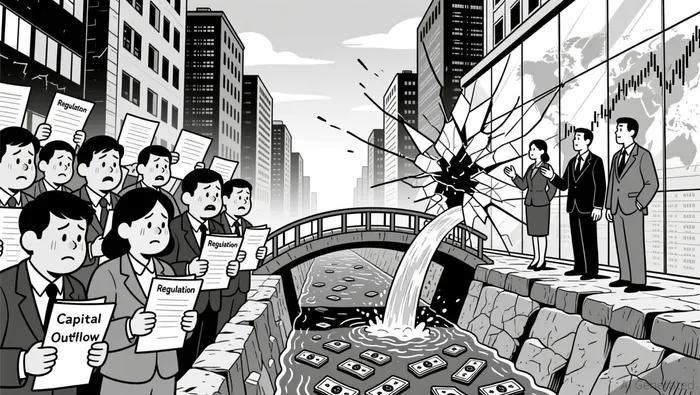
The impact of regulatory fragmentation is starkly visible in liquidity metrics. Kaiko's 2025 analysis highlights that bid-ask spreads and order book depth in South Korea's crypto market have widened compared to global peers, particularly for altcoins. This is partly due to the outflow of capital to foreign exchanges, where trading volumes on domestic platforms dropped by 80% year-on-year. The Korea Exchange's plans to introduce 24/7 trading and crypto ETFs in 2026 suggest a recognition of these inefficiencies, but the absence of a unified regulatory framework continues to deter institutional participation.
Moreover, the Bank of Korea has observed that the shift to foreign platforms has reduced cross-market arbitrage opportunities, a key driver of liquidity in emerging markets. This dynamic underscores a paradox: while South Korea's regulatory focus on stablecoin oversight aligns with global trends such as the EU's MiCA framework and Hong Kong's digital asset strategy, the lack of domestic product diversity has inadvertently accelerated capital flight.
2026 Reforms: A Path Forward or a New Set of Challenges?
The delayed DABA and 2026 stablecoin regulations could either resolve these tensions or deepen them. If implemented, the DABA's requirement for stablecoin issuers to maintain 100% reserves at approved institutions could enhance investor confidence. However, the BOK's insistence on bank-dominated stablecoin issuance risks excluding non-bank innovators, potentially slowing the development of a robust domestic ecosystem.
President Lee Jae-myung's push for a won-backed stablecoin also faces hurdles, including foreign exchange regulations and competition from U.S.-dollar stablecoins like USDTUSDT-- according to Elliptic. While such initiatives could bolster financial sovereignty, they may also divert resources from broader market infrastructure improvements, such as qualified custody solutions and on-chain settlement systems as noted in the Coindesk report.
Conclusion: Balancing Caution and Ambition
South Korea's crypto regulatory tightening is a double-edged sword. On one hand, it signals a commitment to financial stability and investor protection, aligning with global best practices. On the other, the delays and enforcement-heavy approach have created a fragmented market where institutional adoption lags and liquidity is eroded. For 2026 to be a turning point, regulators must strike a balance: fostering innovation without compromising stability, and providing clarity without imposing undue compliance burdens.
As the Korea Exchange prepares to launch crypto ETFs and 24/7 trading according to market reports, the coming year will test whether South Korea can transform its regulatory challenges into a competitive advantage-or whether the exodus to foreign markets will continue to outpace domestic efforts.







Comentarios
Aún no hay comentarios