
South Korea's Crypto Regulatory Overhaul: A Catalyst for Institutional Investment in Digital Assets
South Korea's 2025 cryptocurrency regulatory framework marks a pivotal shift from a retail-driven market to one increasingly structured for institutional participation. The Financial Services Commission (FSC) has unveiled a phased rollout of investment guidelines, allowing non-profits, public companies, and professional investors to engage in crypto trading by Q3 2025, according to a Cryptonews report. This strategic move, coupled with the VirtualCYBER-- Asset User Protection Act (VAUPA) implemented in July 2024, signals a commitment to aligning with global financial standards while fostering market stability, as noted in a BeInCrypto analysis.
A Phased Approach to Institutionalization
The FSC's phased approach prioritizes risk mitigation and gradual market integration. Non-profit organizations and exchanges will gain access to crypto trading in April 2025, with public companies and institutional investors following by year-end, according to CoinEdition. These guidelines mandate robust anti-money laundering (AML) protocols, cybersecurity measures, and cold wallet storage requirements for exchanges, according to a CryptoRobotics report. By institutionalizing participation, South Korea aims to reduce the volatility historically associated with retail-driven markets. Experts project that institutional inflows could stabilize the Kimchi premium-a persistent price discrepancy between Korean and global crypto markets-by introducing deeper liquidity, according to The Financial Analyst.
Global Alignment and Domestic Innovation
South Korea's regulatory strategy balances innovation with oversight. While the European Union's Markets in Crypto-Assets (MiCA) regulation emphasizes uniformity across member states, and the U.S. grapples with fragmented enforcement, South Korea has adopted a "banks-first" model for stablecoin issuance, favoring KRW-pegged assets over dollar-based alternatives, per an Accelab report. This approach not only safeguards monetary sovereignty but also positions the won as a key player in global crypto trading, which currently accounts for 30% of fiat-crypto activity, according to a FinCrime Central analysis.
Long-Term Market Implications
The FSC's reforms are expected to catalyze long-term growth. By Q3 2025, institutional participation could drive the Korean crypto market to $1.1 billion, with projections of $1.3 billion by 2026, according to a Coinotag analysis. The approval of spot BitcoinBTC-- ETFs and security token offerings (STOs) further underscores this trajectory, potentially attracting $19.5 billion in stablecoin outflows in Q1 2025 alone, per a Stablecoin Insider report. However, challenges remain. Smaller exchanges and entities may face compliance costs, and geopolitical risks-such as North Korean crypto activities-necessitate ongoing regulatory vigilance, as highlighted by a CoinEdition report.
A Model for Global Crypto Governance?
South Korea's regulatory framework may serve as a blueprint for other jurisdictions. Unlike the EU's MiCA, which prioritizes uniformity, or the U.S.'s reactive approach, South Korea's phased, compliance-focused model balances innovation with investor protection. The government's pivot from CBDC development to bank-led stablecoin pilots also highlights a pragmatic stance, diverging from global trends while reinforcing domestic financial infrastructure, according to a CoinWy summary.
Conclusion
South Korea's 2025 crypto reforms represent a calculated effort to institutionalize digital assets, reduce volatility, and align with global standards. By fostering a regulated environment that attracts institutional capital, the country is positioning itself as a crypto hub with implications for the broader international market. While challenges persist, the phased rollout and emphasis on compliance suggest a sustainable path forward-one that could redefine the role of digital assets in global finance.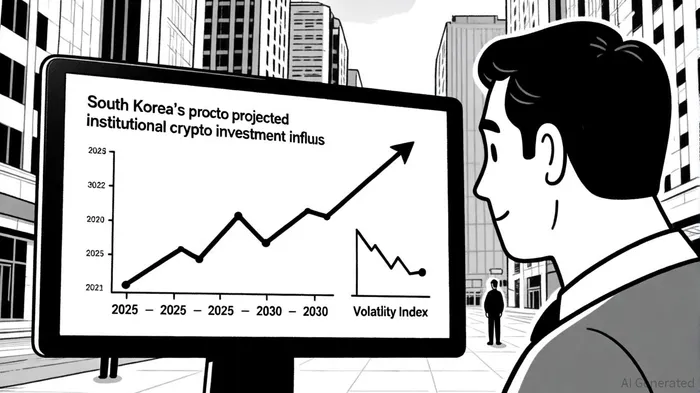






Comentarios
Aún no hay comentarios