
South Korea's Crypto Crossroads: Regulatory Rigor, Market Fragmentation, and the Global Capital Exodus
South Korea's cryptocurrency market stands at a pivotal juncture, shaped by a regulatory landscape that has simultaneously fostered innovation and triggered fragmentation. From 2023 to 2025, the government's introduction of the VirtualCYBER-- Asset User Protection Act (VAUPA) and the Digital Asset Basic Act (DABA) has redefined the sector, creating a dual framework that distinguishes between securities-based tokens and general virtual assets, according to Being National and Institutional. While these reforms aimed to bolster investor protection and market integrity, they have also intensified competition among exchanges, leaving smaller platforms like Coinone struggling to meet compliance costs and liquidity demands, as detailed in Winners and wipeouts. Larger exchanges, such as Upbit and Bithumb, now dominate with 69% and 25% market shares, respectively, while the Financial Services Commission (FSC) enforces stringent requirements like 80% cold storage for user assets and mandatory insurance against network risks, as reported in South Korea blacklists.
The regulatory environment has also catalyzed international exchange consolidation. In September 2025, the South Korean Ministry of Economy and Finance blacklisted 17 foreign exchanges, including KuCoin and MEXC, to align with the OECD's Crypto-Asset Reporting Framework, a move widely covered in South Korea Blacklists KuCoin, MEXC, and 15 Crypto Exchanges. This move has pushed global players to either adapt to South Korea's compliance standards or pivot to offshore markets. Meanwhile, domestic exchanges are exploring partnerships with international firms to navigate regulatory hurdles. For instance, the government's tentative plans to open crypto markets to foreign investors-announced in mid-2025-could attract capital but also intensify competition from global giants like Binance and CoinbaseCOIN--, according to CoinCentral.
Investor capital flight, however, remains a critical concern. Despite inflows of $9.29 billion into South Korean equities in May 2025, as reported by Koreajoongang Daily, the crypto sector has seen a stark divergence. A report by Chaincatcher reveals that 50 trillion won ($35.32 billion) flowed out of the country via stablecoins since November 2024, coinciding with the election of U.S. President Trump and his pro-crypto policies; CoinCentral also noted this dynamic. This exodus is driven by South Korea's restrictive corporate account framework, which prohibits real-name accounts for crypto trading, stifling institutional adoption. As a result, Web3 firms like Nexon's Nexpace, Klaytn's Kaia Foundation, and Wemix have relocated to crypto-friendly jurisdictions such as Abu Dhabi and Dubai, where regulatory clarity and tax incentives create a more hospitable environment, according to Being National and Institutional.
The capital flight is further exacerbated by the rise of offshore stablecoin usage. South Korean investors are increasingly channeling funds into dollar-backed stablecoins to circumvent domestic restrictions, with transfers to foreign virtual asset service provider (VASP) wallets surging 2.3 times year-on-year in early 2024, as documented in South Korea's Crypto Exodus. This trend underscores a growing preference for liquidity and flexibility in markets where South Korea's regulatory rigidity limits operational efficiency.
The government's pivot toward KRW-backed stablecoins under DABA aims to counter this trend, with major banks preparing to issue regulated stablecoins by late 2025, as explored in Being National and Institutional. However, progress is hindered by legislative delays and the need to balance innovation with compliance. The Bank of Korea's decision to pause its CBDC development in favor of a "banks-first" model reflects this tension, as policymakers seek to position South Korea as a global crypto hub without compromising financial stability, according to CoinCentral.
For international investors, the South Korean market presents a paradox: a highly liquid, tech-savvy user base constrained by regulatory fragmentation. While the FSC's roadmap for spot crypto ETFs and institutional trading offers long-term potential, near-term risks include enforcement actions against non-compliant platforms and the continued migration of capital and talent abroad. The recent delisting of unregistered exchanges by Apple and Google was flagged in South Korea's Crypto Exodus, and the Financial Intelligence Unit's scrutiny of KYC/AML practices has been documented in South Korea Blacklists KuCoin, MEXC, and 15 Crypto Exchanges, signaling a regulatory environment where only the most adaptable players will thrive.
In conclusion, South Korea's crypto market is a microcosm of the global struggle between innovation and oversight. As the country navigates this crossroads, the coming months will test whether its regulatory framework can foster sustainable growth or if the allure of offshore jurisdictions will continue to siphon capital and talent away. For now, the data suggests a market in transition-one where international exchange consolidation and investor pragmatism are reshaping the landscape as much as policy itself.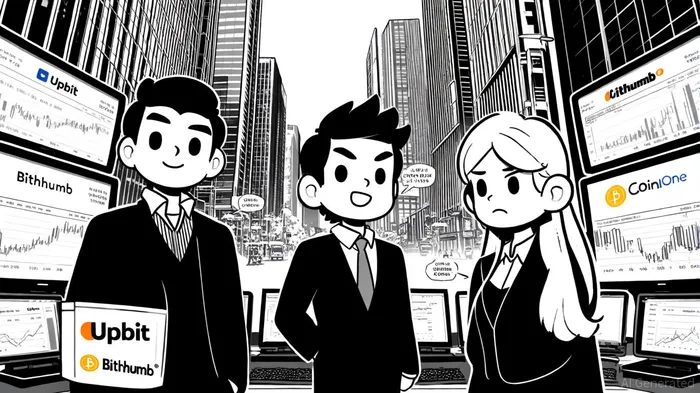





Comentarios
Aún no hay comentarios