
South Korea's $350 Billion U.S. Investment Fund: A Strategic Power Move for Korean Chaebols
South Korea's $350 billion U.S. investment fund, unveiled in July 2025, isn't just a trade agreement—it's a calculated industrial gambit to position Korean chaebols as global leaders in semiconductors, shipbuilding, and energy. This move, negotiated under the Trump administration, locks in long-term access to the U.S. market while embedding Korean firms into America's critical supply chains. Let's dissect the risk-adjusted returns and strategic dominance potential in each sector.
Semiconductors: Filling the Gap in the U.S. Tech Ecosystem
South Korea's $200 billion allocation to semiconductors is a masterstroke. Samsung Electronics and SK Hynix, which control 40% of the global DRAM and NAND markets, are expanding U.S. manufacturing under the Inflation Reduction Act (IRA). Samsung's $30 billion tech stimulus package and SK Hynix's $6.69 billion operating profit in 2024 (a 25% surge from 2023) highlight their financial resilience.
The U.S. is desperate to reduce reliance on Chinese supply chains, and these firms are stepping in. But risks exist: U.S. tariffs on semiconductors (currently 15% instead of the threatened 25%) could still spike if tensions with China escalate. Yet, the IRA's tax credits and U.S. demand for AI infrastructure make this a high-conviction play.
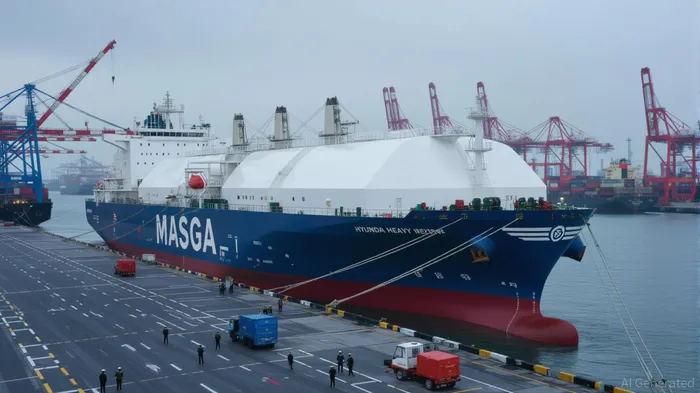
Shipbuilding: Reviving the "MASGA" Dream
The $150 billion shipbuilding fund under the MASGA initiative is a win for Hyundai Heavy Industries (HHI) and Daewoo Shipbuilding. HHI's recent $9.2 billion loan from the U.S. Department of Energy to expand U.S. operations has already driven a 25% stock price surge. Daewoo's 18% revenue growth in 2025 (per Bloomberg) underscores its smart ship technology edge.
The U.S. is modernizing its naval infrastructure, and Korean firms are leading in ammonia-powered ships and LNG carriers. However, China's rising shipbuilding capabilities and potential U.S. Section 232 tariffs on steel (already at 50%) could disrupt margins. Yet, with U.S. defense contracts and green energy projects, the long-term upside outweighs short-term risks.
Energy: Green Gold and LNG Leverage
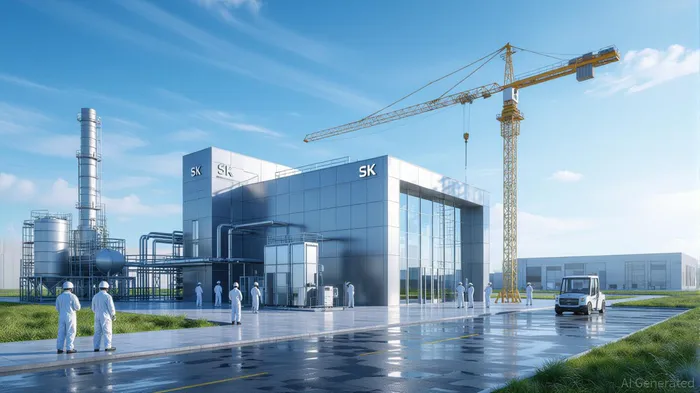
South Korea's $100 billion LNG purchase commitment and $31.8 trillion won green stimulus package are reshaping the energy landscape. Hyundai Motor Group's $21 billion investment in U.S. hydrogen steelmaking and EV infrastructure, alongside SK Group's $50 billion decade-long energy plan, positions these firms as clean energy pioneers.
The IRA's tax credits are fueling a flywheel of domestic job creation and supply chain resilience. SK Innovation and Hanwha Solutions, with dual U.S.-South Korea operations, are prime beneficiaries. But energy markets are volatile—South Korea's fiscal deficit (-4.1% of GDP in 2024) and geopolitical shifts (e.g., U.S.-China tensions) could introduce turbulence.
The Bigger Picture: Strategic Dominance Over Short-Term Volatility
This fund isn't just about money—it's about aligning with U.S. industrial policy. By embedding Korean firms into U.S. supply chains, the deal mitigates geopolitical risks and creates symbiotic growth. Hyundai's Georgia EV plant and SK On's Tennessee battery facilities are early wins in a broader trend.
For investors, the key is to prioritize firms with clear U.S. partnerships and scalable green energy projects. Hyundai Heavy Industries, Samsung Electronics, SK Group, and Hanwha Solutions are high-conviction plays. The next 12–18 months will be pivotal as these companies solidify their roles in the U.S. industrial renaissance.
Final Take: Bet on the Chaebols' Renaissance
South Korea's $350 billion pledge is a masterstroke—a recalibration of global industrial power. While risks like U.S. policy shifts and China's competition linger, the long-term benefits of market access, technology collaboration, and green leadership are undeniable. For those willing to stomach short-term volatility, this is a rare opportunity to align with the next industrial giants.
Investment Advice:
- High-conviction buys: Hyundai Heavy Industries (HHI), Samsung Electronics, SK Group.
- Watchlist: Daewoo Shipbuilding, Hanwha Solutions.
- Avoid: Overexposure to firms reliant on U.S. subsidies without diversification.
The clock is ticking—act before the next wave of U.S. tariffs or geopolitical shocks reshapes the playing field.







Comentarios
Aún no hay comentarios