
South Korea's 2026 Bitcoin ETF Launch: A Strategic Opportunity for Global Investors
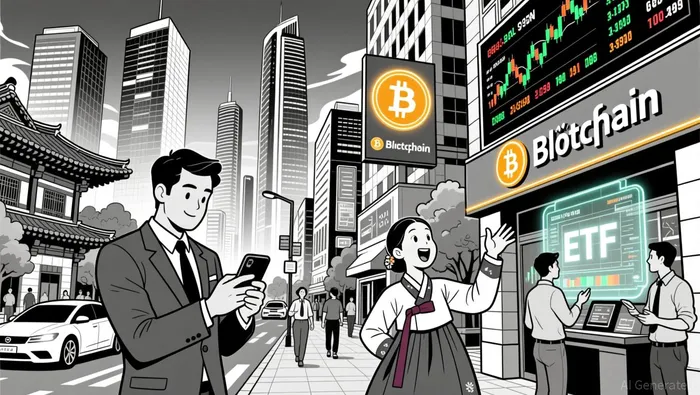
South Korea's decision to approve spot BitcoinBTC-- ETFs in 2026 marks a seismic shift in its approach to digital assets, positioning the nation as a pivotal player in the global crypto market. This move, embedded within its broader 2026 Economic Growth Strategy, is not merely a regulatory tweak but a calculated effort to attract capital, modernize financial infrastructure, and align with global trends. For investors, this represents a unique opportunity to capitalize on a market transformation driven by policy innovation and institutional readiness.
Regulatory Overhaul: A Foundation for Institutional Adoption
South Korea's regulatory framework has long been a double-edged sword-stringent enough to deter speculative chaos but restrictive enough to stifle innovation. That dynamic is set to change. The Financial Services Commission (FSC) is spearheading reforms to amend the Capital Markets Act, explicitly recognizing cryptocurrencies as eligible underlying assets for ETFs. This legislative pivot dismantles prior barriers, enabling domestic investors to access regulated Bitcoin exposure for the first time.
Complementing this is a robust stablecoin regulatory framework, which mandates 100% reserve backing, licensing requirements, and user redemption rights. These measures, inspired by lessons from the 2022 Terra-Luna collapse, aim to restore trust while preventing systemic risks. By Q1 2026, South Korea is expected to finalize these rules, creating a sandbox for institutional players like pension funds and asset managers to enter the market.
The government's ambition extends beyond ETFs. It plans to digitize up to using blockchain-based instruments by 2030. This integration of blockchain into public finance signals a long-term commitment to digital asset adoption, further solidifying South Korea's reputation as a forward-thinking financial hub.
Capital Inflow Potential: A Market Ready to Explode
While exact figures remain unannounced, the potential for capital inflows is staggering. South Korea's Korea Financial Intelligence Unit estimates that are already eligible to trade digital assets. With the introduction of regulated ETFs, this base could expand exponentially, particularly as retail investors gain access to products with enhanced investor protections under the Virtual Asset User Protection Act (VAUPA) of July 2024.
Global trends offer a blueprint. In the U.S. and Hong Kong, spot Bitcoin ETFs have attracted at the start of 2026 alone, driven by institutional confidence and retail demand. South Korea's market, with its tech-savvy population and high smartphone penetration, is uniquely positioned to replicate-and potentially surpass-this success.
Moreover, the Korea Exchange (KRX) has signaled readiness to list these ETFs, aiming to address the so-called "Korea discount"- a persistent undervaluation of Korean assets relative to global peers. By offering Bitcoin ETFs, South Korea could attract foreign capital seeking yield in a market with low correlation to traditional asset classes.
Comparative Regulatory Analysis: South Korea vs. Global Peers
South Korea's approach contrasts with its peers. The U.S. has focused on stablecoin regulation through the STABLE Act and GENIUS Act, prioritizing reserve transparency over direct crypto ETF oversight. Hong Kong, meanwhile, has emphasized structured institutional participation, refining its 2023 exchange licensing regime and introducing staking guidelines in 2025.
South Korea's strategy, however, is more holistic. By combining consumer protection (via VAUPA), institutional access (via ETFs), and public finance innovation (blockchain-based treasury systems), it balances innovation with risk management. This multi-pronged approach could make its market more attractive to global investors than either the U.S. or Hong Kong, particularly as regulatory uncertainty persists in other jurisdictions.
Strategic Implications for Global Investors
For investors, South Korea's 2026 ETF launch is not just about Bitcoin-it's about capturing a market transformation. The FSC's reforms are expected to reduce capital outflows to offshore platforms, channeling funds into domestic financial institutions. This could boost the competitiveness of Korean asset managers and exchanges, creating indirect investment opportunities.
Additionally, the government's push to internationalize the Korean won through 24-hour foreign exchange trading and blockchain-based treasury systems could enhance the currency's global appeal, further attracting foreign capital.
Risks and Challenges
Regulatory delays remain a concern. over stablecoin governance have slowed progress. However, the government's commitment to its 2026 timeline suggests these hurdles will be overcome.
Conclusion
South Korea's 2026 Bitcoin ETF launch is a masterstroke of regulatory foresight and economic strategy. By aligning with global trends while tailoring solutions to its unique market, the country is creating a fertile ground for capital inflows and institutional adoption. For global investors, this is not just an opportunity-it's a strategic imperative to engage with a market poised for exponential growth.






Comentarios
Aún no hay comentarios