
South Africa Central Bank Abandons CBDC to Curb Stablecoin Risks
South Africa's central bank has announced it will no longer pursue the development of a retail central bank digital currency (CBDC), shifting its focus instead to upgrading the country's payments infrastructure and addressing risks posed by private digital assets. The South African Reserve Bank (SARB) stated that a retail CBDC is "not needed now" and emphasized priorities such as improving cross-border payment systems and exploring wholesale digital currency applications. This decision comes amid growing concerns over the rapid adoption of cryptocurrencies and stablecoins, which the central bank warns could undermine existing financial regulations and exchange controls.
The SARB's Financial Stability Review highlighted a "structural shift" in South African crypto markets, with stablecoins-particularly those pegged to the U.S. dollar-overtaking volatile cryptocurrencies as the dominant trading instruments. Trading volumes for stablecoins surged to nearly 80 billion rand ($4.6 billion) by October 2024, up from under 4 billion rand in 2022. The central bank noted that stablecoins now account for the majority of trading activity on domestic platforms, driven by their lower price volatility compared to assets like BitcoinBTC-- or EthereumETH--.
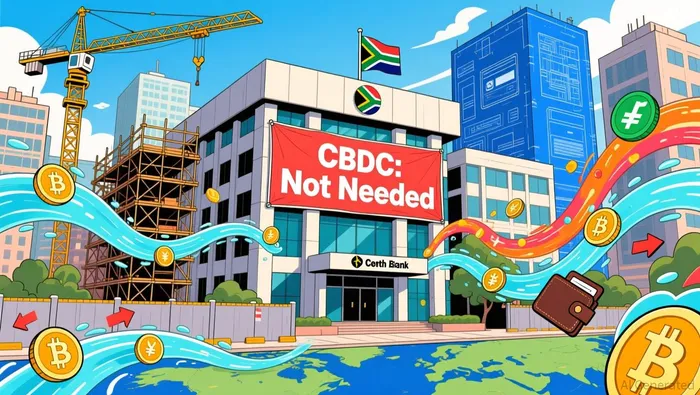
With 7.8 million users registered on South Africa's three largest crypto exchanges-Luno, VALR, and Ovex-and $1.5 billion held in custodial accounts as of July 2025, the SARB has flagged systemic risks tied to the lack of comprehensive regulatory oversight. The Financial Stability Board recently reported that South Africa has no dedicated framework for global stablecoins and only "partial regulations" for cryptocurrencies. SARB officials warned that the borderless nature of digital assets allows them to bypass the country's strict exchange control laws, potentially destabilizing the financial system if left unchecked.
To address these challenges, the central bank and National Treasury are collaborating on new rules to monitor cross-border crypto transactions and integrate digital assets into regulatory frameworks. Herco Steyn, SARB's lead macroprudential specialist, emphasized that without a complete regulatory structure, "we do not have sufficient oversight." The SARB also cautioned that emerging technologies, including artificial intelligence and quantum computing, could introduce additional risks in the future.
The decision to deprioritize a retail CBDC aligns with global trends, as other jurisdictions, including the U.S., have also scaled back retail CBDC ambitions in favor of stablecoin and crypto regulation. Meanwhile, South Africa's focus on payments system upgrades reflects broader efforts to modernize financial infrastructure while mitigating the risks of unregulated digital assets.







Comentarios
Aún no hay comentarios