
SoundHound's Tactical Mispricing: The Piper Sandler Catalyst and the $12 Setup
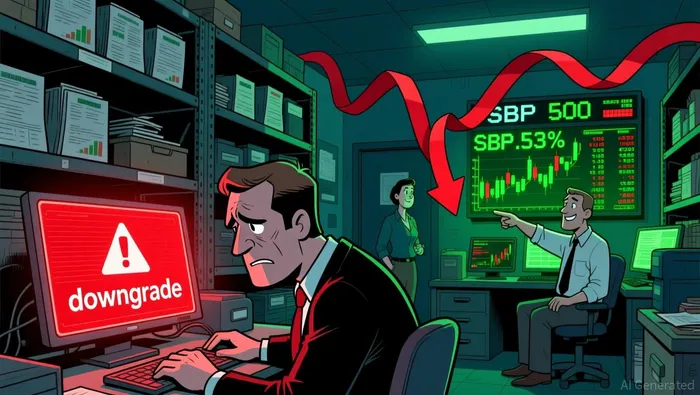
The specific catalyst is clear. On January 6, Piper SandlerPIPR-- downgraded SoundHound AISOUN-- to Neutral from Overweight, citing execution risks in balancing growth investments with its profitability goals in the second half of 2025. The firm maintained its $12 price target, but noted the stock's recent rally left the risk-reward more evenly balanced.
The market's reaction to this news was telling. On that same day, the stock fell 1.53%. Yet, the broader market improved, with the S&P 500 gaining 0.16%. This divergence frames a tactical mispricing. The downgrade, while a negative sentiment shift, did not trigger a severe sell-off. The stock's modest decline against a rising market suggests the sell-off was contained, possibly because the $12 price target and the firm's acknowledgment of SoundHound's underlying growth thesis were seen as a floor.
The setup now is more balanced. After a 30% rally in recent months, the downgrade serves as a reality check. It highlights the near-term pressure of hitting aggressive 2025 targets while scaling new products like Amelia. For a tactical investor, the key is whether this event creates a temporary mispricing. The stock's resilience on the downgrade day, coupled with the maintained price target, suggests the market is weighing the new risks but not abandoning the story entirely. The next catalyst will be the company's ability to demonstrate it can navigate these execution challenges.
Financial Mechanics and the Execution Risk
The downgrade's core concern is a classic growth-versus-profitability tug-of-war. SoundHound's growth trajectory is undeniable. In the third quarter, revenue surged 58.88% year-over-year to $54.88 million. Yet, the company remains deeply unprofitable, with a projected Q4 EPS of -$0.02. This creates a high-stakes setup: the market is paying for explosive top-line expansion while the company works to hit its 2025 targets and inch toward profitability.
The specific execution risk is a steep revenue ramp required in the second half of the year. Piper Sandler estimates SoundHoundSOUN-- needs roughly $20 million in incremental revenue in the second half of 2025 to meet its guidance. That's a massive ask, implying a near-doubling of its Q3 revenue pace. The firm questions whether deal momentum can hold, noting potential "limited traction" for its new Amelia platform and a cautious implementation environment. This raises a critical question: can the company secure this volume of new business, potentially at lower margins, while also investing heavily to scale its go-to-market and new products?
The valuation magnifies this risk. With a price-to-sales ratio that has been described as more than 109 at times, the stock is priced for near-flawless execution. Such a premium leaves no room for error. As one analysis notes, a valuation above 100 times revenue creates a situation where even a minor stumble can cause violent volatility-a "rubber band stretched tight." The stock's recent 30% rally has already priced in significant optimism. The downgrade and the maintained $12 target now frame the immediate test: can the company hit that $20 million second-half target to justify the valuation, or will the execution risks materialize and snap the band?
Valuation and Near-Term Catalysts: The Path to $12
The stock is now trading in a narrow band around $11.50, having fallen 39% from its 52-week high of $22.17. With a market cap of roughly $4.7 billion, the valuation has re-rated sharply from its peak. This pullback, which followed a volatile December, has reset the risk-reward equation. The recent Piper Sandler downgrade, while a negative sentiment shift, now appears to have been priced in, with the stock's modest decline on the downgrade day suggesting the sell-off was contained.
The immediate catalyst is the upcoming Q4 earnings report. The company is projected to report an EPS of -$0.02, a significant improvement from the prior year. More critically, this report will provide the first hard data on whether SoundHound can hit the steep revenue ramp required to meet its 2025 guidance. As Piper Sandler noted, the company needs roughly $20 million in incremental revenue in the second half of 2025. The Q4 results will show if that momentum is building or stalling, directly testing the execution risk that underpins the valuation.
A potential positive catalyst emerged just days ago. On January 5, SoundHound rolled out its advanced Amelia 7 agentic artificial intelligence platform at CES. The launch captured investor attention, with the stock trading over 7% higher in premarket trading the following day. This event provides a tangible update on the company's product roadmap and could reinvigorate sentiment and deal flow, particularly in the auto and customer experience segments. It offers a counter-narrative to the "limited traction" concerns raised by Piper Sandler.
The path to the $12 price target hinges on navigating these near-term catalysts. The stock's volatility has calmed, with trading volume falling and meme stock chatter fading, which may signal a shift toward a more fundamental investor base . For a tactical investor, the setup is clear: the valuation has compressed, creating a floor. The next move depends on whether the Q4 results confirm the ability to hit the $20 million second-half target and whether the Amelia 7 launch translates into concrete business momentum. If both materialize, the $12 target becomes a realistic near-term objective. If not, the stock faces renewed pressure.





Comentarios
Aún no hay comentarios