
Soluna Holdings' $32M Raise: A Strategic Inflection Point for Green Compute and AI Expansion
The recent $32 million registered direct offering by Soluna HoldingsSLNH--, Inc. (NASDAQ: SLNH) marks a pivotal moment in the company's evolution as a leader in green compute infrastructure. Priced at $1.77 per share, the raise includes 18,079,144 shares and accompanying Series C warrants, with proceeds earmarked for working capital, project-level equity, and general corporate purposes. This capital infusion aligns with a broader industry trend: the green data center market, projected to grow at a compound annual rate of 23.15% from $548.16 billion by 2030, is increasingly driven by AI demand, regulatory pressures, and corporate sustainability goals. For SolunaSLNH--, the funds will accelerate its transition from a Bitcoin-focused renewable energy miner to a diversified provider of clean compute solutions, including AI and high-performance computing (HPC) hosting.
Market Dynamics and Strategic Positioning
The green data center sector is experiencing explosive growth, fueled by the convergence of AI infrastructure demand and sustainability mandates. By 2030, AI-specific data center investments are expected to exceed $5.2 trillion, with these facilities consuming over 900 terawatt-hours of electricity annually. This surge underscores the critical need for renewable-powered infrastructure, where Soluna's expertise in repurposing surplus wind and solar energy positions it as a key player.
Soluna's competitive edge lies in its project pipeline and operational milestones. As of Q4 2025, the company has surpassed one gigawatt of clean computing capacity, anchored by two new Texas-based projects: Project Fei (100 MW solar-powered) and Project Gladys 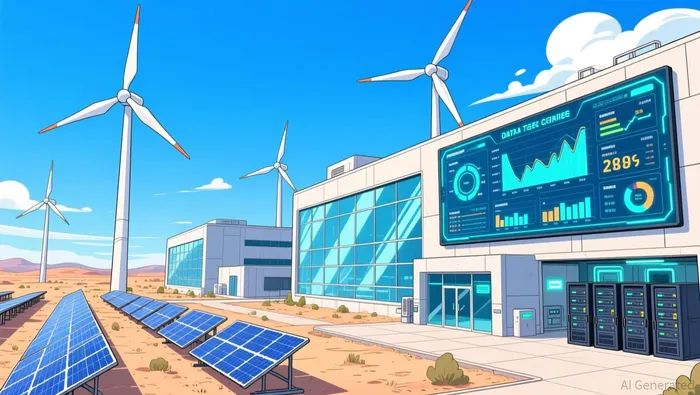 (150 MW wind-powered). These additions, alongside the ongoing development of Project Dorothy 2 (48 MW) and the Kati-2 AI initiative, demonstrate a strategic pivot toward high-margin, scalable solutions. Notably, Soluna's partnership with KULR Technology Group for a 3.3 MW hosting arrangement at Project Sophie further diversifies its revenue streams.
Capital Efficiency and Financial Resilience
Capital efficiency remains a critical metric for evaluating Soluna's growth trajectory. In Q3 2025, the company reported a 37% sequential revenue increase to $38.02 million, with gross profit margins rising to 28% from 19% in the prior quarter. Specific projects, such as Dorothy 1A (43.6% margin) and Sophie (68.4% margin), highlight the potential for operational leverage. However, the company's net loss of $17.7 million in Q3-driven by warrant adjustments and financing expenses-underscores the challenges of scaling in a capital-intensive sector.
The $32 million raise, combined with a $100 million credit facility from Generate Capital, provides Soluna with the liquidity to optimize CAPEX and OPEX. The initial draw of $12.6 million from the credit facility will refinance existing debt and fund active projects, while $20 million is allocated to launch Project Kati 1, a wind-powered data center in Texas. These moves align with industry benchmarks, where modular designs and renewable microgrids are increasingly adopted to reduce reliance on traditional energy sources and improve ROI. Soluna's cash reserves, now at $60.5 million, also provide a buffer against volatility in the public markets.
Long-Term Catalysts and Industry Tailwinds
The long-term success of Soluna's strategy hinges on three key catalysts: AI infrastructure demand, regulatory alignment, and technological innovation. The Kati-2 AI initiative, for instance, positions the company to capitalize on the $5.2 trillion AI data center investment wave by offering renewable-powered HPC hosting. Meanwhile, regulatory frameworks such as the EU's Climate Neutral Data Centre Pact are creating a favorable environment for green operators, with compliance becoming a competitive differentiator.
Technologically, Soluna's integration of AI-driven workload orchestration and cooling innovations mirrors broader industry trends. As stated by Grand View Research, advanced cooling solutions and modular infrastructure are critical for optimizing costs and reducing carbon footprints. Soluna's ability to leverage these technologies while securing project-level financing-such as the $20 million for Project Kati 1-demonstrates its agility in navigating capital constraints.
Strategic Inflection Point and Investment Implications
The $32 million raise is more than a funding event; it represents a strategic inflection point. By expanding its renewable-powered data center footprint and pivoting toward AI and HPC, the company is aligning itself with the most lucrative segments of the green compute sector. While its P/S ratio of ~3.2 lags behind hyperscale giants like AWS and Microsoft, Soluna's niche focus on clean energy and its aggressive project pipeline offer unique value.
For investors, the key risks include execution delays in AI infrastructure deployment and the high costs of scaling renewable-powered operations. However, the growing demand for ESG-aligned assets and the $5.2 trillion AI infrastructure boom suggest that Soluna's long-term potential is substantial. As the company transitions from a BitcoinBTC-- miner to a diversified green compute provider, its capital efficiency and strategic partnerships will be critical in determining whether it can capture a meaningful share of the $548 billion green data center market by 2030.





Comentarios
Aún no hay comentarios