
Solidion Technology's Strategic Restructuring: A Blueprint for Risk Mitigation and Capital Optimization
Solidion Technology Inc. (Nasdaq: STI) has taken a decisive step to stabilize its financial position and align with long-term strategic goals through a comprehensive restructuring of its capital structure. On October 8, 2025, the company announced the cancellation of all Series C and D pre-funded warrants, eliminating 3.4 million warrants and removing approximately $10 million in derivative liabilities. This move not only removes a significant source of dilution but also simplifies financial reporting, positioning the company to attract a large strategic investor aligned with its vision, according to that announcement.
Capital Structure Optimization: A Tech Industry Imperative
The restructuring reflects broader trends in capital structure optimization within the technology sector. For early-stage companies, equity financing is often preferred to avoid the inflexibility of debt during periods of uncertain growth, as noted in a case study. However, as firms mature and generate more predictable revenue streams, debt financing becomes increasingly viable, particularly when it offers tax advantages and avoids further equity dilution, a point also highlighted in that case study. Solidion's decision to convert warrants into common stock-held for at least 12 months-replaces potential short-term dilution with permanent equity, a strategy that balances flexibility with long-term stability.
This approach aligns with industry practices such as the use of hybrid instruments like convertible bonds, which provide a middle ground between debt and equity. By eliminating derivative liabilities and reducing the complexity of its capital structure, SolidionSTI-- mirrors the strategies of peers who leverage digital transformation tools to accelerate capital adjustments, as noted in a study on corporate digital transformation. For instance, big data analytics enable firms to model capital structure scenarios rapidly, a capability that becomes critical for highly leveraged companies navigating volatile markets; the study provides examples of these analytics-driven processes.
Risk Mitigation in a High-Stakes Environment
The restructuring also addresses pressing risk management challenges. Earlier in 2025, Solidion was notified by Nasdaq that its stock had fallen below the minimum bid price requirement, though it was granted an extension until May 16, 2025, to regain compliance. By removing the threat of dilution and stabilizing its balance sheet, the company reduces the likelihood of further regulatory scrutiny while enhancing its appeal to institutional investors.
In the broader tech industry, risk mitigation frameworks such as the NIST Cybersecurity Framework and ISO/IEC 27001 are increasingly adopted to manage information security risks, according to Marsh's 2025 Technology Industry Risk Report. While Solidion's restructuring does not directly address cybersecurity, it underscores a critical principle: financial stability is foundational to mitigating operational and strategic risks. For example, that report highlights the growing importance of alternative risk transfer (ART) solutions and robust capital structures to buffer against supply chain disruptions and capital market volatility. Solidion's actions demonstrate a proactive approach to aligning financial health with these evolving risk paradigms.
Strategic Implications and Investor Takeaways
The restructuring positions Solidion to pursue growth opportunities without the drag of excessive dilution. By converting warrants into equity, the company also signals confidence in its long-term prospects, a sentiment that could bolster investor trust. However, challenges remain. The tech sector's reliance on continuous innovation means that Solidion must balance capital discipline with R&D investment-a tightrope walk that requires vigilant risk management.
For investors, the key takeaway is clear: Solidion's restructuring is a well-calibrated move that addresses both immediate financial risks and long-term structural weaknesses. While the company's Nasdaq compliance status remains a watchpoint, the elimination of derivative liabilities and the shift toward permanent equity provide a stronger foundation for strategic partnerships and operational scalability. 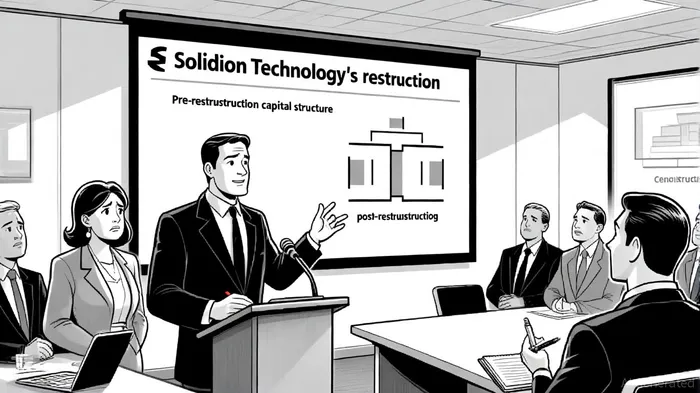





Comentarios
Aún no hay comentarios