
Solarvest Holdings Berhad: Assessing Earnings Momentum and Strategic Growth in a High-Stakes Energy Transition
The renewable energy sector in Malaysia has emerged as a compelling arena for strategic investment, with SolarvestMAXN-- Holdings Berhad (KLSE:SLVEST) standing at the forefront of this transformation. As the global energy landscape shifts toward decarbonization, Solarvest's recent financial performance and growth strategies warrant a rigorous evaluation of its investment potential.
Financial Performance: Profitability Amid Structural Challenges
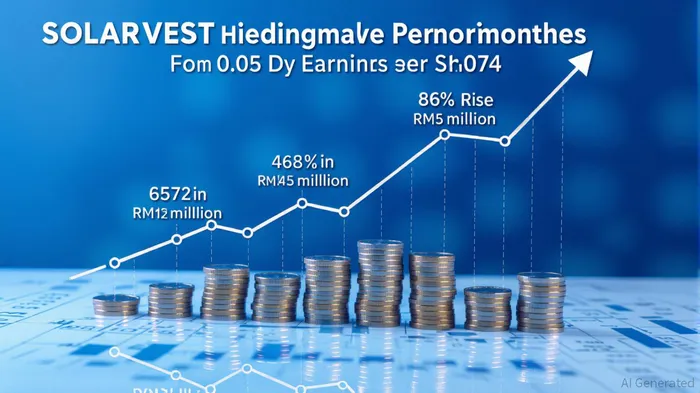
Solarvest's FY25 results underscore its operational resilience. Earnings per share (EPS) surged by 46% year-on-year, climbing from RM0.05 to RM0.074, driven by improved EBIT margins (up 2.2 percentage points to 16%) and robust revenue growth[1]. This outperformance is particularly notable given the headwinds posed by a 15% increase in the number of shares issued, which diluted EPS growth relative to underlying profit improvements[2].
However, the company's aggressive expansion has come at a cost. Total debt ballooned by 86% to RM322 million in FY25, reflecting capital expenditures for utility-scale solar projects and regional expansion[3]. While debt levels raise concerns about leverage, Solarvest's strong orderbook of MYR1.24 billion—ensuring earnings visibility through FY28—provides a buffer against short-term liquidity risks[4].
Growth Strategies: Diversification and Regional Expansion
Solarvest's strategic initiatives position it to capitalize on Malaysia's renewable energy transition. The conversion of Warrants A 2021/2026 into ordinary shares has strengthened its capital structure and liquidity, while the Corporate Green Power Programme (CGPP) has secured a pipeline of projects worth RM877 million for FY25 and FY26[5].
Regionally, the company is expanding its footprint with a 30MWac solar project in Brunei—a 25-year PPA expected to generate RM80 million to RM100 million in EPCC value[6]. Complementing this, Solarvest's tenderbook of 5.86 GWp and focus on hybrid solar-battery energy storage system (BESS) projects signal its intent to diversify revenue streams[7]. The Powervest programme, which has secured multiple corporate PPAs, is projected to deliver RM47.9 million in annual recurrent revenue, enhancing long-term stability[8].
Risks and Analyst Perspectives
Despite these positives, risks persist. The 86% debt increase raises questions about financial flexibility, particularly if interest rates rise or project execution falters. Additionally, the 15% share dilution highlights the company's reliance on equity financing, which could pressure shareholder returns[9].
Analyst ratings, however, remain cautiously optimistic. A price target of RM2.13—12.35% below the current price of RM2.43—suggests a bearish near-term outlook[10]. Yet, this discrepancy may reflect skepticism about short-term debt dynamics rather than long-term potential. Solarvest's insider ownership of RM382 million further underscores confidence in its strategic direction[1].
Strategic Investment Considerations
For investors, Solarvest presents a nuanced case. Its earnings growth and orderbook strength justify optimism about long-term value creation, particularly in a sector poised for sustained demand. However, the elevated debt levels and share dilution necessitate a disciplined approach. A strategic entry point might emerge if the stock corrects further, aligning with the company's ability to execute on its RM2 billion orderbook target by FY26[11].
In conclusion, Solarvest's financial performance and growth strategies reflect a company navigating the dual imperatives of profitability and expansion. While risks are material, the alignment with Malaysia's energy transition and a robust project pipeline make it a compelling, albeit cautious, addition to a diversified portfolio.







Comentarios
Aún no hay comentarios