
Solana's Whale-Driven DeFi Surge and Institutional Buybacks: On-Chain Behavior as a Leading Indicator of Institutional-Grade DeFi Adoption
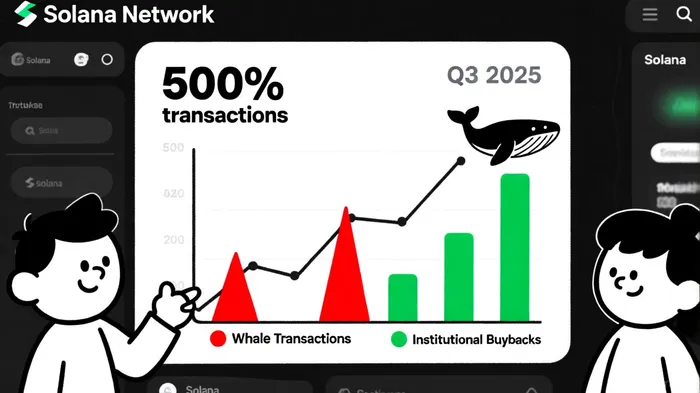
In Q3 2025, Solana's decentralized finance (DeFi) ecosystem has experienced a seismic shift, driven by a confluence of whale activity and institutional buybacks. On-chain data reveals that over $1 billion in capital has flowed into Solana's DeFi infrastructure, catalyzing a 500% surge in network transactions[1]. This growth is not merely speculative but reflects a strategic reallocation of capital from EthereumETH-- to SolanaSOL--, spurred by the Alpenglow consensus upgrade, which reduced transaction finality to 150 milliseconds[2]. Such technical advancements have positioned Solana as a high-throughput, low-cost alternative for institutional players seeking efficiency in DeFi.
Whale Activity: Leveraging DeFi for Capital Efficiency
Whale transactions have been a primary driver of this surge. For instance, a single whale transferred 20,000 SOL (approximately $3.6 million at current prices) from Kraken to Kamino FinanceKMNO--, where they borrowed $3 million in USDCUSDC-- to fund leveraged positions on OKX[1]. This pattern—using DeFi tools to amplify capital without liquidating core holdings—has become increasingly common among large investors. Similarly, a $7.6 million transfer from Ethereum to Solana underscores the blockchain's appeal for cross-chain arbitrage and yield optimization[2].
The scale of these movements is staggering. In August 2025 alone, three major Solana wallets deposited over $40 million in SOL into exchanges like Binance and Kraken within a nine-hour window[5]. Analysts interpret these actions as strategic positioning rather than immediate selling pressure, with whale wallets accumulating liquidity for long-term staking or DeFi strategies.
Institutional Buybacks: Treasuries as Yield-Generating Assets
Parallel to whale activity, institutional buybacks have reshaped Solana's capital flows. DeFi Development Corp., the first publicly listed company structured around a Solana-based treasury, expanded its stock repurchase program to $100 million while accumulating 2 million SOL ($499 million) for staking[1]. This dual approach—buying back shares and deploying capital into Solana's ecosystem—reflects a broader trend of corporations treating digital assets as income-generating components of their balance sheets.
Forward Industries (NASDAQ: FORD), the largest Solana Digital Asset Treasury (DAT), exemplifies this strategy. The company acquired 6.8 million SOL through a $1.65 billion private investment in public equity (PIPE), which it plans to stake and deploy in DeFi protocols to generate 7–8% annualized yields[3]. Such initiatives are mirrored by firms like Upexi and Sharps Technology, which have collectively staked over 9 million SOL, further deepening the network's institutional footprint[5].
On-Chain Analytics: Tracking Institutional Adoption
Blockchain analytics platforms like Solscan, Santiment, and Glassnode have become critical tools for monitoring these developments. Solscan's real-time tracking of whale transactions reveals that public companies now control 8% of Solana's circulating supply, with entities like Franklin Templeton expanding on-chain U.S. Government Money Funds to Solana via the BENJI platform[4]. Santiment's recent Solana data coverage provides granular insights into investor behavior, while Glassnode's institutional-grade market intelligence highlights capital inflows into staking and validator operations[5].
A notable example is the $129.8 million SOL transfer to CoinbaseCOIN-- Institutional in September 2025, which triggered speculation about strategic positioning ahead of potential ETF approvals[3]. These platforms not only validate the scale of institutional participation but also serve as leading indicators for future price action.
Implications and Challenges
Solana's institutional adoption is reshaping the DeFi landscape, but challenges persist. Regulatory uncertainty and liquidity risks remain, particularly as public companies hold concentrated SOL positions totaling 5.9 million tokens[5]. However, the blockchain's technical advantages—combined with strategic partnerships (e.g., Galaxy DigitalGLXY--, Jump Crypto)—suggest a durable foundation for growth[3].
If current trends continue, Solana could approach the $1,000 price level, driven by sustained whale activity, institutional buybacks, and the maturation of DeFi primitives like tokenized real-world assets (RWAs) and compliance-friendly lending protocols[1].
Conclusion
Solana's DeFi surge is no longer a niche phenomenon but a macro-level shift in institutional capital allocation. On-chain data—ranging from whale transactions to corporate buybacks—provides a clear lens into this transformation. As the blockchain solidifies its role as a DeFi hub, investors must monitor these leading indicators to gauge the trajectory of institutional-grade adoption.





Comentarios
Aún no hay comentarios