
Solana's Validator Upgrades: A Catalyst for Institutional Adoption and Network Resilience
Blockchain infrastructure has long been a silent battleground for the future of decentralized finance. In 2025, Solana's validator upgrades-Frankendancer, Alpenglow, and ZK Compression v2-have emerged as a defining force in reshaping the network's scalability, resilience, and institutional appeal. These innovations are not merely technical tweaks but foundational shifts that address critical pain points for enterprise-grade blockchain adoption. By dissecting the interplay between infrastructure improvements and institutional trust, this analysis argues that Solana's 2025 upgrades position it as a formidable contender in the race for real-world utility and long-term value.
Validator Upgrades: Scaling Beyond 65,000 TPS
Solana's Frankendancer validator client, developed by Jump Crypto, represents a paradigm shift in blockchain architecture. By introducing modular "tiles" for parallel processing, Frankendancer aims to scale the network to over 1 million transactions per second, a 15x leap from Solana's pre-upgrade capacity of 65,000 TPS. This is achieved through a hybrid approach that runs alongside the Agave client, reducing hardware costs by 50–80% and mitigating single-client risks. Early data from validator operators like Figment and Luganodes already show improved slot fullness, lower latency, and higher block rewards, underscoring the client's immediate impact on network efficiency.
Complementing this is the Alpenglow upgrade, which replaces Solana's Proof-of-History (PoH) and TowerBFT consensus mechanisms with Votor and Rotor. This new consensus model delivers 150ms block finality and supports deterministic execution, critical for applications requiring real-time settlement. For institutions, this means predictable transaction outcomes and reduced operational risk-a stark contrast to Ethereum's probabilistic finality model.
Meanwhile, ZK Compression v2, tested in Q3 2025, leverages zero-knowledge proofs to compress state data by 70–1,000x. This innovation slashes storage costs while preserving composability, a key requirement for DeFi and tokenized asset platforms. 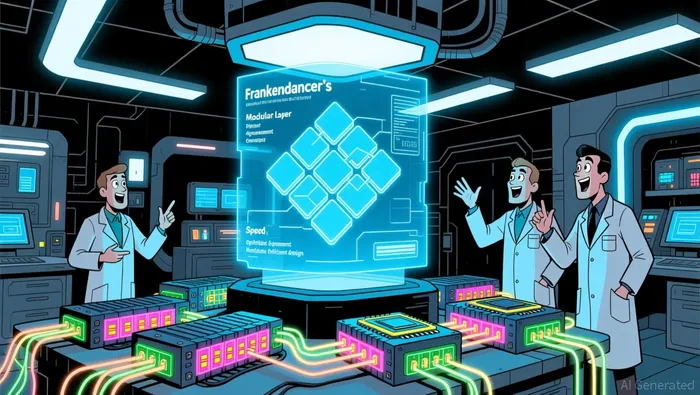 Together, these upgrades address Solana's historical bottlenecks-network congestion, validator centralization, and state bloat-while aligning with the demands of institutional-grade infrastructure.
Institutional Adoption: From Speculation to Structured Investment
The technical prowess of Solana's upgrades is matched by their tangible impact on institutional adoption. Partnerships with Western Union and JPMorgan, coupled with the launch of SolanaSOL-- ETFs like Bitwise's BSOL and Grayscale's GSOL, have transformed the network from a speculative asset into a structured investment vehicle. For instance, BSOL attracted $417 million in its debut week, while GSOL drew $1 million on its first day. These figures signal a shift in institutional sentiment, where Solana is no longer evaluated solely on its price volatility but on its capacity to underpin real-world financial infrastructure.
Validator performance metrics further reinforce this narrative. Figment's Q3 2025 report highlights 99.8% voting effectiveness and 1.02 voting latency, while Luganodes maintained 99.92% uptime. Such precision is critical for institutions wary of downtime in high-stakes environments. Additionally, MEV strategies via Jito have augmented delegator returns, with supplemental rewards boosting total returns for stakers. These factors collectively enhance Solana's appeal to institutional investors seeking both yield and reliability.
Competitive Positioning: Solana vs. Ethereum vs. Avalanche
To assess Solana's long-term viability, it's essential to compare its post-upgrade metrics with competitors like EthereumETH-- and AvalancheAVAX--. Ethereum, with its Pectra upgrade, retains dominance in DeFi TVL ($99 billion) and institutional depth. However, its base-layer throughput of 15.96 TPS pales against Solana's 1,054 TPS average, even as Ethereum relies on Layer-2 solutions for scalability. Solana's ultra-low fees of $0.0011 per transaction and 150ms finality make it a superior choice for high-frequency applications, from micropayments to tokenized equities.
Avalanche, with its subnet architecture, offers theoretical scalability of 1,191 TPS but lags in practical throughput (4.8 TPS). While its dynamic fee mechanism and enterprise focus are strengths, Solana's validator upgrades and institutional partnerships provide a more cohesive value proposition for mainstream adoption.
Challenges and the Road Ahead
Despite these advancements, Solana faces headwinds. Declining stablecoin liquidity could dampen on-chain demand, and validator centralization remains a concern with fewer than 10,000 nodes compared to Ethereum's 1 million. However, the Solana Policy Institute and strategic hires are actively addressing governance and regulatory hurdles. The full rollout of Frankendancer in Q2–Q3 2025 and Alpenglow's mainnet deployment in Q1 2026 will be pivotal in solidifying the network's resilience.
Conclusion: Infrastructure as a Trust Multiplier
Solana's 2025 validator upgrades are more than technical milestones-they are a blueprint for blockchain infrastructure that balances speed, cost, and reliability. By addressing scalability bottlenecks and aligning with institutional requirements, Solana has positioned itself as a critical settlement rail for tokenized assets and real-world finance. While Ethereum's ecosystem depth and Avalanche's niche innovations remain competitive, Solana's focus on infrastructure-first innovation offers a compelling narrative for long-term institutional trust. As the network continues to refine its execution, the question is no longer whether Solana can scale, but whether institutions will embrace it as the backbone of the next financial era.






Comentarios
Aún no hay comentarios