
Solana's Urgent Validator Upgrade: A Strategic Inflection Point for Network Resilience and Institutional Adoption
In the rapidly evolving landscape of blockchain infrastructure, Solana's 2025 validator upgrades represent a pivotal shift toward institutional-grade performance and risk mitigation. By prioritizing throughput, decentralization, and developer tooling, the network has positioned itself as a formidable contender in the race for scalable, high-performance blockchains. This analysis examines how Solana's v3.0.14 patch, Alpenglow consensus rewrite, and Firedancer validator client collectively address systemic risks while unlocking new avenues for institutional adoption.
Technical Foundations: v3.0.14, Alpenglow, and Firedancer
Solana's v3.0.14 validator update, released in late 2025, serves as a critical patch to stabilize the network during its transition to the v3 validator series. This update addresses vulnerabilities in core validator functions, ensuring seamless execution of live upgrades and minimizing disruptions for staked and unstaked nodes. The urgency of this patch underscores Solana's commitment to maintaining reliability amid surging on-chain activity, including tokenized assets and institutional-grade applications.
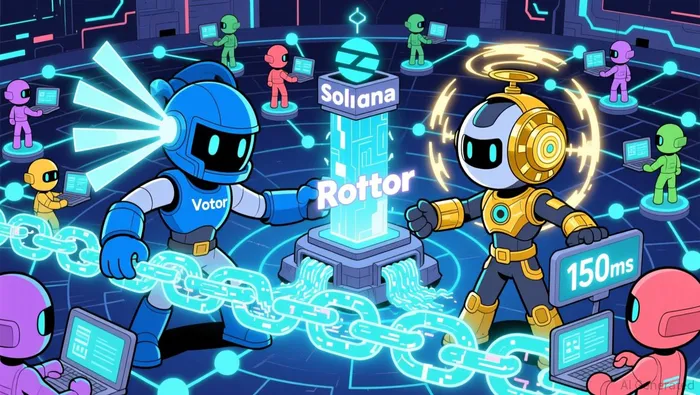
The broader architectural shift is epitomized by Alpenglow, a consensus protocol overhaul that replaces Solana's legacy Proof of History (PoH) and TowerBFT mechanisms with Votor and Rotor. These innovations enable 150ms block finality and parallel execution through multiple leaders, slashing latency to levels competitive with Web2 systems. According to a report by Galaxy, Alpenglow's deterministic execution model is particularly appealing to institutions requiring real-time settlement, such as high-frequency trading platforms and tokenized equity markets.
Complementing Alpenglow is Firedancer, a C++-based validator client developed by Jump Crypto. By operating alongside the Agave client in a hybrid model, Firedancer aims to scale throughput to over 1 million transactions per second (TPS) while reducing validator hardware costs by 50–80%. This diversification of validator infrastructure mitigates the risks of client monoculture, a critical concern for institutional stakeholders seeking resilient networks.
Infrastructure Resilience and Risk Mitigation
The combined impact of these upgrades is a network capable of handling institutional workloads with unprecedented efficiency. For instance, Alpenglow's 20+20 fault tolerance model ensures stability even if 40% of validators are offline or compromised. This level of redundancy is a non-negotiable requirement for enterprises transitioning from traditional finance to blockchain-based systems.
Moreover, Solana's validator count has decreased by 64% since 2023, streamlining operations and reducing the risk of outdated or exploitative operators. This consolidation, coupled with Firedancer's modular architecture, enhances the network's ability to process over 162 million transactions daily at sub-penny fees. As stated by a Helius blog post, these metrics reflect Solana's capacity to sustain high-volume financial operations without compromising decentralization.
Institutional Adoption: Case Studies and Quotes
The technical advancements have directly fueled institutional adoption. Franklin Templeton's CEO recently highlighted SolanaSOL-- as "one of the first institutionally focused chains," citing its deterministic execution and low latency as key enablers for tokenized money market funds. Similarly, BlackRock's BUIDL fund, a tokenized version of its flagship money market fund, leverages Solana's infrastructure to achieve real-time settlement and reduced operational costs.
Data from the Solana Ecosystem Report (H1 2025) reveals that over $90 million in equities has been tokenized on the network since June 2025, with regulated ETFs like Bitwise's BSOL and Grayscale's GSOL attracting significant inflows. These developments are not merely speculative; they reflect a structural shift in how institutions perceive blockchain infrastructure. As one industry analyst noted, "Solana's upgrades have transformed it from a speculative asset into a foundational layer for institutional finance."
Economic and Developer Tooling Improvements
Beyond technical resilience, Solana's 2025 roadmap includes economic upgrades that further reduce barriers to adoption. Inflation has been slashed from 8% to 1.5%, while vote fees have been eliminated to lower validator operational costs. Additionally, ZK Compression v2-a zero-knowledge proof-based state compression technique-reduces storage costs by 70–1,000x, enabling scalable tokenized asset ecosystems.
Developer tooling has also seen significant advancements. Improved RPC infrastructure, accurate transaction simulation, and better indexing solutions have made Solana a more attractive platform for enterprise applications compared to 2022. These improvements are critical for attracting developers building institutional-grade solutions, such as real-time asset tokenization and decentralized custody platforms.
Conclusion: A Strategic Inflection Point
Solana's 2025 validator upgrades mark a strategic inflection point in the blockchain industry. By addressing systemic risks through Alpenglow's consensus innovations, Firedancer's client diversity, and v3.0.14's stability patches, the network has laid the groundwork for sustained institutional adoption. The alignment of technical performance with economic incentives-such as reduced validator costs and tokenized asset ecosystems-positions Solana as a leading infrastructure layer for the next wave of financial innovation.
For investors, the implications are clear: Solana's infrastructure-driven growth model is not just about scaling transactions per second but about redefining the economics of institutional-grade blockchain adoption. As Franklin Templeton and BlackRock have demonstrated, the network's ability to deliver Web2-like performance with blockchain's inherent advantages is a compelling value proposition in an increasingly competitive market.






Comentarios
Aún no hay comentarios