
Solana's Surging Capital Inflows and Systemic Risks in a Fragmented Ecosystem
The SolanaSOL-- DeFi ecosystem has become a focal point of crypto innovation, driven by surging capital inflows and technical advancements. However, beneath the surface of its rapid growth lies a complex web of systemic risks that could test its long-term sustainability. As institutional investors and whale actors pour billions into the network, the question remains: Can Solana's infrastructure withstand the pressures of capital volatility, network congestion, and ecosystem fragmentation?
Capital Inflows: A Double-Edged Sword
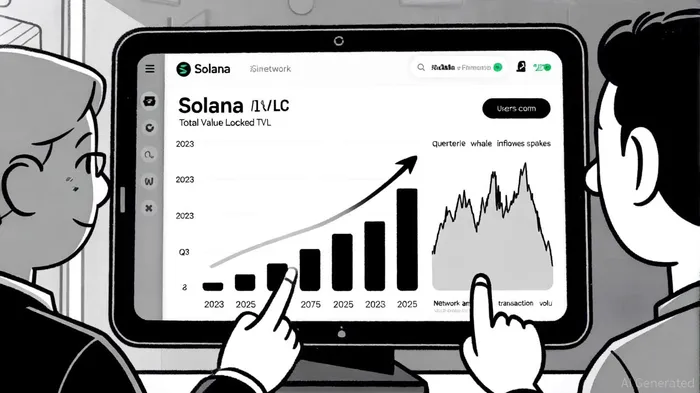
In Q3 2025 alone, whale investors injected over $1 billion into Solana's DeFi platforms, pushing year-to-date inflows past $1.2 billion[1]. This influx has been fueled by the network's Alpenglow consensus upgrade, which slashed transaction finality to 150 milliseconds, making it one of the fastest blockchains[2]. Institutional adoption has further accelerated growth, with ETFs and tokenized real-world assets (RWAs) attracting capital seeking high yields. By mid-2025, Solana's TVL surpassed $9.3 billion, securing its position as the third-largest DeFi ecosystem[2].
Yet, this rapid growth is not without risks. Whale activity, while boosting liquidity, often involves leveraged positions and cross-protocol arbitrage, which amplify volatility. For instance, a whale recently transferred 20,000 SOL to Kamino FinanceKMNO--, borrowed $3 million in USDC, and deployed it on OKX—highlighting how institutional-scale players exploit Solana's infrastructure without liquidating core holdings[1]. Such strategies, while profitable, can destabilize smaller participants during market downturns.
Network Performance: Speed vs. Stability
Solana's technical prowess is undeniable. The Alpenglow upgrade, combined with the Firedancer validator client, has improved throughput to 65,000 transactions per second and reduced outages[3]. By 2025, the network achieved 16 months of continuous uptime, a stark contrast to its early struggles with spam attacks and client bugs[3]. However, periods of high demand still strain the network. In August 2024, a 43-minute outage disrupted transactions, underscoring lingering vulnerabilities[4].
Gas fees, once a major pain point, have stabilized due to improved fee markets and priority fee mechanisms[1]. Yet, during peak congestion, users face delays and slippage, particularly for non-USDC/SOL pairs. Liquidity fragmentation across decentralized exchanges (DEXs) exacerbates this issue, with private DEXs like SolFi and Obric v2 now handling 40–60% of Jupiter's trade volume[3]. While these platforms enhance efficiency, they also introduce opacity, challenging DeFi's core principles of composability and transparency.
Systemic Risks: Smart Contracts, Validator Concentration, and Regulatory Uncertainty
The Solana ecosystem's growth has been accompanied by concentration risks. As of Q1 2025, 72% of TVL is concentrated in just five protocols[2]. This overreliance on a few projects increases exposure to smart contract exploits. For example, the Loopscale Lending hack in April 2024 resulted in a $5.8 million loss, exploiting undercollateralized loans and the network's high-speed transaction processing[2]. Such incidents highlight the need for rigorous audits and insurance mechanisms, which institutional custodians are increasingly demanding[1].
Validator decentralization has improved, with over 2,000 active nodes in 2025[1]. However, validator concentration during high-load events remains a concern. Historical outages, such as the 2022 spam attack that overwhelmed the network, demonstrate how operational risks can erode user trust[3].
Regulatory clarity is another wildcard. While U.S. legislation like FIT21 and the GENIUS Act has spurred compliance-driven adoption, evolving rules on staking, tax treatments, and KYC requirements could disrupt capital flows[1]. Institutions are now implementing multi-signature wallets, hardware security modules, and restricted-liquidity products to navigate these uncertainties[2].
The Path Forward: Innovation vs. Resilience
For Solana to sustain its growth, the ecosystem must address three key areas:
1. Protocol Diversification: Reducing TVL concentration by fostering new DeFi primitives and cross-chain interoperability.
2. Security Enhancements: Prioritizing formal verification, oracleORCL-- security, and insurance pools to mitigate exploit risks[2].
3. Network Resilience: Scaling validator decentralization and stress-testing infrastructure against spam attacks and high-volume scenarios[3].
Conclusion
Solana's DeFi ecosystem is a testament to the power of innovation, but its sustainability hinges on balancing speed with stability. While the network's technical upgrades and institutional adoption are commendable, systemic risks—ranging from smart contract vulnerabilities to liquidity fragmentation—demand urgent attention. For investors, the key takeaway is clear: High-growth DeFi platforms like Solana offer lucrative opportunities, but they require a nuanced understanding of the risks. As the ecosystem evolves, the ability to adapt to regulatory shifts and technical challenges will determine whether Solana remains a leader or becomes a cautionary tale.







Comentarios
Aún no hay comentarios