
Solana's Strategic Play in the $1–$10 Trillion On-Chain Stablecoin Market
The global stablecoin market is rapidly evolving into a cornerstone of digital finance, with on-chain transactions projected to surpass $10 trillion in 2025. Amid this surge, SolanaSOL-- (SOL) has emerged as a critical infrastructure provider, leveraging its high-throughput architecture to capture a pivotal role in the next phase of stablecoin adoption. This analysis examines how Solana's technical advantages-particularly its Proof of History (PoH) consensus mechanism and sub-second finality-position it as the preferred Layer 1 blockchain for scalable, low-cost stablecoin liquidity and real-world use cases.
High-Throughput Infrastructure: Solana's Core Competitive Edge
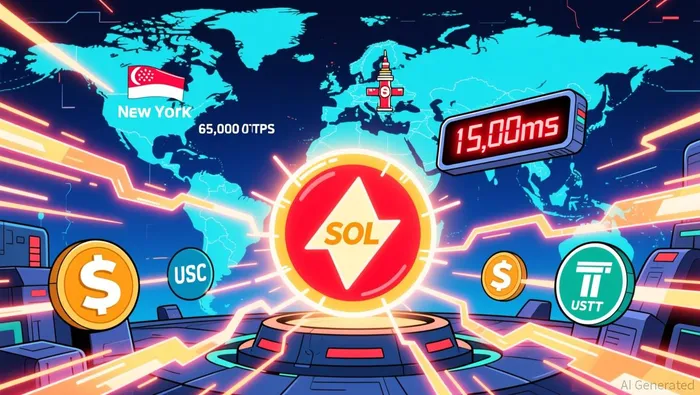
Solana's ability to process up to 65,000 transactions per second (TPS) according to gate.com-far outpacing Ethereum's 15–30 TPS as reported by ledger-is a defining feature of its architecture. This performance is enabled by a hybrid consensus model combining Proof of Stake (PoS) with PoH, which timestamps transactions in a verifiable sequence, eliminating the need for energy-intensive validation. Real-world data from 2025 shows Solana averaging 1,100 TPS, with transaction fees consistently under $0.0025, compared to Ethereum's often prohibitive costs.
These metrics are not merely technical benchmarks but practical enablers for stablecoin ecosystems. For instance, decentralized exchanges (DEXs), cross-border payment platforms, and institutional treasuries require infrastructure that can handle high-volume, low-latency transactions without compromising cost efficiency. Solana's design directly addresses these needs, making it an attractive alternative to EthereumETH-- for developers and enterprises seeking to deploy stablecoin-based applications.
Stablecoin Ecosystem Growth: Market Share and Institutional Adoption
As of 2025, Solana hosts $15 billion in stablecoin supply, ranking it third globally behind Ethereum and TronTRX--. This growth has been exponential: stablecoin liquidity on Solana surged from $2 billion in early 2024 to $12 billion by early 2025, driven by the dominance of USDCUSDC-- and USDTUSDT--. USDC alone accounts for 70–73% of Solana's stablecoin volume, valued at $8 billion, while USDT holds 27–30%, or $2–3 billion as reported by zerion.
The Alpenglow upgrade, launched in late 2025, further solidified Solana's appeal by reducing transaction finality to 150 milliseconds, an 85x improvement over prior benchmarks. This enhancement is critical for real-world applications such as instant cross-border payments and high-frequency trading, where speed and reliability are non-negotiable. Institutional adoption has followed suit, with companies like Forward Industries and Kraken integrating Solana into their treasury systems to leverage its efficiency.
Partnerships and Real-World Use Cases
Solana's strategic partnerships underscore its growing influence in the stablecoin market. Platforms like Stripe, PayPal, and Shopify have expanded stablecoin integrations to Solana, enabling merchants to process payments with 80% lower fees compared to traditional banking systems. During the October 2025 liquidation event-a period of extreme market volatility-Solana demonstrated its resilience by processing 100,000 transactions per second with zero interruptions, a feat that highlighted its reliability for mission-critical financial infrastructure.
Moreover, Bitwise's Matt Hougan has predicted that Solana could overtake Ethereum in stablecoin market share due to its superior performance and usability. This forecast is supported by data from Fireblocks, which noted that Solana's infrastructure "remains operational under extreme stress," a critical factor for institutional investors prioritizing uptime.
Challenges and Risks
Despite its strengths, Solana faces challenges. Its smaller validator set of 850 nodes compared to Ethereum's 1 million raises concerns about centralization. Additionally, stablecoin liquidity on Solana experienced an 8.16% decline in a single week in late 2025, signaling potential volatility in on-chain demand. However, these risks are mitigated by Solana's ongoing upgrades and the growing demand for scalable, cost-effective stablecoin solutions.
Conclusion: A Strategic Investment in the Future of Stablecoin Infrastructure
Solana's high-throughput infrastructure, institutional partnerships, and real-world performance make it a compelling long-term investment in the $1–$10 trillion on-chain stablecoin market. As stablecoins continue to disintermediate traditional financial systems-facilitating $9 trillion in payments in 2025-blockchains that can deliver speed, scalability, and low costs will dominate. Solana's ability to process 100,000 TPS during crises and its $12 billion stablecoin ecosystem position it as a foundational layer for the next generation of digital finance. For investors, this represents not just a technical advantage but a strategic bet on the infrastructure that will power global stablecoin adoption.






Comentarios
Aún no hay comentarios