
Solana's Strategic Momentum in a Shifting Crypto Landscape: Blockchain Scalability and Institutional Adoption as Catalysts for Long-Term Growth
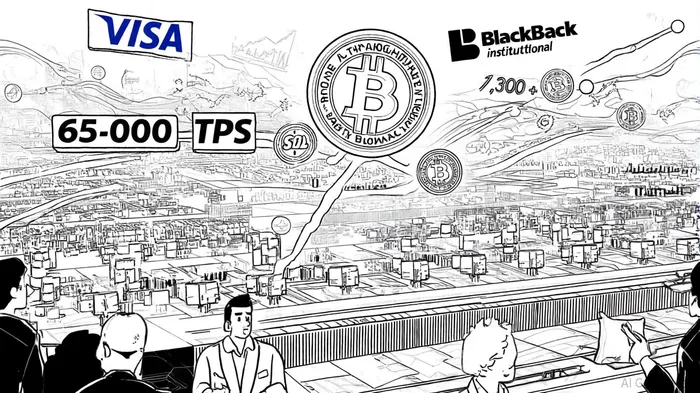
In the ever-evolving crypto landscape, SolanaSOL-- has emerged as a standout contender, leveraging blockchain scalability and institutional adoption to redefine its value proposition. As the market shifts from speculative frenzy to infrastructure-driven utility, Solana's technical innovations and strategic partnerships position it as a bridge between decentralized finance (DeFi) and traditional capital markets.
Scalability: The Technical Foundation
Solana's ability to process 65,000 transactions per second (TPS) in 2025[1] is notNOT-- just a benchmark—it's a testament to its architectural ingenuity. The Proof of History (PoH) consensus mechanism, combined with the Firedancer validator client, has eliminated bottlenecks that plague other Layer 1 blockchains. By timestamping transactions in a verifiable sequence, PoH reduces the need for redundant network communication, while Firedancer's optimized codebase slashes latency and resource consumption[1].
This scalability is further amplified by Token-22, a protocol upgrade enabling complex smart contracts and cross-chain interoperability[3]. For developers and enterprises, Solana's low $0.001 average transaction cost[1] makes it an attractive base layer for DeFi protocols, NFT marketplaces, and real-world asset (RWA) tokenization. As data from Gate's 2025 analysis shows, these improvements have driven a 400% year-over-year increase in enterprise-grade dApps[1].
Institutional Adoption: From Speculation to Strategic Investment
The crypto winter of 2022–2023 forced institutional investors to prioritize capital efficiency and risk mitigation. Solana's ecosystem responded with a surge in Digital Asset Treasury (DAT) entities—companies treating SOLSOL-- as a yield-bearing asset rather than a speculative token.
A landmark example is Pantera Capital's $1.25 billion Solana-focused public treasury, announced in August 2025[3]. This initiative, emphasizing delegated staking and validator support, signals a shift toward infrastructure-aligned tokenomics. Similarly, Forward Industries (NASDAQ: FORD) staked 6.8 million SOL via a $1.65 billion private investment in public equity (PIPE), led by Galaxy DigitalGLXY-- and Jump Crypto[2]. These moves are not isolated: DAT entities like DeFi Development Corp and SOL Strategies Inc now stake billions in SOL, generating 7–8% staking yields[3].
The deflationary dynamics of Solana's tokenomics—where staking rewards and network fees reduce circulating supply—have further incentivized long-term holding. As of 2025, validator nodes have grown to 1,300, with infrastructure upgrades ensuring security and decentralization[3].
Strategic Partnerships: Bridging Traditional and Digital Finance
Solana's institutional momentum is cemented by partnerships with global financial giants. Visa and Stripe's integration of Solana-based payment solutions[3] has unlocked access to billions in liquidity, while BlackRock's exploration of RWA tokenization on the chain highlights its potential to tokenize real estate, commodities, and more[3].
The rise of real-world asset (RWA) platforms on Solana—such as Upexi, Inc.'s 2 million SOL treasury—demonstrates how institutions are leveraging blockchain for enhanced transparency and liquidity[2]. By tokenizing assets, Solana reduces friction in traditional markets, creating a flywheel effect where institutional capital fuels network growth.
The Road Ahead: A Flywheel of Growth
Solana's trajectory is not without risks—regulatory shifts and competition from Ethereum's upgrades could disrupt its momentum. However, its technical execution and institutional alignment create a compelling narrative.
- Validator Network Expansion: With 1,300+ validators by 2025[3], Solana's security and decentralization are on par with leading blockchains.
- Tokenomics: Annual inflation rates have dropped to 1.5%, while staking yields remain attractive[3].
- RWA Adoption: Tokenization platforms could unlock $100+ billion in institutional capital by 2026[3].
Conclusion
Solana's strategic momentum is a product of technical excellence and institutional pragmatism. By solving scalability bottlenecks and aligning with capital-efficient tokenomics, it has positioned itself as a financial infrastructure layer for the next era of crypto. For investors, the key takeaway is clear: Solana is not just a blockchain—it's a platform for institutional-grade value creation in a world where speed, yield, and interoperability reign supreme.





Comentarios
Aún no hay comentarios