
Solana (SOL) as the Next Institutional Treasury Powerhouse
Institutional investors are increasingly treating digital assets as a core part of their treasury strategies, and SolanaSOL-- (SOL) is emerging as the most compelling alternative to BitcoinBTC-- and EthereumETH--. The recent $1.65 billion commitment by Forward Industries—a 60-year-old manufacturing firm turned crypto-native entity—has catalyzed a shift in how institutional capital views blockchain-based returns. This move, coupled with Solana's technical superiority, rising corporate adoption, and ecosystem growth, positions it as a high-yield, scalable solution for institutional treasuries.
Forward Industries: A $1.65B Bet on Solana
Forward Industries' pivot to a Solana-focused treasury is the most significant corporate adoption event in crypto this year. By raising $1.65 billion via a private placement led by Galaxy DigitalGLXY--, Jump Crypto, and Multicoin Capital, the company has become the largest publicly traded holder of SOL, with over 7.7 million tokens at current prices . This strategy mirrors MicroStrategy's Bitcoin playbook but adapts it to Solana's high-performance blockchain. The funds will be deployed into staking, lending, and DeFi opportunities, generating recurring on-chain returns while enhancing shareholder value .
The market responded immediately: Forward's stock surged 70% post-announcement, and SOL's price rose 7% in 24 hours . Leadership changes further validate the move—Kyle Samani of Multicoin Capital joined as chairman, while Galaxy and Jump Crypto representatives became board observers . This institutional credibility has triggered a domino effect, with other firms like DeFi DevelopmentDFDV-- Corp. and UpexiUPXI-- expanding their Solana holdings to compete in the “treasury race” .
Solana's Technical Edge: Speed, Scalability, and Staking
Solana's appeal lies in its ability to deliver institutional-grade performance. The Alpenglow upgrade in 2025 slashed transaction finality to 100–150 milliseconds and achieved 107,540 TPS—far outpacing Ethereum's 15–45 TPS and Bitcoin's 7 TPS . A 20% block size increase in July 2025 further boosted throughput by 15–20%, reducing gas fees and making the network accessible for enterprise use .
Staking yields are another differentiator. Solana offers a 4.77% APY, with 66.37% of its supply staked—valued at $72.9 billion in locked value . This dwarfs Ethereum's 3% APY and Bitcoin's 0% (though liquid staking derivatives like LBTC are experimental). Solana's staking model is also more flexible: no minimum requirements and a 2–3 day unlock period, compared to Ethereum's rigid 32 ETH minimum and 6-month withdrawal delays .
Institutional Adoption: From Treasuries to ETFs
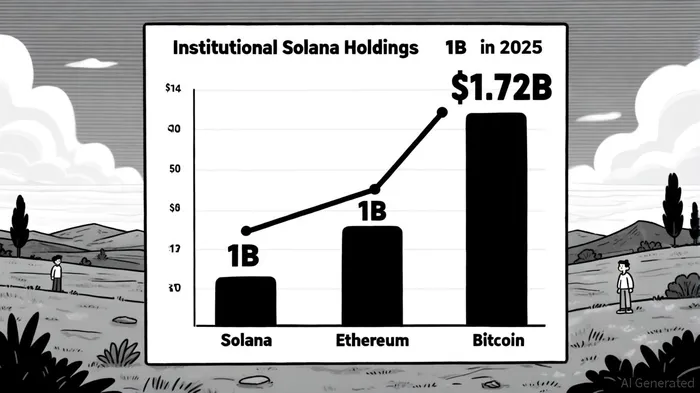
Corporate Solana holdings have exploded in 2025. Thirteen publicly listed companies now hold 1.55% of the circulating supply (~$1.8 billion), with DeFi Development Corp. (1.99 million SOL) and Upexi Inc. (2 million SOL) leading the charge . Forward's $1.65B raise alone tripled the size of the previous largest Solana treasury .
Institutional confidence is also reflected in structured products. The REX-Osprey SSK ETF, launched in July 2025, combines Solana exposure with a 7.3% staking yield and has attracted $183 million in assets under management . Nine more Solana ETFs are pending SEC approval, with a final decision expected by October 16, 2025 . Analysts predict these products could drive $5–8 billion in inflows, replicating Bitcoin ETF success .
Ecosystem Growth: DeFi, TVL, and Institutional Partnerships
Solana's ecosystem is maturing rapidly. Total Value Locked (TVL) in Q2 2025 hit $8.6 billion, driven by platforms like Kamino and Raydium . The network now supports 3,248 active validators, a 57% year-over-year increase, signaling robust decentralization . Innovations like Confidential Transfers—using zero-knowledge proofs for private transactions—have also attracted enterprises seeking compliance-friendly solutions .
Partnerships with validators like Jump Crypto's Firedancer client and Galaxy's risk management tools further solidify Solana's institutional infrastructure. As CantorCEPT-- Fitzgerald analysts note, “Solana's throughput and cost efficiency position it to outperform Ethereum in the long term” .
Why Solana Outpaces Bitcoin and Ethereum
Bitcoin's appeal as a “digital gold” store of value is undeniable, but its lack of staking and scalability limits its utility for active treasuries. Ethereum's post-merge staking yields (3%) are modest, and gas fees remain prohibitive for frequent on-chain activity. Solana, by contrast, offers a hybrid model: it combines security with speed, staking returns with DeFi innovation, and institutional-grade infrastructure with developer-friendly tools.
The SEC's regulatory clarity on protocol staking and the pending ETF approvals add another layer of legitimacy. As one analyst put it, “Solana isn't just a crypto asset—it's a financial infrastructure play” .
Conclusion: The Institutional Shift Is Here
Solana's rise as an institutional treasury asset is no longer speculative—it's a reality. With corporate holdings surpassing $1.72 billion, staking yields outpacing traditional assets, and a robust ecosystem driving adoption, Solana is positioning itself as the go-to blockchain for yield-driven strategies. The pending ETF approvals and continued upgrades like Alpenglow suggest this trend is far from peaking. For institutions seeking to balance growth, security, and scalability, Solana offers a compelling alternative to Bitcoin and Ethereum—one that's backed by data, execution, and a growing army of corporate adopters.







Comentarios
Aún no hay comentarios