
Solana's Scalability Struggles vs. BlockDAG's Emerging Consensus: The 2025 Blockchain Infrastructure Showdown
The Battle for Scalability: Solana's Progress and Persistent Pain Points
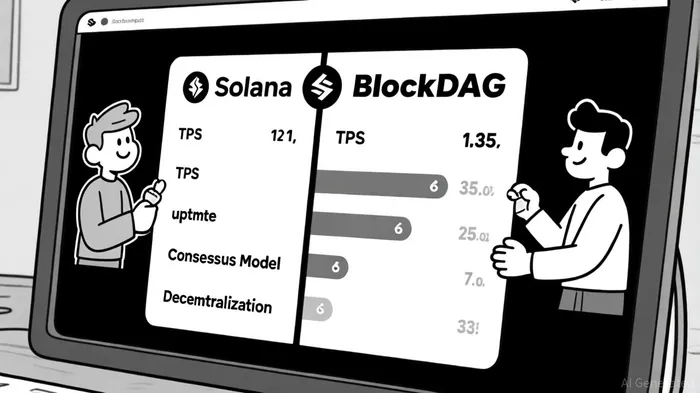
Solana's 2025 performance has been a mixed bag of triumphs and lingering vulnerabilities. According to the Solana Network Health Report (June 2025), the network achieved 100% uptime for 16 consecutive months, a milestone that underscores its improved reliability[1]. This resilience is attributed to upgrades like Firedancer, a next-generation validator client that reduced memory usage and improved synchronization[5]. However, the report also notes that Solana's real-world transaction throughput—around 1,700–2,000 TPS during peak hours—lags behind its theoretical maximum of 65,000 TPS[3].
The gap between potential and practice is widening for high-frequency applications. DeFi and GameFi platforms, which demand real-time execution, have faced bottlenecks despite innovations like SuperSol's Evanescent Rollups[2]. These rollups, designed to offload transactions from the base layer, have mitigated some pressure but not eliminated the underlying issue: Solana's validator centralization and hardware dependencies remain a double-edged sword. As Coinasity highlights, the network's prioritization of consistency over availability (per CAP theorem) can lead to temporary halts during surges, a flaw that has historically triggered outages[4]. The last major incident in August 2024 lasted 43 minutes—a marked improvement over earlier outages but still a red flag for institutional investors[4].
BlockDAG's DAG-PoW Gambit: A New Paradigm?
BlockDAG, a 2025 entrant in the Layer 1 race, is positioning itself as a decentralized alternative to Solana's centralized scalability. Its hybrid Directed Acyclic Graph (DAG) + Proof-of-Work (PoW) model allows parallel block validation, theoretically enabling up to 15,000 TPS[1]. Testnet results from May 2025 show 2,000 TPS with 10 blocks per second, a figure that, if sustained, would outpace Solana's current throughput[6].
The project's architecture is designed to avoid Solana's pitfalls. By distributing validation across mobile apps and ASIC miners, BlockDAG claims to reduce centralization risks[5]. Security audits by Halborn and CertiK further bolster confidence, with the Crescendo hard fork (May 2025) introducing a Rust-based codebase and multi-stage verification processes[3]. Unlike Solana's validator-centric model, BlockDAG's PoW mechanism democratizes participation, though skeptics question whether PoW's energy costs can be reconciled with scalability goals[1].
The Inflection Point: Ecosystem vs. Infrastructure
Solana's ecosystem remains a critical advantage. With 28 million daily transactions and partnerships in traditional finance, it hosts mature DeFi platforms like Raydium and NFT marketplaces like Magic Eden[6]. However, as Cryptodaily notes, these applications often falter during token launches or NFT mints, exposing scalability limits[3]. BlockDAG, by contrast, is still building its ecosystem but offers EVM compatibility and low-code tools to attract developers[2]. Its focus on account abstraction and vesting contracts in testnets suggests a user-friendly approach, though it lacks the critical mass of Solana's ecosystem[6].
The key differentiator lies in consensus design. Solana's Proof-of-History (PoH) timestamps transactions to enable rapid finality, but this relies on high-performance hardware and a small validator set[3]. BlockDAG's PHANTOM GHOSTDAG protocol generalizes Nakamoto consensus, allowing parallel block creation without sacrificing security[7]. While Solana's upgrades (e.g., SIMD-0286) aim to expand block space, BlockDAG's DAG structure inherently avoids linear bottlenecks[1].
Investment Implications: Which Model Wins in 2025?
For investors, the choice hinges on risk tolerance and time horizons. Solana's 99.96% uptime and $2.98 billion June 2025 transaction volume[6] make it a safer bet for near-term gains, particularly in DeFi and NFTs. However, its validator centralization and historical outages pose long-term risks. BlockDAG's testnet performance and decentralized model appeal to those betting on a “sustainable” Layer 1, but its unproven ecosystem and PoW energy costs remain hurdles[5].
The blockchain infrastructure war is far from over. Solana's roadmap—featuring faster consensus algorithms and institutional partnerships—could solidify its dominance. Yet BlockDAG's DAG-PoW hybrid, if scaled effectively, may redefine scalability without compromising decentralization. As CaptainAltcoin argues, the 2025 winner will likely be the chain that balances speed, security, and accessibility[4].






Comentarios
Aún no hay comentarios