
Solana's Role in Scaling Web3 and DeFi: High-Performance Blockchain as the Catalyst for Mass Adoption
The Infrastructure Revolution: Solana's Technical Edge
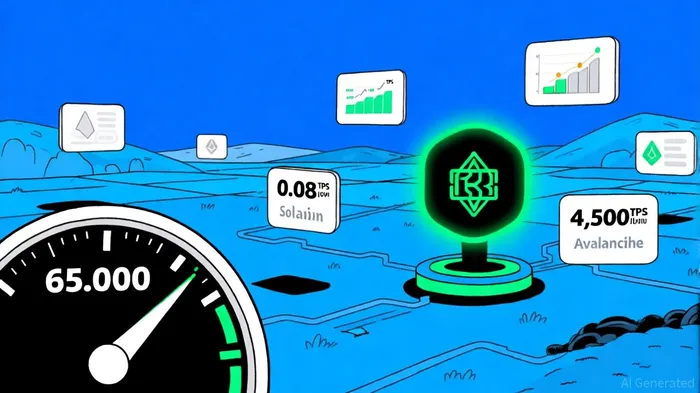
In the race to scale Web3 and DeFi, infrastructure performance is the linchpin. SolanaSOL-- has redefined blockchain capabilities in 2025, processing 65,000 transactions per second (TPS) during peak loads and achieving block finality in under 400 milliseconds, according to the Solana Network Health Report. This is not just incremental improvement—it’s a paradigm shift. Solana's Proof of History (PoH) consensus mechanism, combined with its parallelized Sealevel execution engine, enables a throughput that dwarfs Ethereum's paltry 0.08 TPS and even outpaces Avalanche's 4,500 TPS, as explained in a Solana in 2025 analysis.
The Firedancer upgrade in 2025 pushed Solana's experimental capacity to 1,250 TPS, proving the network's scalability headroom, according to a Solana technical analysis. Meanwhile, transaction fees remain negligible at $0.00025 per transaction, a stark contrast to Ethereum's $2.93 average, per CoinLaw's Solana statistics. These metrics are not just numbers—they are the bedrock for real-world applications. DeFi protocols, NFT marketplaces, and gaming platforms can now operate with the speed and cost-efficiency required to attract mainstream users.
DeFi and Web3: Solana's Ecosystem in Action
Solana's high-performance infrastructure has catalyzed a surge in DeFi and Web3 adoption. Kamino Finance, for instance, scaled from $200 million to $2 billion in TVL by 2025, leveraging Solana's speed to offer advanced lending and trading tools, according to Analytics Insight. Raydium, a hybrid AMM and DEX, now holds $27 billion in TVL, while Jupiter dominates decentralized trading with $700 million in daily swap volume and a 79.2% market share in perpetuals, according to Coin Bureau.
Beyond finance, Solana's ecosystem is reshaping media and gaming. Audius, a decentralized music platform, migrated from EthereumETH-- to Solana, scaling its user base from 2 million to 8 million monthly users by 2025, as reported by ServerMania. Gaming projects like Star Atlas and Aurory have built immersive, community-driven worlds with NFT-based economies, proving that blockchain can power next-gen entertainment.
Developer and Institutional Momentum
Solana's growth is not just user-driven—it's developer-led. By mid-2025, 7,625 new developers joined the ecosystem in 2024 alone, an 83% growth rate, according to the Solana ecosystem report. This surge is fueled by tools like Anchor framework and Neon EVM, which lower entry barriers for smart contract development. The result? Over 8,400 smart contracts and 2,100 active dApps across DeFi, NFTs, and GameFi, per a QuickNode report.
Institutional adoption is equally transformative. BlackRock, Franklin Templeton, and VanEck have launched tokenized money market funds on Solana, while the Rex-Osprey Solana Staking ETF became the first U.S.-approved staking ETF in June 2025, according to Messari. These moves signal a shift in institutional confidence, with Polymarket assigning a 91% chance of approval for multiple SOL ETFs in 2025, per Blockchain.News.
The Road Ahead: Solana as the Web3 Backbone
Solana's Alpenglow upgrade, reducing transaction finality to 100 milliseconds, has further cemented its role as the go-to infrastructure for real-time applications, according to a Medium analysis. With $1.4 trillion in monthly DEX trades and partnerships with R3 for tokenized securities, Solana is no longer just a blockchain—it’s a bridge between Web3 and traditional finance, as reported by OKX.
For investors, the implications are clear: Solana's high-performance infrastructure is not a niche experiment but a critical enabler of mass adoption. As DeFi TVL grows from $9.3 billion in Q1 2025 to projected $15+ billion by 2026, and as institutional capital flows through tokenized assets and ETFs, Solana's network effects will only accelerate.
Conclusion
The blockchain trilemma—security, scalability, and decentralization—has long been a barrier to mass adoption. Solana's technical innovations and ecosystem growth demonstrate that this trilemma is not a dead end but a solvable challenge. By prioritizing performance without compromising decentralization, Solana is building the rails for Web3's future. For investors, the question is no longer if Solana will scale—it's how quickly the world will adopt it.
---







Comentarios
Aún no hay comentarios