
Solana’s PSG1 and the Future of Web3 Gaming Hardware: A Strategic Investment at the Blockchain-Gaming Nexus
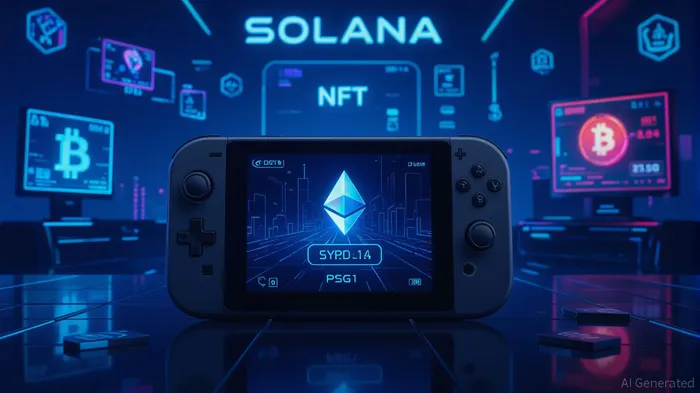
The convergence of blockchain and gaming is no longer a speculative trend but a rapidly materializing market shift. At the forefront of this transformation is Solana’s Play Solana Gen 1 (PSG1), a Web3-native handheld gaming console set to launch on October 6, 2025. Priced at $329, the PSG1 is not merely a gaming device but a strategic catalyst for Solana’s broader vision to mainstream blockchain gaming and solidify its dominance in the $1 trillion+ gaming economy [1]. For investors, the PSG1 represents a unique opportunity to capitalize on the intersection of hardware innovation, decentralized finance (DeFi), and the explosive growth of Web3 gaming.
The PSG1: A Hardware-Driven Ecosystem Play
The PSG1’s technical specifications position it as a versatile platform for both retro and modern blockchain-native games. Equipped with an octa-core ARM processor, 8GB of RAM, and a 5.0-inch OLED display (1280 × 1080 resolution), the device supports real-time multiplayer interactions and microtransactions—critical for Web3 gaming’s play-to-earn (P2E) models [3]. Its built-in hardware wallet and fingerprint authentication address two of the industry’s most persistent challenges: security and usability [1]. By embedding crypto infrastructure directly into the hardware, SolanaSOL-- eliminates the friction of external wallets, making blockchain gaming accessible to mainstream audiences.
Partnerships further amplify the PSG1’s strategic value. The collaboration with Pudgy Penguins to release a $349 exclusive edition, which burns $PENGU tokens per unit sold, creates a deflationary mechanism that enhances token utility and scarcity [3]. Additionally, a limited NFT collection offering early access to 2,000 holders incentivizes community engagement and liquidity [1]. These moves align with Solana’s broader strategy to integrate NFT-driven incentives, fostering a self-sustaining ecosystem where developers, players, and investors share aligned economic interests [4].
Market Growth and Competitive Edge
The Web3 gaming hardware market is projected to grow at a 30% CAGR, reaching $28.86 billion by 2030 [5]. Solana’s PSG1 is well-positioned to capture a significant share of this growth. Competitors like Sui’s SuiPlay0X1, while innovative, lack Solana’s first-mover advantage and mature developer ecosystem. Solana’s network already boasts 7,600 new developers in 2024 and a thriving DeFi Total Value Locked (TVL) of $8.6 billion, driven by platforms like Kamino and Axiom [1]. In contrast, Sui’s developer base, though growing, remains smaller, with 1,400 active developers as of mid-2025 [6].
The PSG1’s affordability ($329 vs. SuiPlay0X1’s higher price) and Solana’s established infrastructure—bolstered by the recent Alpenglow upgrade (reducing block finality to 150 milliseconds)—provide a critical edge in performance and scalability [4]. This positions Solana as a “distribution hub” for decentralized applications (DApps), accelerating adoption of its ecosystem [5].
Financial Resilience and Institutional Momentum
Despite a 44.2% Q2 2025 decline in total application revenue (Chain GDP), Solana’s App Revenue Capture Ratio (RCR) surged to 211.6%, signaling improved efficiency in monetizing network activity [1]. DeFi TVL growth of 30.4% to $8.6 billion and a 30% increase in market cap to $83 billion underscore the ecosystem’s resilience [3]. Institutional interest is also surging, with bullish sentiment reaching a 5.8:1 ratio and firms like Pantera and Galaxy DigitalGLXY-- investing heavily in Solana [4].
Challenges and Long-Term Potential
While the PSG1’s launch is a milestone, challenges remain. Declining retail participation on Solana-based decentralized exchanges and overreliance on memecoin activity could hinder growth [4]. However, the PSG1’s focus on user experience and cross-platform gameplay—enabling both blockchain-native and traditional games—positions it to attract a broader demographic, including casual gamers [5].
For investors, the key metrics to monitor are adoption rates, developer engagement, and network effects. If the PSG1 achieves mass adoption, it could catalyze a $1 trillion blockchain gaming market, with Solana’s ecosystem reaping the lion’s share of value creation [1].
Conclusion
Solana’s PSG1 is more than a gaming console—it is a strategic lever for expanding blockchain’s reach into mainstream entertainment. By combining hardware innovation with Solana’s high-performance infrastructure and DeFi dominance, the PSG1 addresses the usability, security, and scalability barriers that have long hindered Web3 adoption. As the Web3 gaming market accelerates toward its projected $118.36 billion valuation by 2034 [5], Solana’s ecosystem is uniquely positioned to lead the charge. For investors, the PSG1 represents a high-conviction bet on the future of decentralized gaming—and a compelling entry point into one of the most transformative sectors of the digital economy.
Source:
[1] Solana's PSG1 Console: A Strategic Catalyst for Blockchain Gaming [https://www.ainvest.com/news/solana-psg1-console-strategic-catalyst-blockchain-gaming-adoption-2508/]
[2] SUISUI-- vs Solana: The Battle of Layer 1 Giants [https://archway.finance/blog/sui-vs-solana-crypto-rivalry]
[3] Everything We Know About Solana's Gaming Console [https://www.ccn.com/news/crypto/play-solana-everything-you-need-to-know-about-solanas-first-gaming-console/]
[4] Solana price surge amid Alpenglow Upgrade and PSG1 Console Debut [https://coinjournal.net/news/solana-price-surge-amid-alpenglow-upgrade-and-psg1-console-debut/]
[5] Web3 Gaming Market to Reach USD 124.74 Billion by 2032 [https://www.globenewswire.com/news-release/2025/07/01/3108529/0/en/Web3-Gaming-Market-to-Reach-USD-124-74-Billion-by-2032-Driven-by-Blockchain-Adoption-NFT-Integration-and-Play-to-Earn-Models-SNS-Insider.html]






Comentarios
Aún no hay comentarios