
Solana's Price Trajectory Amid Wall Street's Institutional Adoption of Crypto ETFs: Institutional Validation and Retail Spillover into High-Utility AI and Infrastructure Plays
The institutionalization of cryptocurrency has reached a pivotal inflection point in 2025, with Wall Street's aggressive foray into crypto ETFs reshaping the landscape for digital assets. SolanaSOL-- (SOL), in particular, has emerged as a focal point of this transformation, driven by institutional validation through ETF launches and a parallel surge in AI-driven infrastructure upgrades. While institutional adoption has injected over $1 billion into Solana ETFs by early 2026, the token's price remains disconnected from this momentum, trading near 2023 levels despite robust on-chain activity. This divergence highlights a critical dynamic: the interplay between institutional confidence and retail spillover into high-utility sectors like AI and infrastructure.
Institutional Adoption: A New Paradigm for Solana
Wall Street's embrace of Solana is no longer speculative but structural. Morgan Stanley's filing for the Morgan Stanley Solana Trust-a spot ETF with a staking component- marks a departure from third-party distribution models, signaling deep institutional conviction. This move aligns with broader regulatory tailwinds, including the repeal of SAB 121 and the SEC's 75-day listing standard, which have accelerated the approval of crypto ETFs. By early 2026, Solana-focused ETFs like Invesco's QSOL and REX-Osprey's SSK had attracted $670 million and $417 million in net inflows, underscoring a diversification of institutional portfolios beyond BitcoinBTC-- and EthereumETH--.
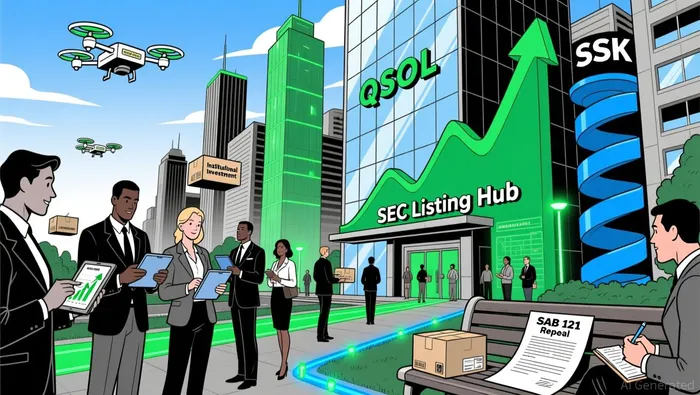
The institutional narrative is further reinforced by Solana's role in real-world applications (RWAs). Projects like FRNT and JupUSD stablecoins, launched on the network in early 2026, position Solana as a scalable platform for tokenized assets. Meanwhile, Western Union's exploration of Solana for blockchain-based remittances underscores its utility in cross-border finance, a sector projected to grow as global stablecoin adoption accelerates.
The Infrastructure Revolution: AI and Technical Upgrades
Solana's technical roadmap in 2025 has been nothing short of transformative. The Firedancer validator client, developed by Jump Crypto, aims to achieve 1 million transactions per second and sub-150 millisecond finality through the Alpenglow consensus mechanism. These upgrades, coupled with a 25% increase in compute units per block, are designed to support high-frequency DeFi protocols. Such advancements are critical for institutional adoption, as they address scalability bottlenecks that have historically hindered blockchain's utility in mainstream finance.
AI is also playing a pivotal role in Solana's ecosystem. Machine learning models from platforms like Gemini and Doo Prime analyze on-chain data, sentiment, and transaction volumes to forecast price movements. These tools have generated bullish scenarios, with some models projecting Solana to reach $400–$500 by year-end. Meanwhile, AI-driven trading agents like AutoGPT enable real-time adaptation to network performance, providing actionable insights for both institutional and retail investors.
Retail Spillover: The Missing Link
Despite institutional enthusiasm, Solana's price trajectory has lagged. A 50% decline in the past year contrasts sharply with the network's technical and institutional progress. The disconnect stems from muted retail participation: on-chain trading activity remains subdued compared to the 2021 and 2024 bull cycles. However, early signs of retail spillover are emerging. By July 2025, Solana's ecosystem generated $146 million in dApp revenue, surpassing Ethereum and BNBBNB-- Chain, driven by projects like Jupiter and RaydiumRAY--.
The key to unlocking retail demand lies in Solana's AI-driven infrastructure. As Firedancer and Alpenglow reduce transaction costs and improve speed, the network becomes more accessible to everyday users. For example, Application-Controlled Execution (ACE) protocols mitigate MEV risks, creating a fairer environment for retail traders. Additionally, AI-driven price predictions and trading tools are democratizing access to Solana's ecosystem, enabling retail investors to participate in high-utility sectors without requiring deep technical expertise.
Investment Implications: A Convergence of Forces
The convergence of institutional validation and AI-driven infrastructure upgrades positions Solana as a unique investment opportunity. While institutional inflows have already validated Solana's utility, the token's price is likely to follow once retail adoption accelerates. This scenario is supported by historical patterns: the 2024 ETF approvals triggered a 400% surge in institutional flows, but it was retail participation that drove Bitcoin's price to record highs.
For investors, the focus should be on two metrics: (1) the expansion of Solana's RWA ecosystem, which could attract further institutional capital, and (2) retail on-chain activity, which will signal broader market acceptance. The launch of Morgan Stanley's Solana ETF and the proliferation of AI-driven trading tools suggest that both forces are aligning.
Conclusion
Solana's 2025 trajectory reflects a broader shift in the crypto market: the transition from speculative trading to structured, utility-driven investment. Institutional adoption has laid the foundation, but the token's price will ultimately be determined by retail spillover into high-utility sectors like AI and infrastructure. As Firedancer, Alpenglow, and AI-driven analytics redefine Solana's capabilities, the network is poised to become a cornerstone of the Internet Capital Markets vision. For investors, the key takeaway is clear: Solana's price is not just a function of institutional demand but a reflection of its evolving role in the future of decentralized finance.






Comentarios
Aún no hay comentarios