
Solana's Price Correction and Derivatives Market Dynamics: A Risk Management Perspective for Crypto Portfolios
Solana's Price Correction and Derivatives Market Dynamics: A Risk Management Perspective for Crypto Portfolios
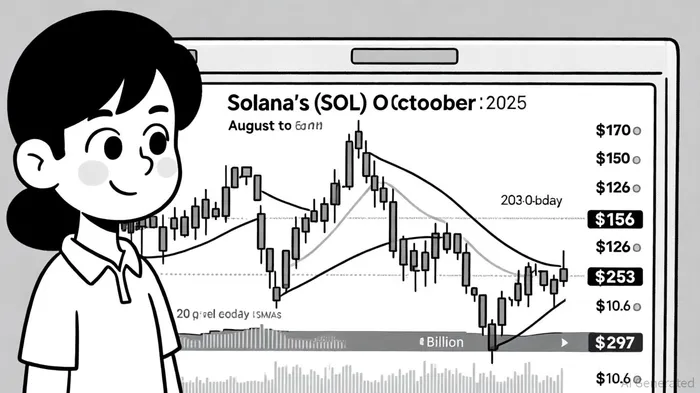
The cryptocurrency market's recent volatility has placed SolanaSOL-- (SOL) under intense scrutiny, with its price correction and derivatives activity offering critical insights for risk management and portfolio reallocation. As of October 2025, SOLSOL-- trades at $194, down 14% weekly amid broader crypto market weakness following Bitcoin's decline, according to BTCC analysis. This correction has exposed fragile leverage in derivatives markets and shifting sentiment among long-term holders, demanding a strategic reassessment of exposure to the asset.
Price Correction and Technical Vulnerabilities
Solana's current price action reflects a tug-of-war between bullish structural patterns and bearish momentum. The 20-day simple moving average (SMA) has turned bearish, while the 200-day SMA remains in a long-term uptrend, per BTCC analysis. This divergence signals a potential consolidation phase, with key technical levels acting as pivotal decision points. Immediate support at $170, if breached, could trigger a cascade to $156 or even $126, according to BTCC and a Cointribune analysis. Conversely, a sustained rebound above $210 might validate a bullish breakout toward $230 and beyond, the BTCC piece suggests.
Historical context from a buy-and-hold strategy around the $170 support level reveals mixed signals. A backtest from 2022 to 2025 shows an annualized return of 11.03% but with a maximum drawdown of 59.77%, underscoring the volatility inherent in this strategy. While the average return suggests resilience, the sharp corrections highlight the need for disciplined risk management.
For risk managers, this volatility underscores the importance of position sizing and stop-loss placement. Derivatives data further complicates the picture: open interest has declined amid speculative unwinding, and the Commitment to Volume Delta (CVD) indicator is skewed toward sellers, according to BTCC. These metrics suggest heightened sensitivity to liquidity shocks, particularly around $230–$250 (resistance) and $190–$174 (support), where prior liquidations have amplified price swings.
Derivatives Market Activity and Leverage Risks
Derivatives markets remain a double-edged sword for Solana. While open interest has rebounded to $10.3 billion–$10.6 billion, indicating renewed trader participation, excessive leverage remains a concern, according to a Benzinga report. The absence of spot outflows pushing prices lower suggests larger participants are absorbing selling pressure, a dynamic noted in the Benzinga piece, but this balance could reverse if short-term holders face margin calls.
Whale activity in perpetual futures has plummeted by over 800% in 30 days, signaling reduced confidence in near-term price stability, according to Yahoo Finance. This exodus from leveraged positions aligns with broader bearish pressure, as Yahoo Finance also highlights Glassnode's Liveliness metric hitting a year-to-date high of 0.78. For portfolio managers, these trends highlight the need to hedge against forced liquidations and rebalance exposure between spot and derivatives instruments.
On-Chain Indicators and Catalysts for Rebound
Despite the bearish near-term outlook, on-chain data reveals asymmetric potential. Solana's rebound from $186 has preserved its bullish structure, forming a contracting triangle pattern that could precede a sharp directional move, as noted by Benzinga. Meanwhile, amendments to proposed Solana ETFs by major asset managers introduce a high-impact catalyst, which Yahoo Finance has covered; if approved, these products could inject liquidity and drive prices toward $248.50, the Yahoo piece suggests, offering a compelling case for selective entry.
However, optimism must be tempered with caution. The current environment demands a focus on liquidity management and diversification. Investors should prioritize assets with robust on-chain fundamentals and lower leverage risk while maintaining dry powder to capitalize on potential rebounds.
Portfolio Reallocation Strategies
Given Solana's precarious technical setup, risk-averse investors may consider reducing exposure to overleveraged positions and shifting capital to less correlated assets like BitcoinBTC-- or EthereumETH--, which exhibit stronger near-term momentum. For those with a longer-term bullish thesis, dollar-cost averaging into Solana at key support levels (e.g., $170) could mitigate downside risk while aligning with potential ETF-driven rallies.
Derivatives traders, meanwhile, should focus on low-leverage products and use options strategies to hedge against volatility. The current open interest levels suggest that aggressive shorting carries elevated counterparty risk, particularly if the market absorbs selling pressure without further price declines, as Benzinga warns.
Conclusion
Solana's price correction and derivatives dynamics present a textbook case for disciplined risk management. While technical indicators and on-chain metrics highlight near-term fragility, structural patterns and potential ETF approvals offer a path for recovery. Investors must balance caution with opportunism, adjusting portfolios to reflect both the risks of a breakdown below $170 and the rewards of a sustained rebound above $210. In a market defined by rapid shifts in sentiment, adaptability will be the key to preserving capital and capturing upside.







Comentarios
Aún no hay comentarios