
Solana's Potential Move into Perpetual Futures with Percolator DEX: A Strategic and Financial Deep Dive
The decentralized finance (DeFi) landscape is undergoing a seismic shift as SolanaSOL--, the high-performance blockchain known for its speed and scalability, prepares to enter the perpetual futures market with its ambitious Percolator DEX project. Announced by co-founder Anatoly Yakovenko in October 2025, Percolator represents a calculated response to the explosive growth of competitors like Hyperliquid and AsterASTER--, which have collectively captured over 50% of blockchain derivatives trading volume in recent months. This article evaluates the strategic and financial implications of Percolator for Solana's ecosystem, the broader DeFi market, and the crypto derivatives sector.
Strategic Rationale: Solana's Response to a Crowded Market
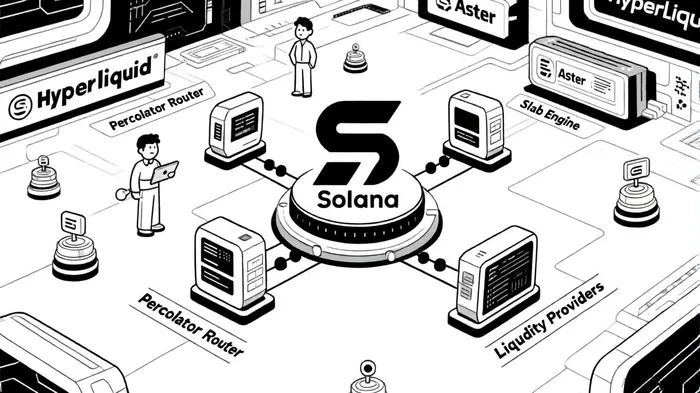
Percolator's architecture is designed to address two critical pain points in decentralized derivatives trading: liquidity fragmentation and user experience limitations. The protocol's dual-program structure-comprising the Router (for collateral management and cross-market routing) and the Slab (a self-contained perpetuals engine operated by liquidity providers)-leverages Solana's native parallelism to enable high-throughput, low-latency trading. This design mirrors the sharding strategies of centralized exchanges but executes entirely on-chain, preserving decentralization while competing with the efficiency of centralized platforms.
The timing of Percolator's development is no coincidence. Hyperliquid, a permissionless DEX on Solana, captured 35% of blockchain revenue in July 2025 by offering user-friendly interfaces and builder-deployed perpetual contracts. Meanwhile, Aster, launched on BNBBNB-- Chain, briefly surpassed Hyperliquid in daily volume ($14.5 billion) despite trailing in 30-day volume ($145 billion vs. $309 billion). Solana's move to launch Percolator signals a direct bid to reclaim market share by combining the chain's performance advantages with a self-custodial, decentralized model that aligns with institutional and retail demand for trustless trading.
Financial Implications: Volume, Fees, and Network Effects
Perpetual futures markets are a $100+ billion sector, with decentralized platforms now accounting for over 20% of total derivatives volume. Percolator's potential to capture even a fraction of this market could significantly boost Solana's revenue streams. The Router program's cross-slab routing mechanism, for instance, could incentivize liquidity aggregation across multiple Slab instances, reducing slippage and attracting high-frequency traders. This, in turn, could drive transaction fees and gasGAS-- demand on Solana, reinforcing the network's value proposition for developers and users alike. For example, Humidifi became a top Solana DEX by volume in under three months, illustrating how rapid liquidity growth can compound network effects.
Moreover, Percolator's focus on token-specific order routing-a feature absent in most existing DEXs-could create a flywheel effect. By allowing traders to route orders to the most liquid Slab for a given asset, Percolator may reduce arbitrage opportunities and attract specialized liquidity providers. This could lower trading costs and increase user retention, further entrenching Solana's position in the derivatives space.
Technical Advantages and Risks
Percolator's architecture is optimized for Solana's execution model, which prioritizes parallelism and fault isolation. The Slab program's self-contained matching and settlement logic, for example, ensures that individual liquidity pools operate independently, minimizing systemic risk from bugs or attacks. This contrasts with monolithic DEX designs, where a single vulnerability can disrupt entire markets.
However, challenges remain. The liquidation engine-a critical component for managing undercollateralized positions-is still in development, raising questions about risk management capabilities. Additionally, while Percolator's self-custodial model appeals to privacy-conscious users, it may struggle to match the ease of use offered by Hyperliquid's permissionless contract deployment. Early traction is promising: two external contributors have already submitted pull requests to Percolator's GitHub repository, indicating community buy-in, as reported by Cointelegraph. Yet, the absence of a launch timeline means the project's success hinges on Yakovenko's team's ability to execute under pressure.
Market Positioning and Long-Term Outlook
Percolator's strategic value extends beyond Solana's immediate competitors. By introducing a decentralized alternative to centralized perpetual exchanges like Bybit and Binance, the DEX could attract institutional capital seeking regulatory-friendly, on-chain solutions. This aligns with broader trends in DeFi, where "permissioned decentralization" models are gaining traction.
Financially, Percolator's success could catalyze a virtuous cycle for Solana. Increased derivatives trading volume would drive demand for SOLSOL-- as collateral and settlement asset, potentially boosting the token's utility and price. According to CoinGecko data, Solana's DEX volumes hit $6 billion in July 2025, a 40% quarter-over-quarter increase. If Percolator captures even 10% of the $100 billion derivatives market, it could generate $10 billion in annualized fees-a figure that would significantly bolster Solana's ecosystem.
Risks and Mitigations
Despite its promise, Percolator faces headwinds. Competition from Hyperliquid and Aster is intensifying, with the latter recently surpassing Hyperliquid in daily volume. Additionally, regulatory scrutiny of perpetual derivatives-particularly in the U.S.-could delay Percolator's launch or limit its market access.
To mitigate these risks, Solana must prioritize developer tooling and user education. Yakovenko's team has already begun documenting core components on GitHub, but broader adoption will require robust APIs, staking incentives for liquidity providers, and partnerships with DeFi protocols like SerumSRM-- or RaydiumRAY--.
Conclusion: A High-Stakes Bet for DeFi's Future
Percolator represents a bold, technically sophisticated attempt to redefine decentralized derivatives trading. If successful, it could position Solana as the dominant chain for high-volume, low-cost perpetual futures-reclaiming ground lost to competitors and reshaping the DeFi landscape. However, the project's financial and strategic impact will depend on its ability to balance decentralization with usability, execute on its roadmap, and navigate regulatory uncertainties. For investors, Percolator is not just a DEX-it's a litmus test for Solana's ambition to lead the next phase of blockchain innovation.







Comentarios
Aún no hay comentarios