
Solana's Path to Mass Adoption and Institutional Onboarding: Network Effects, Tech, and Macro Trends
In 2025, SolanaSOL-- has emerged as a formidable force in the blockchain ecosystem, driven by a confluence of network effects, technological innovation, and macroeconomic tailwinds. As the network transitions from speculative hype to institutional credibility, its trajectory toward mass adoption is increasingly defined by three pillars: ecosystem expansion, technical resilience, and capital inflows from macroeconomic shifts.
Network Effects: From Speculation to Utility
Solana's network effects have reached a critical inflection point. According to the Solana Compass report, the network has achieved 600 million+ active wallets and generated $1.6 billion in app revenue in the first half of 2025 alone. This growth is not merely quantitative but qualitative: institutions are shifting from asking "Should we invest in Solana?" to "How do we integrate it into our operations?", as described in a Forbes article.
The network's utility-driven appeal is underscored by its dominance in real-time applications. Gaming, DeFi, and tokenized real-world assets (RWAs) now account for over 70% of Solana's transaction volume, the Solana Compass report found. For example, decentralized physical infrastructure networks (DePIN) projects leveraging Solana's low-cost, high-speed infrastructure have attracted $2.3 billion in funding this year, according to that same report. This shift from speculative trading to productive use cases is a hallmark of maturing network effects.
Technological Upgrades: The Infrastructure of Trust
Solana's technical roadmap in 2025 has been nothing short of transformative. The introduction of Firedancer, a high-performance validator client developed by Jump Crypto, has increased throughput by 30% while reducing single-point failure risks, according to the Forbes piece. Coupled with the Alpenglow consensus upgrade, which slashed block finality times to 100–150 ms, Solana now rivals EthereumETH-- in reliability while maintaining its signature speed, as reported in a Techloy article.
These upgrades are not just technical achievements-they are institutional enablers. As noted in Solana's Network Health Report, the network's 16-month uptime streak and industry-leading decentralization score have made it a safe harbor for capital, per a Phemex analysis. Validator-client diversity has expanded to 12 distinct implementations, mitigating centralization risks and aligning with institutional demands for robust infrastructure, the Techloy article also explains.
Macro-Driven Inflows: ETFs, Treasuries, and Regulatory Clarity
The macroeconomic landscape in 2025 has been a tailwind for Solana's institutional adoption. With global inflation easing and the U.S. Federal Reserve signaling potential rate cuts, liquidity is flowing into risk-on assets like crypto. Solana, with its 65,000 TPS and $0.00025 average transaction fee, has become a preferred platform for scalable applications, a point underscored by the Phemex analysis.
Institutional onboarding has accelerated through ETF filings and corporate treasuries. Over $600 million in SOL is now held by public companies, including Forward Industries (NASDAQ: FORD), which staked 6.8 million SOL as part of a $1.65 billion private investment led by Galaxy DigitalGLXY-- and Jump Crypto, as detailed in the Forbes article. Regulatory clarity, such as the Financial Accounting Standards Board's January 2025 ruling on digital asset accounting, has further legitimized Solana as a balance-sheet asset, the Phemex analysis notes.
The pending approval of Solana ETFs by the SEC in October 2025 could be a watershed moment. As highlighted in Phemex's analysis, these products would democratize access to Solana's ecosystem while injecting billions in institutional capital.
The Road Ahead: Challenges and Opportunities
While Solana's momentum is undeniable, challenges remain. Regulatory scrutiny over staking mechanisms and custody models persists, with the SEC's final ETF decision looming as a key catalyst, the Solana Compass report warns. Additionally, macroeconomic volatility-such as Trump-era trade tariffs-could disrupt inflows, a risk underscored in the Forbes article.
However, Solana's ecosystem is primed to capitalize on these risks. Its validator diversity, low-cost infrastructure, and real-world use cases position it to outperform Ethereum in institutional adoption. As one analyst put it, "Solana isn't just a blockchain-it's a utility layer for the digital economy", an insight quoted in the Forbes piece.
Conclusion
Solana's 2025 journey is a masterclass in leveraging network effects, technical innovation, and macroeconomic trends. With institutional treasuries, ETFs, and real-time applications driving growth, the network is no longer a speculative bet but a foundational infrastructure play. For investors, the question is no longer "Is Solana the future?" but "How soon will it arrive?" 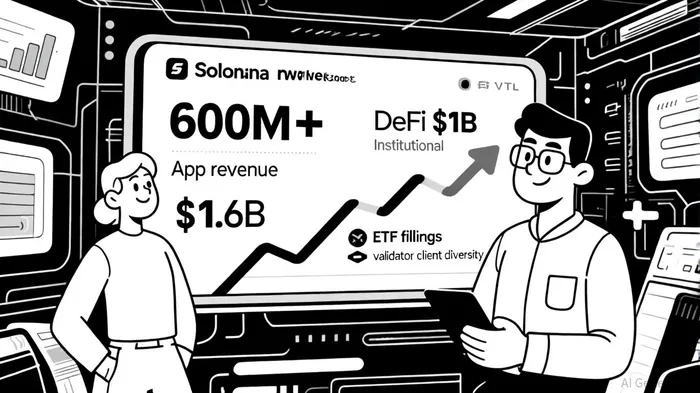





Comentarios
Aún no hay comentarios