
Solana Network Volatility and Whale Behavior: On-Chain Activity as a Leading Indicator of Market Sentiment
The Paradox of Solana's On-Chain Strength and Price Stagnation
Solana's on-chain metrics in 2024–2025 have painted a picture of robust institutional confidence and ecosystem growth, yet its price has remained stubbornly range-bound between $164 and $168. This disconnect raises critical questions for investors: Are whale movements and TVL trends reliable leading indicators of market sentiment, or do they mask deeper structural risks?
Whale Behavior: Strategic Positioning vs. Selling Pressure
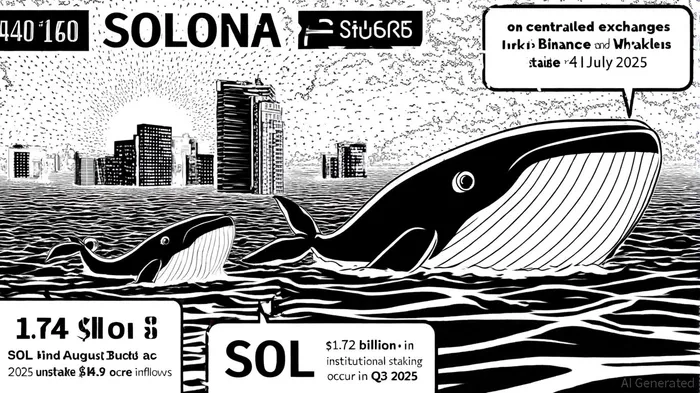
Whale activity on SolanaSOL-- has been a double-edged sword. In August 2025, large wallets deposited over $40 million in SOLSOL-- into centralized exchanges like Binance and Kraken, including 96,996 SOL ($17.45 million) from the CMJiHu wallet and 91,890 SOL ($15.98 million) from the 5PjMxa wallet [1]. Analysts argue these transfers reflect strategic positioning rather than short-term selling pressure, as institutions continue to accumulate SOL. Public companies and institutional investors now control 8% of Solana's circulating supply, with entities like Sharps Technology acquiring over 2 million SOL [1].
However, bearish signals emerged in July 2025, when Galaxy DigitalGLXY-- unstaked 250,000 SOL ($40.7 million) and transferred it to Binance, while another whale unstaked $4.9 million after a period of inactivity [2]. These moves contrasted with Solana's on-chain performance, which saw record monthly non-voted transactions and a 1,318 average TPS [2]. The divergence between whale behavior and network fundamentals suggests a market grappling with conflicting narratives: institutional accumulation versus profit-taking and liquidity management.
TVL and Staking: A Maturing Ecosystem
Solana's Total Value Locked (TVL) reached a 3-year peak in 2025, driven by DeFi engagement and staking innovation. By April 2025, TVL surpassed $7.97 billion, with protocols like JitoJTO--, Jupiter, and Kamino dominating the landscape [2]. Staking rates also surged, with over 67% of SOL tokens staked across 1,300+ validators. Liquid staking tokens (LSTs) accounted for 10% of total staked SOL, with Jito alone holding 17.6 million SOL (4.4% of the staked supply) [2].
Institutional-grade products further bolstered Solana's appeal. The REX-Osprey Solana Staking Fund (SSK) raised $1.2 billion in its first month, leveraging Solana's 7–8% annualized staking yields [1]. This influx of capital into treasuries and DeFi protocols created a flywheel effect: staking yields attract liquidity, which in turn fuels network activity and TVL growth. Yet, despite these fundamentals, SOL's price stagnation highlights a potential mismatch between on-chain health and market sentiment.
Market Correlations and Systemic Risks
Solana's price movements have increasingly aligned with Bitcoin's trajectory. In Q3 2025, as BitcoinBTC-- approached $130,000, Solana's institutional activity mirrored broader market optimism, suggesting whale transfers were driven by hedging or portfolio rebalancing rather than bearish sentiment [1]. However, Bitcoin's growing correlation with traditional markets (0.87 in 2024) introduces new systemic risks, as macroeconomic shifts could amplify Solana's volatility.
Whale activity also revealed liquidity pressures. In September 2025, $836 million in whale transfers to exchanges—$54 million to Coinbase Institutional—sparked fears of a $200 support test [2]. While Binance inflows were interpreted as strategic repositioning, Coinbase's institutional flows hinted at potential short-term liquidation. This duality underscores the importance of distinguishing between tactical exchange transfers and genuine selling pressure.
Risks on the Horizon
Despite Solana's strengths, risks loom large. The FTX bankruptcy auction unlocked 11.2 million SOL ($2.06 billion), creating a potential overhang in the market [2]. Analysts caution that while institutional absorption may mitigate impacts, the sheer volume of unlocked tokens could reintroduce volatility. Additionally, delays in the Firedancer upgrade and competition from platforms like Hyperliquid DEX have eroded confidence, prompting some whales to exit [2].
Conclusion: Navigating the Solana Paradox
For investors, Solana's 2024–2025 trajectory offers a masterclass in the interplay between on-chain activity and market sentiment. Whale behavior, TVL growth, and staking yields signal a maturing ecosystem, yet price stagnation and liquidity risks highlight the need for caution. The key lies in monitoring whale inflows/outflows alongside technical indicators and macroeconomic trends. As Solana's infrastructure evolves and institutional adoption deepens, its on-chain metrics will remain critical leading indicators—both of opportunity and risk.







Comentarios
Aún no hay comentarios