
Solana Mobile's SKR Token: A High-Utility On-Chain Governance Play for the Web3 Mobile Revolution
The Web3 mobile revolution is no longer a distant vision-it's a tangible reality being built by projects like SolanaSOL-- Mobile, whose native token, SKR, is poised to redefine how users interact with decentralized infrastructure. As the first open mobile stack powered by blockchain, Solana Mobile's ecosystem leverages SKR to decentralize governance, security, and user incentives. For investors seeking exposure to the next phase of decentralized mobile infrastructure, SKR represents a strategic entry point with high utility, clear tokenomics, and a robust alignment with Solana's broader ecosystem.
SKR's Dual Role: Governance and Utility in a Mobile-First Ecosystem
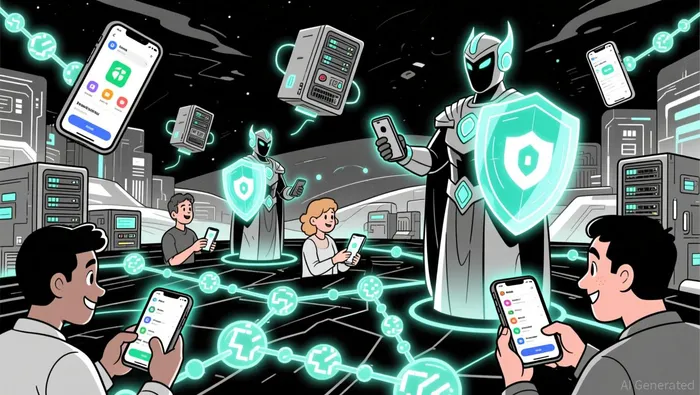
SKR is not just a governance token; it is the economic backbone of Solana Mobile's decentralized infrastructure. Holders can delegate their tokens to Guardians-nodes responsible for verifying devices, curating the decentralized app store, and securing the network according to CoinGecko. This mechanism ensures that governance is distributed among users, developers, and hardware partners, creating a self-sustaining ecosystem where incentives are aligned.
The token's utility extends beyond governance. For instance, SKR holders earn rewards for staking, gain access to premium features in the Seeker app, and participate in decision-making processes that shape the platform's evolution as detailed on Solana Mobile's site. This dual functionality-governance and utility-positions SKR as a critical asset for both passive income generation and active community participation.
Tokenomics Designed for Long-Term Adoption
Solana Mobile's tokenomics are engineered to balance early adoption incentives with long-term sustainability. The total supply of 10 billion SKR tokens includes a 30% airdrop allocation for community members and developers at launch, with two-thirds of this airdrop reserved for Seeker phone users as confirmed by CoinDesk. This approach not only rewards early adopters but also ensures broad distribution, reducing the risk of centralization.
The inflation model is equally strategic. Starting at 10% in the first year, inflation decreases linearly to 2% over six years according to CoinGecko. This tapering model rewards early participants while avoiding perpetual dilution, a common pitfall in token economies. Additionally, 25% of the supply is allocated to growth and partnerships, ensuring the ecosystem can scale without relying on external capital as reported by PR Newswire.
Competitive Advantages: Solana's Infrastructure and Ecosystem Momentum
SKR's value proposition is amplified by Solana's technical and economic advantages. The Solana blockchain, known for its high throughput (over 162 million daily transactions in early 2025) and low fees, provides a robust foundation for SKR's utility according to Helius. The upcoming Alpenglow consensus upgrade further strengthens this by enhancing security and scalability as reported by MEXC.
Compared to other decentralized mobile infrastructure projects like MOB and WRLD, SKR's larger initial supply and aggressive community allocation (30% vs. 15–25% in competing projects) give it a distinct edge in user acquisition and network security according to MEXC analysis. Moreover, Solana's Real Economic Value (REV) of over $550 million in January 2025 underscores its ability to sustain high-utility applications, a critical factor for SKR's long-term viability as noted by Ambcrypto.
Risks and Mitigations: A Realistic Assessment
No investment is without risk. SKR's success hinges on sustained user engagement post-launch, particularly after the initial campaign-driven incentives (like the Seeker Season, which saw 100,000+ users and $2.6 billion in volume) fade according to MEXC. Additionally, the token's price volatility-common to most crypto assets-could deter risk-averse investors.
However, Solana Mobile's strategy mitigates these risks. The airdrop model ensures a broad base of token holders, while the Guardian system decentralizes trust and reduces reliance on centralized entities. Furthermore, the Seeker smartphone's hardware integration with blockchain (e.g., secure custody and signing) addresses pain points like key management, enhancing the token's real-world utility as explained by Atomic Wallet.
Strategic Entry Point for Investors
For investors, SKR offers a unique opportunity to capitalize on the convergence of mobile technology and blockchain. Its airdrop strategy democratizes access, while its governance and utility functions create intrinsic value. The token's alignment with Solana's broader ecosystem-already a leader in on-chain transactions-further strengthens its case as a long-term play.
Critically, SKR's launch on January 21, 2026, marks a pivotal moment. Early adopters who stake their tokens will benefit from inflation rewards and governance rights, while the token's decreasing inflation rate ensures that its value proposition remains attractive over time according to Solana Floor.
Conclusion
Solana Mobile's SKR token is more than a speculative asset-it's a foundational element of a decentralized mobile infrastructure that bridges hardware, software, and community. With its dual utility, inflation-tapering model, and alignment with Solana's technical strengths, SKR is well-positioned to become a cornerstone of the Web3 mobile revolution. For investors seeking exposure to this next phase of decentralization, SKR offers a compelling, high-utility entry point.






Comentarios
Aún no hay comentarios