
Solana Mobile's SKR Token: A Catalyst for Web3 Mobile Disruption Through Governance, Security, and Developer Incentives
The rise of Web3 has long been constrained by the dominance of centralized platforms, particularly in mobile technology. SolanaSOL-- Mobile's SKR token, however, represents a bold attempt to redefine this landscape. By embedding blockchain into hardware-specifically the Solana Seeker phone-SKR aims to create a decentralized mobile ecosystem where users, developers, and hardware manufacturers are economically aligned. This analysis evaluates SKR's potential to disrupt the Web3 mobile ecosystem by dissecting its role in governance, security, and developer incentives, drawing on recent developments and tokenomics.
Decentralized Governance: Aligning Stakeholders Through Tokenized Ownership
SKR is not just a utility token; it is the cornerstone of Solana Mobile's governance model. According to the company's documentation, SKR holders are granted voting rights to shape the future of the ecosystem, from protocol upgrades to feature prioritization. This design contrasts sharply with traditional mobile ecosystems, where decisions are centralized and opaque.
The token's non-transferable, soul-bound nature further reinforces this alignment. Each SKR token is tied to a Solana Seeker device, ensuring that governance power is distributed to active participants rather than speculative investors. This mechanism prevents token concentration and incentivizes long-term commitment to the ecosystem. For instance, users who engage with onchain transactions via the Seeker earn SKR rewards, creating a feedback loop where utility and governance rights are directly tied to real-world usage.
Security: Incentivizing Network Integrity
SKR's tokenomics are structured to reinforce the principle of economic incentives in securing blockchain ecosystems. By rewarding users for onchain activity-such as validating transactions or participating in decentralized apps (dApps)-SKR creates a self-sustaining security model. The more users engage with the network, the more robust it becomes against attacks.
This approach is amplified by Solana Mobile's TEEPIN architecture, which integrates hardware-based security with blockchain protocols. As stated in a recent press release, TEEPIN ensures that sensitive operations, like cryptographic key management, are isolated from potential software vulnerabilities. SKR's role here is twofold: it incentivizes users to adopt the Seeker phone (thereby expanding the secure network) and rewards developers for building apps that leverage TEEPIN's capabilities.
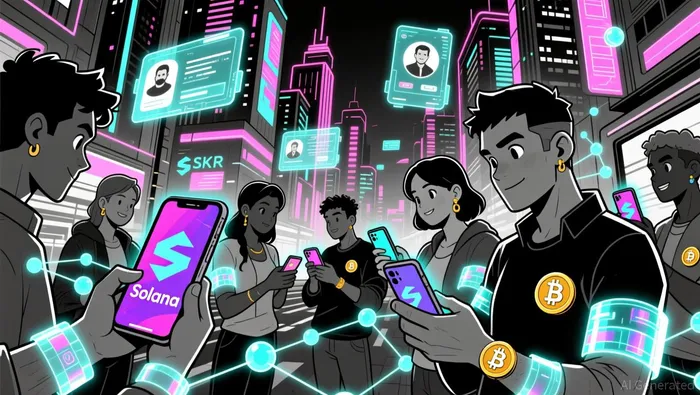
Developer Incentives: Building a Decentralized App Ecosystem
One of the most compelling aspects of SKR is its focus on developers. Traditional app stores extract significant value from creators, often limiting their ability to innovate. Solana Mobile's model compensates developers directly with SKR for platform usage and app distribution. This eliminates reliance on centralized gatekeepers and aligns developer success with the broader health of the ecosystem.
For example, developers can earn SKR by integrating their dApps with the Seeker's onchain features or by driving user engagement. This creates a virtuous cycle: more developers mean more apps, which in turn attract more users and increase SKR's utility. According to a guide on maximizing SKR allocations, early adopters and developers can optimize their rewards by leveraging the token's exclusive access to features and governance proposals.
The Bigger Picture: A Self-Sustaining Ecosystem
The SKR token's design reflects a broader vision: a mobile ecosystem where value is distributed equitably. By tying governance, security, and developer incentives to a single token, Solana Mobile reduces friction between stakeholders. Users are rewarded for participation, developers are incentivized to build, and hardware manufacturers benefit from a growing user base. This alignment is critical for scaling Web3 adoption in a space dominated by legacy systems.
However, challenges remain. The success of SKR hinges on the Seeker's market penetration and the ability to attract developers. If the phone fails to gain traction, the token's utility could be limited. Conversely, if the ecosystem thrives, SKR could become a blueprint for future Web3 hardware projects.
Conclusion
Solana Mobile's SKR token is more than a speculative asset-it is a strategic tool for decentralizing mobile technology. Its governance model ensures stakeholder alignment, its security incentives strengthen the network, and its developer rewards foster innovation. While risks exist, the token's unique design and integration with hardware position it as a potential disruptor in the Web3 mobile space. For investors, SKR represents an opportunity to bet on a future where mobile ecosystems are as decentralized as the internet itself.







Comentarios
Aún no hay comentarios