
Solana's Recent Market Performance: On-Chain Activity and Institutional Adoption as Key Growth Drivers
On-Chain Activity: A Network at Full Throttle
Solana's on-chain metrics from Q4 2024 to Q1 2025 underscore its role as a high-performance blockchain. In Q1 2025 alone, the network averaged 5.2 million daily active addresses and processed 953 million daily transactions, with median gas fees hovering around $0.00025 per transaction according to the Helius report. This efficiency is a direct result of technical upgrades like the Firedancer validator client and Alpenglow consensus protocol, which have slashed finality times and boosted throughput to 4,700 transactions per second according to Bitget analysis.
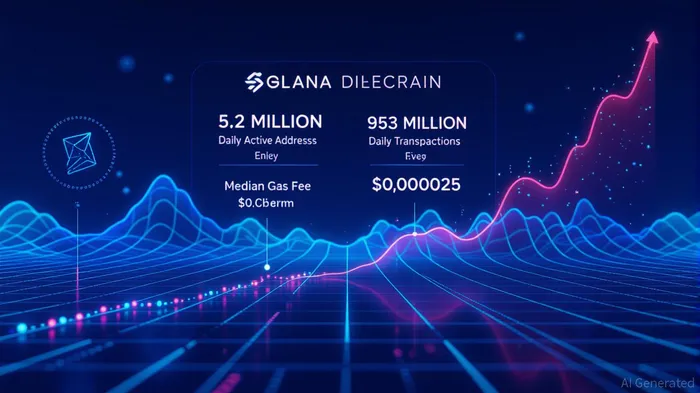 The network's resilience during high-demand events, such as the TRUMP-mania token frenzy in January 2025, further highlights its reliability. Despite surging activity, SolanaSOL-- maintained sub-penny fees (median fees as low as $0.003178 USD) and processed over 162 million transactions daily according to Phemex data. These metrics not only validate Solana's scalability but also reinforce its appeal for on-chain trading, decentralized finance (DeFi), and memeMEME-- coin ecosystems. For instance, decentralized exchange (DEX) trading volumes on Solana have surpassed EthereumETH-- in certain periods, driven by its cost-effectiveness and speed according to Binance data.
Institutional Adoption: From Speculation to Utility
While on-chain activity demonstrates Solana's technical prowess, institutional adoption is cementing its role as a foundational layer for global finance. Strategic partnerships with Visa, Stripe, PayPal, Apollo, and BlackRock have expanded Solana's utility beyond speculative trading, enabling asset issuance, stablecoin payments, and real-world asset (RWA) tokenization according to ScalingX analysis. These collaborations signal a shift from blockchain as a speculative tool to a production-grade infrastructure for capital markets.
Institutional confidence is also reflected in corporate SOLSOL-- holdings. For example, DeFi Development Corp., a Nasdaq-listed firm, holds 1.18 million SOL and earns 7–8% annual staking yields, while Upexi Inc. maintains a $320 million stake in 2 million SOL according to Phemex data. Such holdings are not merely speculative but leverage Solana's DeFi infrastructure to optimize liquidity and yield generation. Additionally, the approval of SEC-registered Solana ETFs, including the Bitwise Solana Staking ETF (BSOL) and Grayscale Solana Trust (GSOL), has opened regulated investment avenues, attracting capital from institutional investors seeking exposure to staking yields according to Helius reports.
Stablecoins and Regulatory Tailwinds
Solana's stablecoin ecosystem has also seen explosive growth, with supply expanding from $5.2 billion in late 2024 to $16 billion in 2025 according to ScalingX analysis. This growth is supported by regulatory developments like the GENIUS Act in the U.S. and integrations such as Western Union's USD Payment Token (USDPT), which leverages Solana's low-cost infrastructure for cross-border payments according to Helius reports. These developments align with Solana's broader vision of bridging blockchain and traditional finance, offering enterprises a scalable, cost-efficient alternative to legacy systems.
Investment Implications
The interplay between on-chain activity and institutional adoption creates a self-reinforcing cycle for Solana. High transaction throughput and low fees attract developers and users, while institutional partnerships and regulatory clarity draw capital. This dynamic is evident in Solana's revenue growth: the network generated $2.85 billion in annual revenue across DeFi, trading tools, and AI applications in 2024–2025 according to 21Shares research, with monthly revenue consistently ranging between $150 million and $250 million according to Phemex data.
For investors, Solana's trajectory suggests a transition from a speculative asset to a foundational infrastructure play. The approval of ETFs, combined with technical upgrades and enterprise integrations, positions Solana to capture a significant share of the global financial infrastructure market. Analysts project a potential price range of $450–$1,000 for SOL by 2030, driven by sustained institutional inflows and expanding use cases according to Helius reports.
Conclusion
Solana's recent market performance is a testament to its ability to balance technical innovation with real-world utility. The network's on-chain metrics demonstrate its capacity to handle high-volume, low-cost transactions, while institutional partnerships and regulatory advancements validate its role in mainstream finance. As the lines between blockchain and traditional financial systems blurBLUR--, Solana stands at the intersection of scalability and adoption-a position that could drive long-term value for investors.







Comentarios
Aún no hay comentarios