
Solana's Liquidity Reset: A Strategic Buying Opportunity Amid Volatility and Derivative Divergence
The SolanaSOL-- (SOL) market in late 2025 is undergoing a liquidity reset that has exposed deep fissures in its capital structure while simultaneously creating asymmetric opportunities for disciplined investors. As on-chain metrics reveal a bear-market contraction in liquidity and derivative markets teeter on the brink of cascading liquidations, institutional capital is flowing into Solana spot ETFs at a steady clip, creating a divergence that demands closer scrutiny. This divergence-between short-term volatility and long-term positioning-reflects a broader re-equilibration of risk and capital, one that could signal a strategic entry point for value-oriented investors willing to navigate the turbulence.
On-Chain Dynamics: A Bear-Market Reset
By mid-November 2025, Solana's liquidity had contracted to levels last seen during prior bear markets, with realized losses outpacing profits across the network. This contraction is exacerbated by declining futures open interest and fragmented trading pools, which historically precede market bottoms. The most immediate risk lies in leveraged long positions: approximately $500 million in exposure is at risk if the price dips modestly from its current level of around $129. Such a move would trigger a wave of liquidations, further compressing liquidity and amplifying volatility.
Yet, this fragility is counterbalanced by structural resilience. Solana's on-chain spot volume surged to $1.6 trillion in 2025, outpacing combined volumes on major exchanges like Coinbase, Bybit, and Bitget. This underscores Solana's role as a critical liquidity layer, bolstered by innovations like PropAMMs and CLOBs that enable institutions to deploy capital with greater efficiency. Meanwhile, persistent outflows from exchanges have reduced sell-side supply, while spot ETFs have attracted $17.72 million in net inflows in a single week. These metrics suggest that while the market is under pressure, deeper demand remains intact.
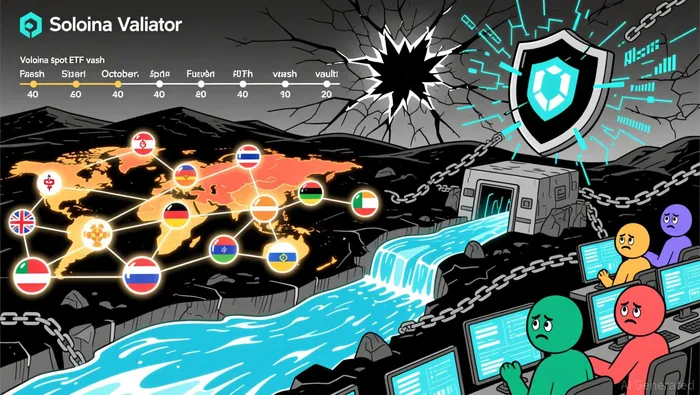
Institutional Strategies: Accumulation Amid Chaos
Institutional investors are adopting a dual approach to navigate this environment: aggressive value accumulation and risk-managed positioning. Firms like SolSOL-- Strategies have emphasized multi-strategy frameworks that align with Solana's ecosystem growth, leveraging both CeFi and DeFi markets to balance risk and return. This includes deploying capital into high-conviction on-chain infrastructure while hedging against short-term volatility through derivatives and stablecoin arbitrage.
A key tactic is the use of automated risk mitigation systems. These tools apply rule-based filters to vet protocols by audit history, cap exposure to individual liquidity pools, and dynamically adjust allocations based on market conditions. For instance, a typical strategy might allocate 60% to established pools like Raydium's core pool, 30% to Orca's stable-swap variant, and 10% to vetted aggregators or lending protocols. This diversification not only preserves capital but also capitalizes on Solana's speed and cost-efficiency, which remain attractive even in a bear market.
Derivative Divergence: A Tale of Two Markets
The most striking feature of Solana's current landscape is the divergence between spot and derivative markets. While institutional inflows into spot ETFs provide structural support, derivatives markets are experiencing deleveraging, with perpetual futures volumes declining even as open interest rises. This suggests a shift in risk-taking behavior: retail traders are exiting leveraged positions, while institutions are methodically accumulating at discounted levels.
This divergence mirrors trends in EthereumETH-- (ETH) derivatives, where measured exposure buildup has replaced speculative frenzies. For Solana, the implications are clear: the market is transitioning from a leveraged, beta-driven phase to one defined by patient capital. This creates a unique opportunity for investors who can tolerate short-term volatility in exchange for long-term value capture.
Risk Mitigation: Lessons from the FTX Aftermath
Solana's resilience post-FTX offers further confidence. The network's validator count expanded to over 5,000 nodes across 40 countries, enhancing decentralization and trust. However, recent challenges-such as a 68% decline in active validator nodes and cryptographic flaws in ZK ElGamal Proof-highlight ongoing vulnerabilities. To address these, exchanges are implementing circuit breakers, insurance funds, and AI-driven risk management systems to prevent cascading liquidations. For example, the October 10, 2025 flash crash, triggered by a stablecoin depeg on Binance, underscored the need for cross-market safeguards.
Conclusion: A Strategic Inflection Point
Solana's liquidity reset is a double-edged sword. On one hand, it exposes the fragility of leveraged positions and fragmented liquidity. On the other, it creates a fertile ground for value accumulation by institutions with the patience and capital to navigate the volatility. The key lies in balancing aggressive buying with disciplined risk management-leveraging Solana's infrastructure strengths while hedging against its inherent weaknesses.
For investors, the message is clear: this is not a market for panic, but for precision. As liquidity depth rebuilds in early 2026, those who position themselves with a mix of spot exposure, diversified derivatives, and automated safeguards will be best placed to capitalize on the next phase of Solana's cycle.






Comentarios
Aún no hay comentarios