
Solana Launchpad Dynamics and $PUMP's Liquidity Risks: Evaluating Short-Term Volatility and Long-Term Value Potential in Meme Coins
The SolanaSOL-- blockchain has emerged as a fertile ground for memeMEME-- coin innovation, driven by platforms like Pump.fun, which democratize token creation and liquidity provision. However, the rapid growth of this ecosystem has introduced unique risks and opportunities. This article examines the mechanics of Solana launchpads, the role of Pump.fun's bonding curve model, and the liquidity risks inherent in $PUMP, while evaluating whether these projects can balance short-term volatility with long-term value retention.
The Rise of Solana Meme Coin Launchpads
Solana's high throughput and low fees have made it a preferred chain for meme coin creation, with platforms like Pump.fun, Bags.fm, and Smithii dominating the space. Pump.fun, in particular, has streamlined token creation to under five minutes, enabling non-technical users to mint tokens with no upfront costs. By 2025, Pump.fun had facilitated the creation of over 11.49 million tokens, with an average of 36,000 new tokens minted daily, according to a 2025 competitive analysis. This volume, however, masks a harsh reality: that analysis found less than 1.5% of these tokens survive long enough to migrate to RaydiumRAY--, and fewer than 0.2% endure past 24 hours.
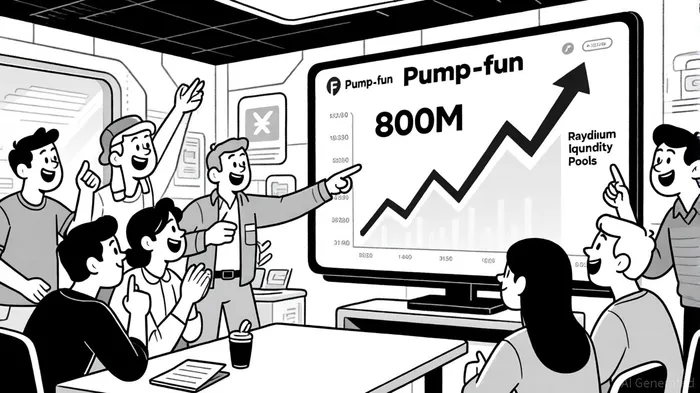
The platform's bonding curve model-a mathematical framework that dictates token pricing based on supply and demand-has been central to its success. When a token is launched, 800 million units are allocated to the bonding curve, with prices rising exponentially as tokens are sold. This creates a self-reinforcing cycle where early buyers benefit from low entry prices, while later participants face escalating costs, as described in the Pump.fun math. Once the bonding curve is exhausted, liquidity is automatically migrated to PumpSwap and eventually Raydium, ensuring broader market exposure, the competitive analysis notes.
Liquidity Risks in $PUMP and the Bonding Curve Model
While Pump.fun's model reduces rug-pull risks by automating liquidity provision, it introduces new challenges. The bonding curve relies on virtualCYBER-- and real reserves to maintain price stability, but this system is vulnerable to impermanent loss-a phenomenon where liquidity providers (LPs) lose value due to price divergence between assets in a pool. For example, if a token's price on Raydium diverges significantly from its bonding curve price, LPs may face losses when withdrawing liquidity, the dCentralab write-up explains.
Pump.fun mitigates this risk by transitioning tokens to Raydium only after market cap thresholds are met, but this does not eliminate impermanent loss entirely. Data from WalletFinder.ai suggests that liquidity pool metrics, such as Total Value Locked (TVL) and fee generation, are critical for assessing risk. However, the high volatility of meme coins means that even well-managed pools can experience sharp price swings, compounding impermanent loss.
Security and legal risks further complicate the picture. In May 2024, a former Pump.fun employee exploited a vulnerability to siphon $1.9 million in assets, according to a Cointelegraph report. Additionally, U.S. civil actions have alleged that Pump.fun facilitated the sale of unregistered securities under the RICO Act, which the same report details. These incidents underscore the fragility of a system built on speculative demand and algorithmic pricing.
Short-Term Volatility vs. Long-Term Value Potential
The Solana meme coin market is inherently cyclical, with most tokens fading after initial hype. For instance, $USELESS-a token launched on Pump.fun-peaked at a $204 million market cap but has since lost 90% of its value, the competitive analysis found. This pattern reflects the speculative nature of the ecosystem, where social media virality often drives short-term gains but lacks sustainable utility.
However, a small subset of tokens may achieve long-term value. Platforms like Raydium provide a path for tokens to gain broader adoption, and community-driven initiatives (e.g., Smithii's revenue-sharing tools) aim to foster engagement, as noted by the competitive analysis. The key differentiator is whether a token can transition from a speculative asset to a utility-driven one. For example, tokens integrated into decentralized applications (dApps) or governance systems may retain value beyond their launchpad phase, as suggested by a pump characteristic study.
Strategic Considerations for Investors
Investors must weigh the high-risk, high-reward nature of Solana meme coins. Short-term traders can capitalize on the bonding curve's exponential pricing, but they must monitor liquidity pool dynamics and impermanent loss risks. Long-term investors, meanwhile, should prioritize tokens with clear utility, active communities, and integration into broader DeFi ecosystems.
For $PUMP itself, the token's value is tied to Pump.fun's dominance in the launchpad market. While the platform currently holds 75%-80% of Solana's memecoinMEME-- activity, that Cointelegraph report warns competition from rivals like BONK-linked platforms is intensifying. This suggests that $PUMP's long-term value depends on its ability to adapt to shifting market demands and regulatory scrutiny.
Conclusion
Solana's meme coin launchpads have redefined accessibility in DeFi, but they come with significant liquidity and security risks. Pump.fun's bonding curve model offers structured price discovery and reduced rug-pull risks, yet it cannot insulate tokens from the inherent volatility of the space. Investors must approach this market with caution, balancing short-term opportunities with long-term fundamentals. As the ecosystem matures, sustainability will likely depend on innovation in utility, governance, and risk mitigation-factors that will determine whether Solana's meme coins evolve from fads to foundational assets.






Comentarios
Aún no hay comentarios