
Solana and the Institutionalization of Crypto: A 2026 Investment Play
The institutionalization of crypto is no longer a distant promise-it is a present-day reality. As traditional finance (TradFi) and blockchain ecosystems converge, SolanaSOL-- (SOL) has emerged as a pivotal infrastructure layerLAYER--, uniquely positioned to catalyze this transformation. By 2026, the compounding effects of Solana's technical upgrades, surging stablecoin and real-world asset (RWA) activity, and institutional-grade custody solutions will solidify its role as the backbone of a new financial paradigm. For investors, this represents a rare opportunity to align with a blockchain network that is not just adapting to institutional demands but actively redefining them.
Technical Upgrades: The Bedrock of Enterprise-Ready Infrastructure
Solana's 2024–2025 technical roadmap has laid the groundwork for a blockchain capable of rivaling traditional financial systems in speed, reliability, and scalability. The Firedancer validator client, developed by Jump Crypto, is a cornerstone of this evolution. By reducing network outages and enabling up to 1 million transactions per second (TPS) in testing, Firedancer addresses one of Solana's historical pain points-infrastructure fragility-while preparing the network for enterprise-grade workloads. The hybrid Frankendancer implementation, which merges Firedancer with the existing Agave client, ensures a seamless transition without disrupting the network's operational continuity.
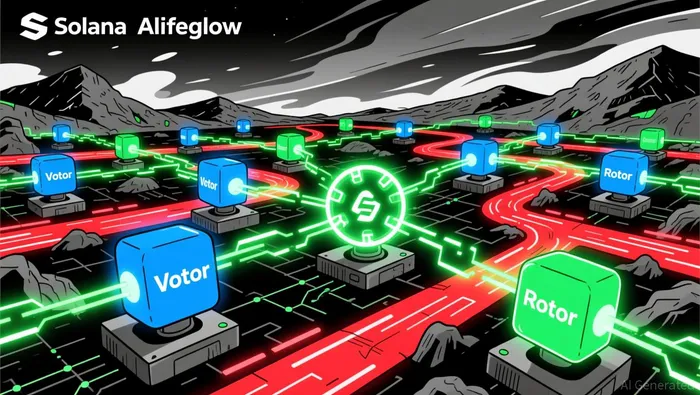
Complementing these upgrades is the Alpenglow consensus protocol, which slashes transaction finality to sub-150ms. This is achieved through Votor, a lightweight voting mechanism that minimizes validator coordination overhead, and Rotor, a data distribution protocol that optimizes node communication. Together, these innovations create a 20+20 fault tolerance model, allowing the network to function even if 20% of validators are malicious or offline. For institutions, this means a level of resilience previously unattainable in blockchain systems, making Solana a viable alternative to legacy financial infrastructure.
Further, Solana's SIMD-0256 proposal aims to expand block capacity and compute units by 2025, enabling the network to process 60 million compute units per block-a 25% throughput boost. These enhancements are not incremental but foundational, positioning Solana to handle high-frequency trading, tokenized securities, and real-time settlement at scale.
Stablecoin and RWA Activity: Bridging Crypto and TradFi
Solana's institutional appeal is amplified by its role as a bridge between crypto and TradFi, particularly through stablecoin adoption and RWA tokenization. The network's low fees and high throughput have made it a preferred platform for stablecoin issuers, with total stablecoin volume surging in 2024–2025. This growth is critical for institutions seeking to hedge volatility while leveraging blockchain's programmability.
The RWA sector has seen even more explosive growth. By mid-2025, Solana's RWA total value locked (TVL) reached $2.4 billion, a 200% year-over-year increase. Projects like Maple Finance (tokenized private credit) and Ondo Finance (tokenized U.S. treasuries) have demonstrated Solana's ability to tokenize illiquid assets into liquid, tradable tokens. Kraken's xStocks platform, which tokenizes equities on Solana, further underscores the network's versatility in integrating traditional assets into a blockchain-native framework. These developments are not speculative-they represent a tangible shift in how institutions perceive and utilize blockchain infrastructure.
Institutional Adoption Catalysts: ETFs, Custody, and Policy
The final piece of Solana's institutional puzzle is its rapidly maturing custody and investment infrastructure. The launch of the Bitwise Spot Solana ETF with staking rewards (BSOL) in 2025 marked a watershed moment, enabling traditional investors to access Solana through familiar brokerage platforms. This product alone attracted over $2 billion in inflows, signaling strong institutional confidence.
Custody solutions have also evolved to meet institutional demands. By 2025, 11 specialized custody platforms-ranging from BitGo and Dfns to Anchorage Digital-offer multi-party computation (MPC) wallets, secure APIs, and SaaS products tailored for Solana. These solutions are critical for institutions managing large-scale digital assets, as they mitigate risks associated with key management and regulatory compliance.
Policy alignment further accelerates adoption. The Solana Policy Institute, launched in 2025, has actively engaged regulators to shape a framework that supports blockchain innovation without compromising financial stability. This proactive approach ensures that Solana's growth remains aligned with institutional expectations, reducing friction in onboarding.
Why Solana Is the 2026 Investment Play
For investors, Solana's trajectory is clear: it is not merely a blockchain but a financial infrastructure layer designed to meet the demands of a post-speculative crypto era. Its technical upgrades address scalability and reliability, its RWA and stablecoin ecosystems bridge crypto and TradFi, and its custody and ETF infrastructure provide institutional on-ramps.
By 2026, these factors will compound into a self-reinforcing cycle. Institutions seeking to tokenize assets, execute high-frequency trades, or hedge risk will gravitate toward Solana's infrastructure. Meanwhile, the network's growing TVL and transaction volume will drive demand for SOLSOL--, both as a utility token and a staking asset.
In a market increasingly dominated by institutional capital, Solana's ability to deliver internet-speed financial infrastructure-combined with its strategic alignment with regulatory and technological trends-makes it the most compelling investment thesis for 2026.







Comentarios
Aún no hay comentarios