
Solana's Institutional Resilience Amid Price Volatility: Why Institutional Confidence Outpaces Short-Term Market Fears
The cryptocurrency market has long been a theater of extremes-where price swings often overshadow fundamentals. Yet, in 2025, SolanaSOL-- (SOL) has emerged as a striking counterpoint to this narrative. Despite a 150% price drop in November 2025 and a security breach affecting Upbit's Solana wallet according to CoinLaw, institutional confidence in the network has not only persisted but accelerated. This resilience raises a critical question: Why do institutional investors continue to pour capital into Solana, even as retail sentiment wavers? The answer lies in a confluence of structural advantages, strategic partnerships, and macroeconomic tailwinds that outpace short-term volatility.
A $500M Bet on Solana's Future
Institutional confidence in Solana reached a pivotal inflection point in Q3 2025, when the Solana Company secured a $500 million partnership with Pantera Capital and Summer Capital to fund a digital asset treasury strategy focused on Solana tokens. This partnership was part of a broader $508 million private investment in public equity (PIPE) transaction, with additional cash-exercise warrants potentially raising $750 million more according to QuiverQuant. Such commitments signal a vote of confidence in Solana's ability to serve as a foundational layer for institutional-grade financial infrastructure.
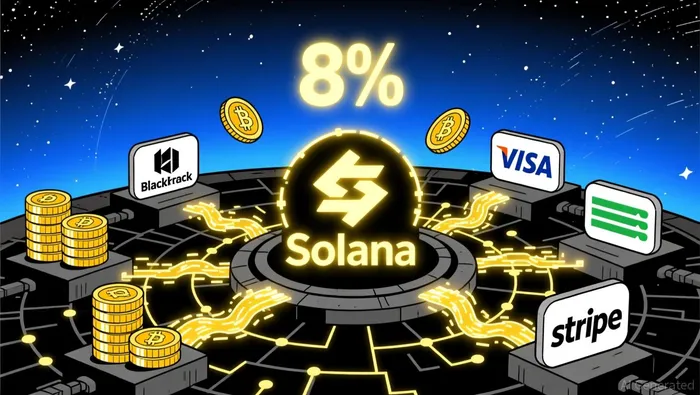
Meanwhile, 19 publicly traded firms accumulated 15.4 million SOL tokens, valued at $3 billion, and allocated $4.3 billion to structured investments leveraging Solana's 8% staking yields. These figures underscore a shift from speculative trading to strategic capital allocation. Even as the price of SOLSOL-- plummeted, the network's staking rewards and DeFi protocols provided a stable return mechanism, making it an attractive alternative to traditional banking.
ETFs Defying the Downturn
Solana's institutional appeal is further evidenced by its ETF performance. In 2025, Bitwise's Solana Staking ETF (BSOL) defied a broader market decline, recording 19 consecutive days of inflows totaling $476 million. This streak, which outpaced BitcoinBTC-- and EthereumETH-- ETFs during the same period, highlights Solana's unique value proposition: a low-fee (0.20% annual) structure combined with 100% staking of holdings according to Yahoo Finance.
Even after a historic $8.1 million outflow on November 26, 2025-ending a 21-day inflow streak-the broader trend remains intact. Total assets in Solana ETFs remain near $1 billion, with the 21Shares Solana ETF (TSOL) and Grayscale Solana Trust (GSOL) continuing to attract capital according to CoinMarketCap. Notably, the outflow coincided with a rotation of institutional capital toward Ethereum and XRPXRP-- products, suggesting tactical rebalancing rather than a fundamental shift in sentiment according to Intellectia.
From Web3 to Financial Infrastructure
Solana's institutional resilience is not accidental. The network has systematically repositioned itself as a financial infrastructure layer, moving beyond its early identity as a blockchain for Web3. By 2025, Solana processed 70 million daily transactions and recorded $146 billion in monthly decentralized exchange volume. Partnerships with Visa, Stripe, and BlackRock have further cemented its role in mainstream finance, while its stablecoin ecosystem-boasting $16 billion in supply-has provided a critical on-ramp for institutional capital according to ScalingX.
This transition is reflected in the growing adoption of Solana's staking economy. Public companies now hold 15.4 million SOL in treasuries, leveraging staking yields to generate returns without relying on traditional banking channels according to ScalingX. Such strategies are particularly appealing in a macroeconomic environment where liquidity is scarce and interest rates are in flux.
Macroeconomic Tailwinds and Institutional Calculus
The Federal Reserve's 2025 rate cuts and the cessation of quantitative tightening have injected liquidity into financial markets, indirectly benefiting Solana. Institutional investors, who often operate on multi-year time horizons, are less swayed by short-term price swings and more focused on long-term yield generation. Solana's 8% staking rewards, combined with its growing institutional ecosystem, offer a compelling alternative to low-yield government bonds and volatile equities.
Moreover, Solana's institutional partnerships-such as the $211 million raised by 23 projects in Q3 2025 according to Phemex-reflect a broader trend of capital seeking innovation. These projects, spanning decentralized finance (DeFi), stablecoins, and cross-chain bridges, are building infrastructure that aligns with institutional use cases. Even as the price of SOL fluctuates, the underlying network effects continue to strengthen.
Conclusion: Confidence as a Strategic Asset
Solana's institutional resilience is a testament to the power of long-term thinking. While retail investors may flee during price drops, institutions are betting on Solana's ability to evolve into a critical component of global finance. The network's strategic partnerships, staking yields, and macroeconomic tailwinds create a flywheel effect that outpaces short-term volatility.
For investors, the lesson is clear: Institutional confidence is not a reaction to price-it is a driver of it. As Solana continues to solidify its position as a financial infrastructure layer, the market may yet rediscover the value of patience.







Comentarios
Aún no hay comentarios