
Solana's Institutional Moment: Decoding ETF Timelines and Capital Inflows
The SolanaSOL-- (SOL) ecosystem is at a pivotal inflection point, driven by a confluence of institutional capital flows and regulatory developments. As the U.S. Securities and Exchange Commission (SEC) edges closer to a decision on spot Solana ETFs, market participants are recalibrating their strategies around a potential $3–6 billion influx of institutional capital[1]. This analysis dissects the interplay between institutional behavior, regulatory timelines, and market timing signals to assess Solana's trajectory in 2025.
Institutional Behavior: A Mirror of Bitcoin's Pre-ETF Dynamics
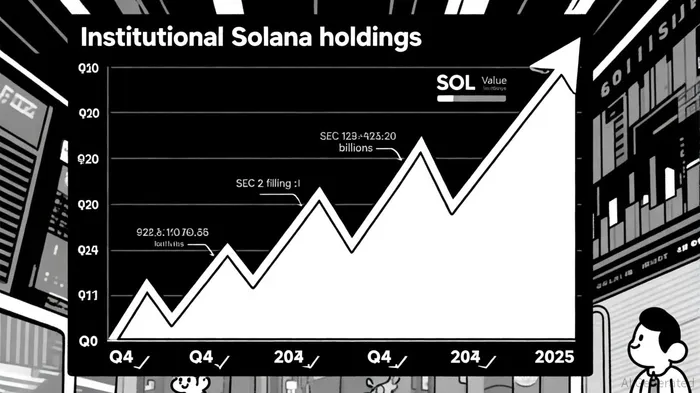
Institutional accumulation of Solana has mirrored the patterns observed ahead of BitcoinBTC-- and EthereumETH-- ETF approvals. By Q4 2025, firms like Forward IndustriesFORD-- (NASDAQ: FORD), Galaxy DigitalGLXY--, and Pantera Capital collectively held nearly 9 million SOLSOL--, valued at $2 billion[3]. Forward Industries alone staked 6.8 million SOL ($1.58 billion), while Galaxy and Pantera committed $1.5 billion and $1.1 billion, respectively[5]. These moves reflect a strategic bet on Solana's infrastructure and its potential to benefit from ETF-driven liquidity.
The rationale for such accumulation is twofold. First, staking yields (averaging 4–6% annually) provide a revenue stream for institutional treasuries[2]. Second, holding large SOL balances positions these firms to influence governance and infrastructure development, reinforcing Solana's appeal as a high-performance blockchain. This dynamic is reminiscent of Bitcoin's 2023 ETF frenzy, where institutional "stacking" preceded regulatory greenlights.
SEC Timelines: Delays as a Feature, Not a Bug
The SEC's October 16, 2025, deadline for Solana ETF decisions[4] has become a focal point for market timing. While delays have historically frustrated crypto advocates-Bitcoin ETFs faced similar hurdles in 2023-analysts argue these pauses are part of a broader regulatory strategy. Bloomberg Intelligence assigns a 95% probability of approval by October, citing the SEC's "Project Crypto" initiative, which aims to modernize digital asset frameworks[5].
The regulatory calculus hinges on three factors:
1. Market Integrity: The SEC is scrutinizing custody models and trading volumes to ensure ETFs won't destabilize Solana's price.
2. Legal Classification: SOL's status as a commodity (favoring ETF approval) versus a security remains unresolved[1].
3. Competitive Pressure: With Ethereum ETFs already approved, the SEC may prioritize Solana to avoid stifling innovation in the altcoin space[3].
Market Timing: Inflows, Volatility, and the "ETF Premium"
Timing the Solana ETF rollout requires parsing institutional inflows and technical indicators. Futures trading volume on Solana surged 252% to $8.1 billion in Q3 2025[5], signaling infrastructure readiness for ETFs. Meanwhile, ETF applications from VanEck, Fidelity, and Bitwise-featuring innovations like staking yield integration-have advanced the regulatory timeline[2].
A critical metric is the "ETF premium," where assets under management (AUM) in pending Solana ETFs could reach $3–6 billion post-approval[1]. Historical data from Bitcoin ETFs suggests a 20–30% price surge post-approval, driven by inflows and reduced volatility. If Solana follows this pattern, $750–$900 price targets by Q1 2026 are plausible[3].
Strategic Implications for Investors
For retail and institutional investors, the Solana ETF timeline offers a dual opportunity:
1. Pre-Approval Positioning: Accumulating SOL ahead of ETF approval could yield outsized returns, assuming regulatory clarity.
2. Post-Approval Arbitrage: ETFs may trade at a premium to spot prices, creating opportunities for liquidity providers[2].
However, risks persist. The SEC's final decision remains binary, and a rejection could trigger short-term volatility. Additionally, competition from Ethereum's existing ETFs may cap Solana's market share unless its unique value proposition (e.g., high throughput, low fees) is clearly differentiated[5].
Conclusion: A New Era for Altcoin Institutionalization
Solana's journey mirrors the broader crypto market's evolution-from niche speculation to institutional-grade asset. With $2 billion in institutional holdings and a regulatory timeline crystallizing in October 2025, the stage is set for a transformative event. Investors who align their strategies with institutional behavior and regulatory signals may find themselves at the forefront of a new era in digital asset adoption.





Comentarios
Aún no hay comentarios