
Solana's Institutional Bull Case: Why $200 Is the New Conviction Level by 2025
The crypto market's next major inflection point may hinge on SolanaSOL-- (SOL). As institutional adoption accelerates and technical upgrades redefine blockchain performance, the $200 price target for Solana is no longer speculative-it's a conviction level backed by tangible catalysts. This analysis unpacks why Solana is uniquely positioned to deliver exponential returns in 2025, driven by institutional-grade infrastructure and a reimagined consensus architecture.
Technical Catalysts: Alpenglow, Firedancer, and the Path to Enterprise-Grade Performance
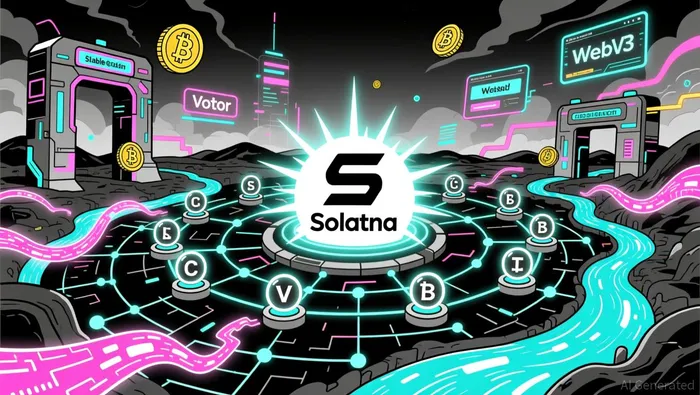
Solana's 2025 roadmap is a masterclass in blockchain engineering. The Alpenglow consensus upgrade, set for late 2025 or early 2026, replaces Solana's Proof-of-History (PoH) and TowerBFT mechanisms with Votor and Rotor, enabling 100–150 ms block finality and deterministic consensus according to QuickNode. This leap from 12.8-second finality to near-instant settlement transforms Solana into a blockchain that rivals Web2 systems in speed and reliability according to QuickNode.
Complementing Alpenglow is Firedancer, a C++-based validator client developed by Jump Crypto. Early testnet benchmarks show 1 million TPS under synthetic loads, with validator hardware costs slashed by 50–80% according to Antier Solutions. This democratizes participation, diversifies the validator monoculture, and positions Solana as a cost-effective solution for enterprises. Meanwhile, ZK Compression v2 reduces state data storage by 70–1,000x, enabling scalable airdrops and NFT mints without network bloat according to Antier Solutions. Together, these upgrades create a flywheel: lower costs → higher throughput → broader adoption.
Institutional Adoption: From Tokenized Assets to Treasury Stacks
Institutional demand for Solana is no longer theoretical. Major financial players like BlackRock, Franklin Templeton, and Apollo are leveraging Solana for real-world asset (RWA) tokenization and money market funds according to QuickNode. PayPal, Shopify, and Visa have integrated Solana for stablecoin flows and cross-border payments, capitalizing on its $0.00025 per transaction fee according to QuickNode.
The REX-Osprey Solana + Staking ETF (SSK), launched in July 2025, provides institutional investors with exposure to both Solana's price and staking yields according to TickerOn. This product mirrors the success of BitcoinBTC-- and EthereumETH-- ETFs, with $2 billion in treasury purchases already accumulating according to FXStreet. Analysts like Bitwise CIO Matt Hougan argue that Solana's smaller market cap (vs. Bitcoin) could amplify the price impact of institutional inflows according to FXStreet.
Moreover, global banks are tokenizing stocks, bonds, and commodities on Solana, creating a bridge between traditional finance and blockchain infrastructure according to IB Times. This trend is accelerating: Bullish's partnership with the Solana Foundation to deploy Solana-native stablecoins underscores the network's role in tokenized finance according to TickerOn.
Network Performance: Revenue, Activity, and Developer Growth
Solana's network metrics tell a story of exponential growth. In Q2 2025, the network generated $271 million in revenue, outpacing Ethereum and Bitcoin according to TickerOn. By late 2025, monthly protocol revenue averaged $240 million, with peaks exceeding $600 million according to 247WallSt. This surge is driven by 1.2–1.5 million daily active addresses and 162 million daily transactions, supported by Solana's $0.00025 fee model according to QuickNode.
Developer activity is equally robust. Solana now has 17,708 active developers-second only to Ethereum according to 247WallSt. This talent pool is building decentralized exchanges, NFT marketplaces, and RWA platforms, further diversifying the ecosystem. With Alpenglow reducing validator costs and Firedancer enabling enterprise-grade scalability, Solana is becoming the default infrastructure for Web3 and Web2.5 applications according to Blockchain App Factory.
Price Projections: From $143 to $200+
As of December 2025, Solana trades at $143.22, with technical indicators showing short-term bearishness according to Changelly. However, the long-term outlook is bullish. Analysts project a $200 target if Solana breaks above the $146–$150 resistance level, with $240–$280 as end-of-2025 goals according to BraveNewCoin.
The catalysts are clear:
1. U.S. spot Solana ETF approval could replicate Bitcoin's 2024 surge according to FXStreet.
2. Institutional treasury allocations (e.g., BlackRock, Apollo) are creating a $2 billion+ on-chain demand according to FXStreet.
3. Alpenglow's Q4 2025 rollout will reduce finality times to 100–150 ms, attracting high-frequency trading and real-time financial apps according to QuickNode.
Even conservative models suggest $131 average pricing in 2025, with $1,000 by 2030 if adoption continues according to BraveNewCoin.
Conclusion: The $200 Thesis Is Here
Solana's 2025 bull case is built on technical superiority and institutional inevitability. Alpenglow and Firedancer have redefined blockchain performance, while partnerships with global banks and treasuries are cementing Solana's role in the future of finance. With $200 as a near-term conviction level and $1,000 as a long-term target, this is not just a crypto story-it's a redefinition of financial infrastructure.
For investors, the question isn't if Solana will reach $200, but when.






Comentarios
Aún no hay comentarios