
Solana's Institutional Ascend: A New Era for Crypto Treasuries
The evolution of corporate treasuries in the digital age has been marked by a strategic pivot toward blockchain-based assets. SolanaSOL-- (SOL), once a high-performance smart contract platform, is now emerging as a cornerstone of institutional digital asset strategies. By leveraging its technical architecture, yield-generating capabilities, and ecosystem innovation, Solana has attracted over $4 billion in corporate holdings as of September 2025, with 17.11 million tokens-nearly 3% of its circulating supply-staked or held by public and private entities, according to Cointelegraph. This shift reflects a broader redefinition of corporate balance sheets, where digital assets are no longer speculative add-ons but operational necessities.
Competitive Advantages: Speed, Yield, and Scalability
Solana's appeal to institutional investors stems from its unique combination of speed, cost efficiency, and financial utility. The network's capacity to process 65,000 transactions per second (TPS) at sub-cent fees positions it as a viable alternative to EthereumETH-- and BitcoinBTC-- for high-frequency treasury operations, as noted in a Phemex report. For firms like DeFi Development Corp. and Upexi Inc., this translates into lower overhead costs and faster capital deployment.
Moreover, Solana's staking rewards-averaging 7–8% annually-offer a compelling yield compared to traditional fixed-income instruments. This is particularly attractive in a low-interest-rate environment, where corporations seek to optimize idle cash. A report from Phemex observes that companies are not merely staking SOLSOL-- passively but engaging in liquid staking derivatives and validator governance to amplify returns. Forward Industries, for instance, has staked 6.8 million SOL acquired through a $1.65 billion private investment, generating recurring revenue while participating in on-chain governance, according to a CoinGecko guide.
Adoption Trends: From Speculation to Strategic Allocation
The institutional adoption of Solana has transitioned from niche experimentation to systematic integration. As of Q3 2025, 13 public companies hold a combined 8.91 million SOL in treasuries, with holdings ranging from $370 million (Upexi Inc.) to $1.25 billion (Pantera Capital's public treasury initiative), reported by The Market Periodical. These allocations are not speculative but reflect a calculated bet on Solana's role as a financial infrastructure layer.
Data from the Strategic Solana Reserve reveals that corporate holdings now total $4.03 billion, with entities like Galaxy DigitalGLXY-- and Jump Crypto committing to long-term staking and validator participation, as previously reported by Cointelegraph. This trend is further amplified by strategic partnerships with traditional financial institutions and advancements in tokenized real-world assets (RWAs). For example, Solana's ability to tokenize commercial real estate and corporate bonds is expanding its utility beyond pure speculation, aligning with institutional demands for diversification and risk management, according to an OKX analysis.
Future Outlook: ETFs, Partnerships, and Regulatory Clarity
The trajectory of Solana's institutional adoption hinges on three factors: regulatory clarity, product innovation, and market access. The anticipated approval of Solana ETFs could unlock billions in inflows, mirroring the surge seen in Bitcoin and Ethereum treasuries. Additionally, initiatives like Pantera Capital's $1.25 billion public treasury and Sharps Technology's $400 million private placement underscore a growing appetite for infrastructure-aligned assets, a trend highlighted by Phemex.
However, challenges remain. Solana's rapid growth has occasionally strained its network, raising questions about long-term scalability. Moreover, regulatory scrutiny of staking mechanisms and RWA tokenization could introduce friction. Yet, for institutions prioritizing yield and operational efficiency, Solana's advantages currently outweigh these risks.
Conclusion: A Strategic Asset in the Digital Treasury Era
Solana's rise in crypto treasuries is not a fleeting trend but a structural shift in how corporations manage capital. By combining high throughput, competitive yields, and a robust ecosystem, Solana has positioned itself as a critical component of the next-generation financial infrastructure. As institutional holdings surpass $4 billion and staking participation grows, the network's role in corporate finance is set to expand further-provided it continues to innovate and navigate regulatory landscapes effectively.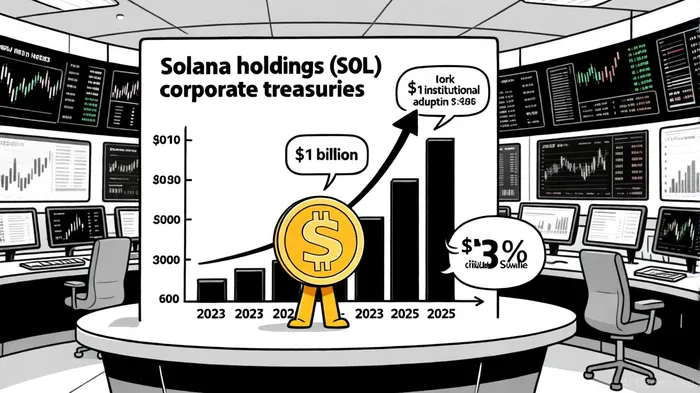







Comentarios
Aún no hay comentarios