
Solana's Institutional Adoption Surge: Strategic Token Allocation and Market Dynamics in 2025
The SolanaSOL-- (SOL) blockchain has entered a new era of institutional adoption, marked by strategic token allocations from corporate treasuries and investment firms. Helius MedicalHSDT-- Technologies' recent $175.6 million purchase of 760,190 SOLSOL-- tokens at an average price of $231 per token[1] has become a focal point in this shift, signaling a broader trend of institutional confidence in Solana's infrastructure and long-term value proposition. This analysis explores how Helius' move, alongside parallel efforts by other entities, is reshaping Solana's market dynamics and investor returns.
Institutional Allocations: From Speculation to Strategic Infrastructure
Helius' acquisition is emblematic of a strategic pivot by corporations to treat Solana not merely as a speculative asset but as a yield-generating component of their balance sheets. The company's $500 million Solana treasury plan, funded by a $1.25 billion fundraising led by Pantera Capital and Summer Capital[2], underscores this approach. By allocating $335 million of its cash reserves to future purchases and staking opportunities[3], HeliusHSDT-- is aligning its financial strategy with Solana's ecosystem growth.
This trend is not isolated. Public companies like Forward Industries (6.8 million SOL, $1.65 billion value) and DeFi Development Corp. (1.83 million SOL, $295.6 million value) are staking their holdings to generate 7–8% annual yields[4]. Such allocations reinforce Solana's network security while creating a flywheel effect: increased staking activity enhances validator participation, which in turn attracts more institutional capital.
Market Performance: Volatility and Resilience
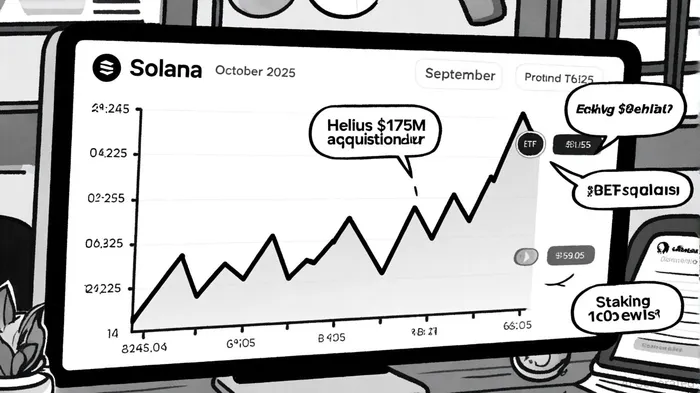
Solana's price performance post-Helius' purchase reflects both short-term volatility and long-term resilience. On September 22, 2025, the token opened at $236.57 but closed at $220.50, a 6.9% drop in the following 24 hours[5]. By September 25, it had fallen further to $192.38, a 16.5% decline from Helius' average purchase price. However, this dip masked broader bullish fundamentals.
Over the 30 days following Helius' announcement, Solana surged by 29.54%, trading near $239 by late October[6]. Technical indicators, including a 20-day EMA of $218.3 and an RSI of 69.5, suggested strong buyer support despite overbought conditions[7]. Analysts attribute this resilience to institutional buying pressure and the growing Total Value Locked (TVL) in Solana's DeFi ecosystem, which rose by 18% in Q3 2025[8].
Catalysts for Institutional Adoption
Several factors are accelerating Solana's institutionalization:
1. Yield Generation: Staking yields of 6.86–8%[9] make Solana a compelling alternative to traditional fixed-income assets.
2. Infrastructure Alignment: Solana's 3,500+ transactions per second and 3.7 million daily active wallets[10] position it as a scalable solution for enterprises.
3. Regulatory Developments: Anticipated spot ETF approvals (e.g., Franklin Templeton and Grayscale filings[11]) could unlock billions in institutional capital.
4. Ecosystem Growth: Upgrades like Alpenglow[12] and partnerships with gaming/NFT platforms are expanding use cases.
Investor Returns: Balancing Risk and Reward
While Helius' stock initially fell 16% post-announcement[13], its 200% monthly gain highlights the dual-edged nature of corporate crypto bets. For retail investors, Solana's price trajectory offers lessons in volatility management. Short-term dips, such as the $192 low in late September, created entry points for long-term holders, while the 30-day 29.54% surge[14] demonstrated the power of institutional accumulation.
Looking ahead, analysts project a $250–$260 price target if Solana holds above $180[15], with some bullish forecasts reaching $800 by December 2025[16]. These projections hinge on continued institutional inflows and ecosystem innovation.
Conclusion: A New Paradigm for Digital Assets
Solana's institutional adoption is redefining how corporations and investors approach blockchain assets. By treating SOL as both a strategic infrastructure component and a yield-generating asset, entities like Helius are accelerating Solana's transition from speculative token to institutional-grade asset. While short-term volatility remains, the interplay of staking yields, regulatory progress, and ecosystem growth suggests a durable bull case for 2025 and beyond.





Comentarios
Aún no hay comentarios