
Solana's Institutional Adoption Surge: A Catalyst for Network Utility and Price Breakout in 2025
The Institutional Tsunami: Solana's Treasury Accumulation Strategy
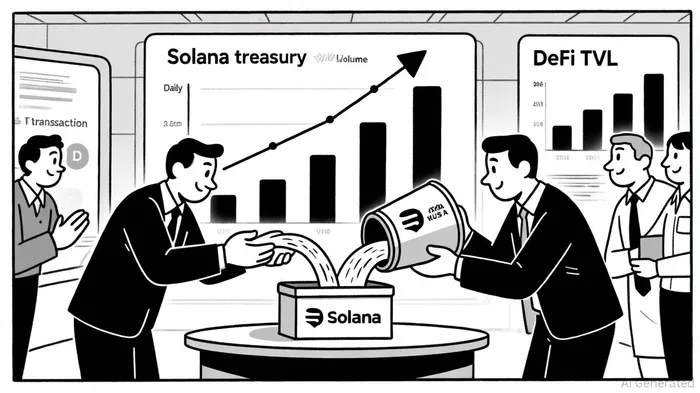
Solana's institutional adoption in Q3 2025 has reached a tipping point, with over $1.72 billion in institutional capital flowing into Solana treasuries[1]. This surge is driven by a dual strategy: long-term treasury accumulation and active staking. Public companies like DeFi Development Corp. (DFDV) have built $371 million SolanaSOL-- treasuries, leveraging the network's 7–8% staking yields to generate $12–14 million annually in passive income[2].
Notably, Forward Industries (NASDAQ: FORD)—backed by Galaxy Digital, Jump Crypto, and Multicoin Capital—has acquired and staked 6.8 million SOL, signaling a new era of corporate-driven demand[1]. Meanwhile, Sharps Technology raised $400 million in a private placement, including a $50 million purchase of SOL at a 15% discount from the Solana Foundation[2]. These moves highlight Solana's growing appeal as a yield-generating asset for institutional portfolios.
The regulatory tailwind is equally significant. The REX-Osprey Solana Staking ETF (SSK), approved in early 2025, provides a regulated avenue for institutional and retail investors to access Solana's staking rewards[2]. This product bridges the gap between traditional finance and crypto, accelerating mainstream adoption.
Network Utility: The Infrastructure Behind the Hype
Solana's Q3 2025 network metrics underscore its dominance in scalability and efficiency. The network processed 93.5 million daily transactions and achieved 500,000 TPS on average, with gas fees as low as $0.00025[3]. The Alpenglow upgrade further boosted throughput to 10,000 TPS, reducing transaction finality to 100 milliseconds[3]. These improvements position Solana as the go-to infrastructure for high-frequency trading and enterprise applications.
In DeFi, Solana's ecosystem generated $1.6 billion in DApp revenue in Q3 2025, a fourfold increase from H1 2024[1]. Platforms like Serum and Raydium now process 81% of global DEX transactions, more than double its nearest competitor[1]. The TVL for DeFi reached $13 billion, driven by liquid staking protocols locking 51.7 million SOL (12.8% of all staked tokens)[1].
Enterprise adoption is equally robust. Strategic partnerships with Franklin Templeton, Société Générale, and BlackRock's BUIDL initiative have tokenized assets on Solana, expanding its real-world utility[3]. Public companies now hold 5.9 million SOL in corporate treasuries, further entrenching the network's role in traditional finance[3].
The Path to a Price Breakout: Staking Yields and Developer Momentum
Solana's 7–8% staking yields are a critical catalyst for price appreciation. With 12.8% of all staked tokens in liquid staking protocols, the network is creating a flywheel effect: higher staking demand increases token utility, which drives up demand and price[1]. This dynamic is amplified by ZK compression, which reduces storage costs and enables scalable enterprise applications[3].
Developer activity is another key driver. The Solana ecosystem welcomed 7,600 new developers in 2025, contributing to 2,100 active dApps and 8,400 smart contracts[3]. This surge in innovation ensures Solana remains at the forefront of blockchain adoption, attracting both capital and talent.
Conclusion: A Network Poised for Exponential Growth
Solana's institutional adoption surge is notNOT-- just a short-term trend—it's a structural shift in how capital and enterprises engage with blockchain. With $1.72 billion in Q3 inflows, 500,000 TPS throughput, and $13 billion in DeFi TVL, the network is building a foundation for a massive price breakout. As staking yields, regulatory clarity, and developer momentum align, Solana is uniquely positioned to dominate the next leg of the crypto bull run.





Comentarios
Aún no hay comentarios