
Solana's Institutional Adoption and Price Catalysts: A New Era for Blockchain Infrastructure
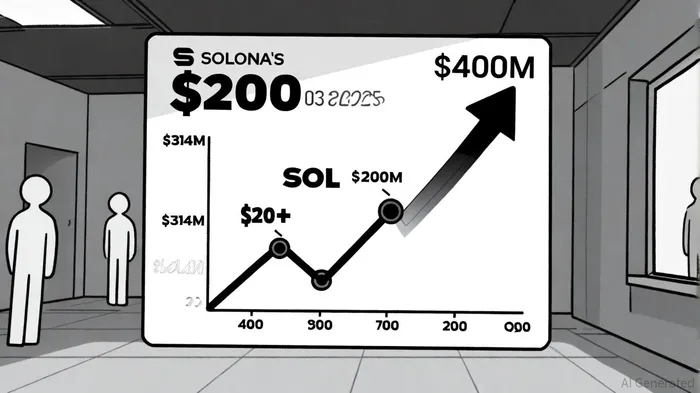
Solana's 2025 resurgence has been nothing short of meteoric. After a 60% price plunge in early 2025, the network has clawed back over 132% year-to-date, trading near $236 in Q3 2025[1]. This recovery isn't just a market anomaly—it's a structural shift driven by institutional adoption that's redefining SolanaSOL-- as a yield-bearing infrastructure asset.
Institutional Capital: From Speculation to Strategic Staking
The past two years have seen Solana attract over $374 million in funding across six rounds, including a landmark $314 million Series C in 2021[1]. But the real story lies in 2025: Solana's institutional treasury initiatives now exceed $695 million, with Sharps TechnologySTSS-- alone committing $400 million[3]. This capital isn't just parked—it's being deployed to stake SOLSOL--, fund DeFi protocols, and secure validator nodes.
Public companies like Forward IndustriesFORD-- (NASDAQ: FORD) and DeFi DevelopmentDFDV-- Corp have staked 6.8 million and 2.05 million SOL, respectively[1]. These moves signal a shift from speculative token trading to active ecosystem participation. Institutions are no longer asking, “Is SOL a good bet?” They're asking, “How can we build on Solana?”
Market Sentiment: The DAT Revolution
Digital Asset Treasury (DAT) organizations—entities holding and staking SOL as core infrastructure—are now pivotal to Solana's narrative. According to a report by Forbes, over 8% of Solana's circulating supply is held by public companies[1]. This includes Pantera Capital's $1.25 billion Solana-focused treasury initiative[1] and Solmate's $300 million PIPE round, backed by ARKARK-- Invest and the Solana Foundation[3].
These DATs are creating a flywheel: staked SOL generates yield, which funds further infrastructure development, which attracts more institutional capital. The Strategic SOL Reserve (SSR), a real-time tracker of institutional holdings, reveals entities control 5.904 million SOL (1.03% of total supply) valued at $1.15 billion[3]. This isn't just liquidity—it's a vote of confidence in Solana's long-term utility.
Price Catalysts: ETFs, TVL, and On-Chain Metrics
Solana's price surge correlates with tangible on-chain growth. By May 2025, DeFi TVL hit $7.8 billion[1], while transaction throughput hit 2,300 TPS[1]. But the most potent catalysts are institutional-driven:
- ETF Filings: VanEck and 21Shares have submitted spot Solana ETF applications, with regulatory approval potentially unlocking billions in new demand[1].
- Yield-Seeking Capital: Institutions staking SOL earn ~5–7% annualized returns, making it a compelling alternative to traditional assets[1].
- Whale Accumulation: On-chain data shows $40 million in large SOL transfers to centralized exchanges, often signaling strategic accumulation rather than dumping[1].
The Bigger Picture: Infrastructure as a Commodity
Solana's institutional adoption mirrors the early days of Ethereum—but with a critical difference: infrastructure funding. Unlike speculative crypto assets, Solana's ecosystem is being capitalized by entities that treat blockchain as a utility. Galaxy DigitalGLXY--, Jump Crypto, and Multicoin Capital aren't just investors—they're infrastructure partners[2].
This shift has profound implications. As CoinDesk notes, Solana's institutional treasury initiatives are now approaching $1 billion[3], creating a self-sustaining ecosystem where capital and innovation align. The result? A network that's not just surviving volatility but thriving through it.





Comentarios
Aún no hay comentarios