
Solana vs. Ethereum in 2025: Why Solana's Scalability and Ecosystem Momentum Make It the More Strategic Bet for Growth
In 2025, the blockchain landscape remains dominated by two titans: EthereumETH-- and SolanaSOL--. While Ethereum retains its crown as the foundational platform for decentralized finance (DeFi) and institutional adoption, Solana's meteoric rise in scalability, cost efficiency, and ecosystem innovation has positioned it as a compelling alternative for investors seeking high-growth opportunities. This analysis examines why Solana's technical advantages and accelerating ecosystem momentum make it the more strategic bet for growth in the current market cycle.
Network Performance: Solana's Speed and Cost Edge
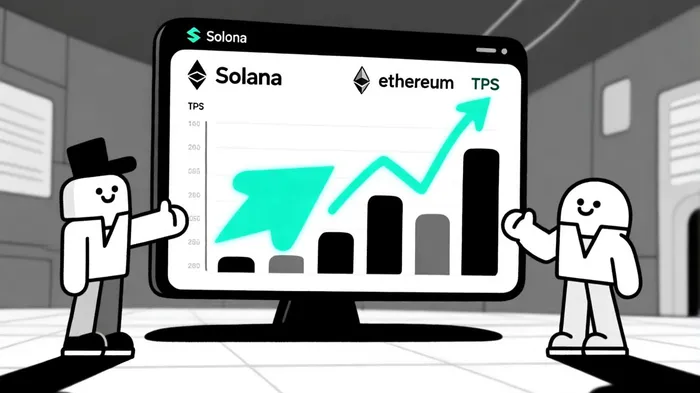
Solana's architectural design—combining Proof of History (PoH) with Proof of Stake (PoS)—enables it to process 2,000–4,000 transactions per second (TPS) in real-world conditions, with theoretical maximums reaching 65,000 TPS[1]. This dwarfs Ethereum's base-layer throughput of 30 TPS, even as Layer 2 solutions like ArbitrumARB-- and OptimismOP-- mitigate some bottlenecks[1]. For applications requiring real-time finality, such as high-frequency trading or AI-driven dApps, Solana's 0.4-second finality[2] is a critical differentiator.
Transaction fees further underscore Solana's appeal. With average costs of $0.0001–$0.0025 per transaction[1], Solana's fee structure is orders of magnitude cheaper than Ethereum's $5–$6 on mainnet[1]. While Ethereum's Layer 2 networks reduce fees, they add complexity and latency, which Solana avoids entirely. This cost efficiency has fueled explosive growth in Solana's DeFi and NFT ecosystems, attracting retail and institutional users alike[2].
Ecosystem Momentum: Developer Growth and Institutional Adoption
Despite Ethereum's larger developer base (1,695 active contributors as of June 2025[3]), Solana has outpaced it in year-over-year growth, with 83% developer growth in 2024[5]. By Q3 2025, Solana reported 3,201 monthly active developers, reflecting its appeal for scalable dApp development[5]. This momentum is driven by Solana's high-performance infrastructure, grants programs, and hackathons, which lower barriers to entry for new builders[5].
Institutional adoption has also tilted in Solana's favor. Over 17 million SOL (worth $4 billion) is now held in corporate treasuries, with firms like Galaxy DigitalGLXY-- and Forward Industries leading a $1.65 billion investment in Solana-based assets[2]. Solana's staking yields of 7–8%[1]—nearly double Ethereum's 3.5%—have made it a preferred choice for yield-seeking investors, including major players like Visa and PayPal[2]. In contrast, Ethereum's institutional dominance is increasingly challenged by Solana's ability to deliver both scalability and attractive returns[2].
Investor Returns: TVL Growth and Market Dynamics
Total Value Locked (TVL) metrics highlight Solana's rapid ascent. By Q3 2025, Solana's DeFi TVL surged to $13 billion, surpassing the combined TVL of Ethereum's Layer 2 solutions (Base, Arbitrum, and Optimism)[5]. While Ethereum's TVL remains larger at $96.86 billion, Solana's 30% growth in Q3 2025[5] outpaces Ethereum's 50% increase, signaling a shift in capital allocation toward high-throughput platforms[5].
Price projections reinforce this trend. Solana's bullish case targets $500–$650 by year-end, driven by NFTs, tokenization, and AI adoption[1], while Ethereum's range is $2,500–$8,000[1]. Solana's technical indicators, including an oversold RSI, suggest near-term upside potential[1], whereas Ethereum's growth hinges on macroeconomic factors and the success of its Pectra upgrade[1].
Historical backtesting of a strategy buying SOLSOL-- at RSI-oversold levels and holding for 30 trading days (2022–2025) reveals mixed results. The approach yielded an average return of –2.7% per trade, with a hit rate of 35% (average win: +15%, average loss: –17%). Over the full period, the cumulative return was –60.1%, with a maximum drawdown of 76.9% and a Sharpe ratio of –0.16[6]. These findings suggest that while RSI-oversold signals may occasionally capture rebounds, they offer limited downside protection during prolonged bear markets. Investors considering such signals should pair them with additional filters (e.g., trend-following indicators or stop-loss rules) to mitigate risk[6].
Strategic Implications for Investors
For investors prioritizing long-term stability and institutional credibility, Ethereum remains a safer bet. Its robust security model, Layer 2 ecosystem, and regulatory clarity make it the bedrock of DeFi and real-world asset (RWA) adoption[2]. However, Solana's scalability, low fees, and high staking yields position it as the superior choice for those seeking explosive growth in a market increasingly driven by retail adoption and AI-driven applications[1].
Conclusion
While Ethereum's dominance in DeFi and institutional adoption is undeniable, Solana's technical superiority and ecosystem momentum make it the more strategic bet for growth in 2025. Its ability to process transactions at unprecedented speeds, coupled with institutional-grade staking yields and a rapidly expanding developer base, positions it to capture market share in sectors demanding real-time performance and cost efficiency. For investors willing to tolerate higher volatility, Solana's trajectory suggests it is not just a challenger but a potential leader in the next phase of blockchain innovation.







Comentarios
Aún no hay comentarios