
Why Solana ETFs Are Poised to Outperform in the Emerging Altseason
Institutional Conviction: A Catalyst for Growth
Institutional adoption of Solana ETFs has accelerated dramatically in 2025, with several funds attracting hundreds of millions in assets under management (AUM). The REX-Osprey Staking Solana ETF (SSK), for instance, saw $24 million in inflows, pushing its total assets to over $400 million according to reports. This momentum is further amplified by the launch of Bitwise's BSOL ETFBSOL--, which recorded a record $56 million in first-day trading volume-the highest ETF debut of 2025.
JPMorgan analysts predict that upcoming Solana ETFs from VanEck and Grayscale could draw over $6 billion in initial investments, signaling a broader acceptance of crypto as a liquid asset class according to market analysis. Such figures underscore the growing confidence of institutional investors in Solana's ecosystem, particularly its high-performance blockchain infrastructure and staking capabilities.
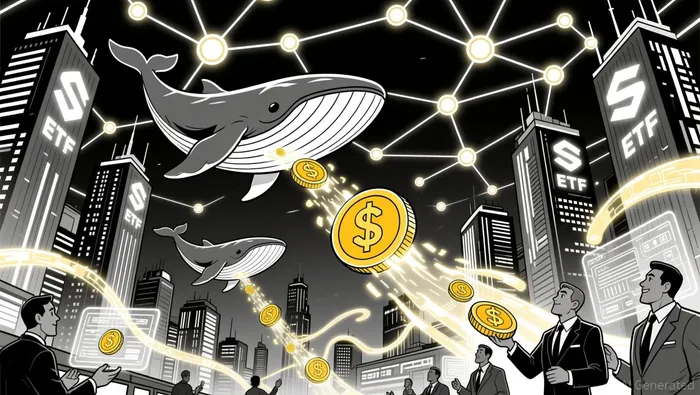 A critical indicator of institutional alignment is the movement of large Solana holdings. A long-term whale recently transferred 200,000 SOLSOL-- ($40 million) to Coinbase Prime, coinciding with major ETF launches. This activity suggests that institutional players are notNOT-- only investing in Solana but also providing liquidity to support ETFs, creating a flywheel effect for price discovery and market depth as reported.
Fee-Driven Incentives: Lowering Barriers to Entry
Fee structures have emerged as a key battleground for ETF providers, with zero-fee models and staking integration designed to attract both institutional and retail investors. VanEck's VSOL ETFVSOL--, for example, offers a zero-fee structure for the first $1 billion in assets until February 17, 2026, after which a 0.30% sponsor fee will apply according to product details. Similarly, Bitwise's BSOL ETF provides a 0% net sponsor fee for the first three months on the first $1 billion in assets, followed by a 0.20% sponsor fee and a 0.06% staking fee (charged only on staking rewards) as detailed.
These incentives are not merely promotional tactics but strategic tools to accelerate adoption. By reducing upfront costs, ETF providers are making Solana's high-yield staking rewards more accessible to institutional investors. For example, Fidelity's FSOL and Canary's SOLC ETFs, launched in Q3 2025, integrated on-chain staking while maintaining competitive fee structures of 0.25%. Such innovations align with institutional demand for products that balance cost efficiency with yield generation, a critical factor in a risk-off market environment.
Market Dynamics and the Path Forward
Despite challenges like broader ETF outflows and a risk-averse investor sentiment, Solana ETFs remain well-positioned to outperform. Solana's price has held steady near $195, with a relative strength index (RSI) of 47, indicating balanced momentum according to market data. This stability, combined with the influx of institutional capital, suggests that Solana ETFs are less susceptible to the volatility that has historically hindered altcoin adoption.
Moreover, the zero-fee and staking-integrated models are likely to drive long-term adoption. As JPMorgan analysts note, these structures reduce friction for institutions entering the crypto space, enabling them to scale exposure without compromising returns according to market analysis. With more than $1 billion in assets already flowing into Solana ETFs, the critical mass required to sustain an altseason appears to be forming.
Conclusion
Solana ETFs are uniquely positioned to outperform in the emerging altseason due to a combination of institutional conviction and fee-driven incentives. The aggressive capital inflows, strategic whale activity, and innovative fee structures are creating a self-reinforcing cycle of demand and liquidity. While macroeconomic headwinds persist, the structural advantages of Solana's ecosystem-coupled with institutional-grade product design-make it a standout asset in a market increasingly focused on efficiency and yield. For investors seeking exposure to the next phase of crypto adoption, Solana ETFs offer a compelling, well-structured pathway.





Comentarios
Aún no hay comentarios