
Solana ETFs' First Outflow and Institutional Rotation in Crypto Asset Allocation
The crypto market's institutional landscape is undergoing a subtle but significant shift. On November 26, 2025, SolanaSOL-- ETFs recorded their first net outflow of $8.1 million, ending a 21-day inflow streak that had driven cumulative inflows to $613.22 million. This reversal coincided with robust inflows into EthereumETH-- and XRPXRP-- ETFs-$60.82 million and $21.81 million, respectively-highlighting a strategic reallocation of capital toward assets with clearer regulatory pathways and established adoption. As institutional investors navigate a maturing crypto market, the implications of this rotation demand closer scrutiny: Is this a short-term rebalancing, or a broader trend signaling a structural shift in asset preferences?
The Outflow and Market Context
Solana's recent outflow marks a pivotal moment. For 21 days, the network's ETFs had attracted capital amid optimismOP-- around its high-speed blockchain and institutional-friendly infrastructure. However, the November 26 outflow suggests growing caution, particularly as the price of SOL consolidates between $125 and $145. Meanwhile, Ethereum ETFs extended a four-day inflow streak, buoyed by sustained institutional demand for the Ethereum 2.0 upgrade and its role in decentralized finance (DeFi). XRP ETFs, meanwhile, benefited from regulatory clarity following Ripple's legal victory over the SEC, which has positioned XRP as a viable alternative to BitcoinBTC-- and Solana in institutional portfolios.
Institutional Rotation: Regulatory Clarity and Adoption
The shift toward Ethereum and XRP ETFs reflects a broader institutional preference for assets with defined regulatory frameworks. Ethereum's transition to a proof-of-stake model and its dominance in smart contract ecosystems have made it a cornerstone of institutional crypto strategies. XRP's appeal, meanwhile, stems from its utility in cross-border payments and the resolution of its SEC case, which has reduced legal uncertainty. In contrast, Solana's rapid growth has outpaced regulatory engagement, leaving some institutional investors hesitant to overcommit during a consolidation phase.
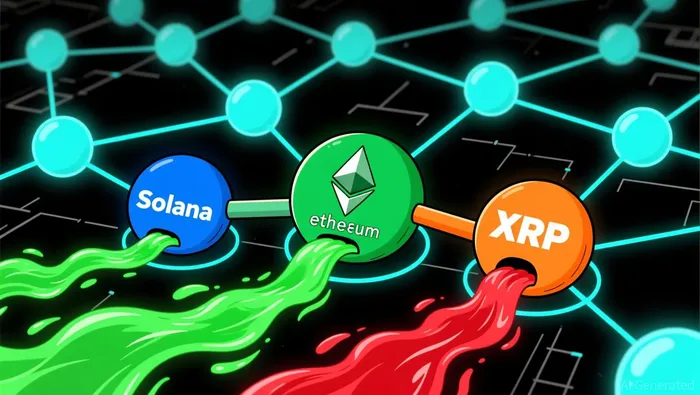
This reallocation also underscores a growing trend: diversification. As Bitcoin ETFs recorded modest inflows of $21.12 million, with BlackRock's IBIT leading the way, institutions appear to be spreading risk across multiple crypto assets rather than concentrating capital in a single narrative.
Trend or Rebalancing?
The question remains: Is this rotation a long-term trend or a short-term correction? Analysts note that Solana's outflow follows a period of aggressive inflows, suggesting the possibility of profit-taking or portfolio rebalancing. However, the sustained inflows into Ethereum and XRP ETFs indicate a deeper structural shift. For example, Franklin Templeton's recent launch of the SOEZ ETF-a spot Solana ETF with a 0.19% fee, the lowest in the sector-demonstrates confidence in Solana's long-term potential. The ETF also waives sponsor fees on the first $5 billion in assets until May 2026, a move designed to incentivize early adoption.
Yet, the broader market context complicates this optimism. With over 100 new crypto ETFs projected to launch in the next six months, competition for institutional capital is intensifying. Ethereum and XRP ETFs are currently outpacing their counterparts in inflows, suggesting that Solana may need a stronger catalyst-such as a major institutional partnership or a breakthrough in decentralized applications-to regain momentum (https://www.dlnews.com/articles/markets/etfs-to-drive-xrp-and-solana-price-rally/).
Franklin Templeton's SOEZ ETF: A Catalyst for Renewed Inflows?
Franklin Templeton's entry into the Solana ETF space is strategically timed. The SOEZ ETF, which holds physical SOLSOL-- tokens and tracks the CF Benchmarks Solana Index, offers a regulated exposure model akin to traditional commodity ETFs (https://www.bitget.com/news/detail/12560605088825). Its low fee structure and fee waiver could attract capital back to Solana, particularly if institutions perceive it as undervalued during its consolidation phase.
However, the ETF's success hinges on broader market dynamics. While Franklin Templeton has previously driven adoption with its XRPZ ETF, Solana faces stiffer competition from Ethereum and XRP products that are already entrenched in institutional portfolios (https://rareevo.io/rare-network-blog/franklin-templeton-xrpz-etf-launch-analysis). Analysts predict that XRP and Solana prices could rise by 33% and 10%, respectively, if ETF inflows continue, but this outcome depends on sustained institutional demand.
Conclusion
The recent outflow from Solana ETFs and the concurrent inflows into Ethereum and XRP products signal a nuanced shift in institutional capital allocation. While regulatory clarity and adoption are driving Ethereum and XRP, Solana's consolidation phase has created a window for competitors to gain ground. Franklin Templeton's SOEZ ETF offers a compelling value proposition, but its impact will depend on whether institutions view Solana as a long-term bet or a temporary correction. As the crypto ETF landscape evolves, the coming months will reveal whether this rotation is a fleeting adjustment or a harbinger of a new era in institutional crypto investing.





Comentarios
Aún no hay comentarios