
Solana ETFs: A New Liquidity Paradigm for Crypto Investors
The institutionalization of cryptocurrency markets has reached a pivotal inflection point, with SolanaSOL-- ETFs emerging as a cornerstone of this transformation. As major asset managers like Franklin Templeton, Grayscale, and CoinShares navigate regulatory and strategic shifts, Solana's unique value proposition-7% staking yields, zero outflows in key products, and sub-cent transaction fees-positions it as a magnet for yield-driven capital. This article dissects the interplay between institutional adoption and Solana's ecosystem dynamics, arguing that 2025 marks the optimal window to capitalize on this liquidity revolution.
Institutional Adoption: A Structural Shift
Franklin Templeton's November 2025 filing of its Solana ETF (SOEZ) underscored a broader institutional embrace of the asset class. By submitting Form 8-A to the SEC and launching the ETF on NYSE Arca just days later, the firm demonstrated confidence in Solana's market readiness according to filings. This followed the successful debut of its XRP ETF, signaling a strategic pivot toward digital assets as a core offering. Similarly, Grayscale's conversion of its Solana Trust (GSOL) to an ETF in October 2025 marked a critical milestone, enabling retail and institutional investors to access staked Solana with the liquidity of traditional markets.
CoinShares, however, took a divergent path. The firm withdrew its Solana Staking ETF application in November 2025, citing incomplete structuring deals and a strategic reallocation toward thematic crypto baskets and multi-asset strategies. This retreat highlights the competitive pressures in the single-asset ETF space, where firms like BlackRock and Fidelity now dominate. Yet, CoinShares' exit also created room for niche players like REX-Osprey and Bitwise, whose staked Solana ETFs attracted $369 million in November 2025 alone.
Yield-Driven Capital Flows: Solana's Competitive Edge
At the heart of Solana's appeal lies its staking yield structure. Grayscale's GSOLGSOL--, for instance, offers a gross staking reward rate of 7.29% and a net rate of 6.31%, with 77% of rewards passed directly to investors. This effectively translates to an annualized return of 5-6%, outpacing traditional fixed-income assets in a low-interest-rate environment. Meanwhile, Franklin Templeton's SOEZSOEZ--, which holds physical Solana and tracks the CF Benchmarks Solana Index, has attracted over $933 million in assets since its launch.
The cost efficiency of Solana's infrastructure further amplifies its attractiveness. 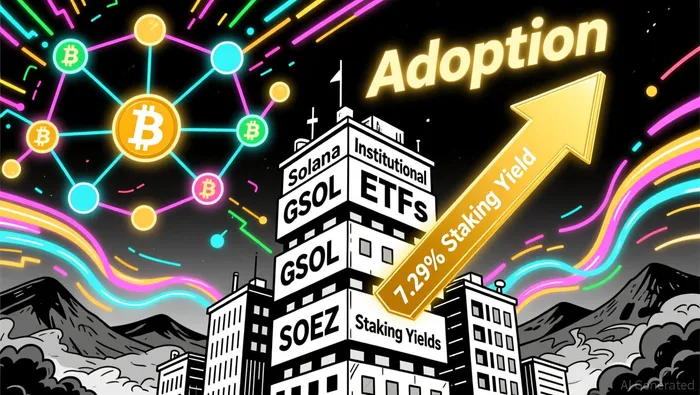 With median transaction fees below one-tenth of a cent and block finality times of 150ms (thanks to the Alpenglow upgrade), Solana's blockchain rivals institutional-grade platforms like Nasdaq. This low-cost, high-throughput model not only supports DeFi growth-total value locked (TVL) on Solana surged 32.7% to $11.5 billion in Q3 2025-but also enables seamless integration with ETF structures.
Strategic ETF Filings: A Tale of Three Firms
Franklin Templeton's rapid execution of its Solana ETF filing exemplifies the urgency of institutional players to capture early-mover advantages. By leveraging its existing XRP ETF infrastructure, the firm minimized regulatory friction and capitalized on market momentum. Grayscale, meanwhile, has adopted a hybrid approach, converting its private trust into an ETF while maintaining a 77% reward pass-through to investors-a model that balances institutional-grade security with crypto-native innovation according to reports.
CoinShares' withdrawal, in contrast, reflects a recalibration of priorities. The firm's CEO, Jean-Marie Mognetti, emphasized a pivot toward crypto equities and thematic baskets, acknowledging the dominance of larger firms in the single-asset space. This strategic shift underscores the importance of differentiation in a crowded market, where yield and liquidity are no longer sufficient to guarantee traction.
Why Now? The Convergence of Forces
The current moment is uniquely positioned for Solana ETFs to drive institutional adoption. Technologically, Solana's ZK Compression v2 has reduced transaction costs by 5,200 times, making it a viable backbone for large-scale capital flows. On the capital side, the asset's 7% staking yields provide a compelling alternative to traditional assets, particularly as central banks maintain accommodative policies.
Moreover, the Solana ecosystem's resilience is evident in its on-chain activity. Despite a Q3 2025 net loss by Solana Co, the chain's decentralized exchange volumes and real-world asset tokenization capabilities have drawn institutional interest. Over $321 million in EthereumETH-- inflows into Solana in the past month further signals a migration of capital toward high-yield, low-cost environments.
Conclusion: Positioning for the Growth Wave
The convergence of institutional adoption, yield-driven capital flows, and technological innovation positions Solana ETFs as a defining asset class for 2025. Franklin Templeton's SOEZ and Grayscale's GSOL have already demonstrated the viability of this model, while CoinShares' strategic pivot highlights the need for agility in a rapidly evolving market. For investors, the message is clear: Solana's institutional-driven growth wave is not only inevitable but already underway.





Comentarios
Aún no hay comentarios