
Solana ETFs: A New Era of Institutional Adoption and Staking-Driven Demand
Institutional Capital Flows: A Divergence in Strategy
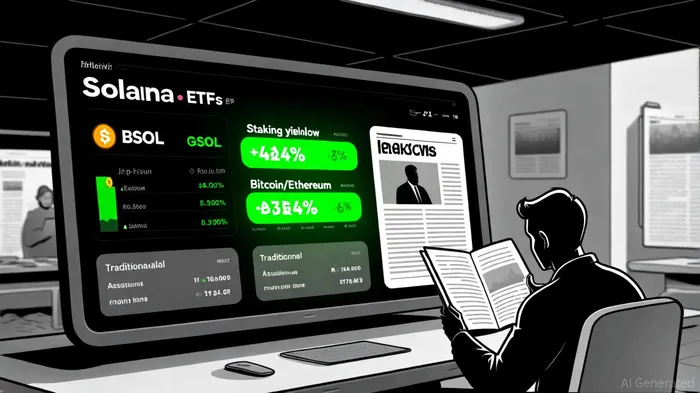
Institutional investors are increasingly reallocating capital from Bitcoin and Ethereum ETFs to Solana-based products, a trend underscored by stark net flows in October 2025. While Bitcoin and Ethereum ETFs faced combined outflows exceeding $630 million, Solana ETFs saw a net inflow of $48 million, with Bitwise's BSOL alone capturing $46.54 million in its first full trading day, the Bitcoin.com piece noted. This divergence highlights a strategic recalibration by institutions seeking higher returns in a low-yield environment.
The appeal of Solana ETFs lies in their dual exposure to price appreciation and staking rewards. Bitwise's BSOL, for instance, offers investors an estimated 7% annual staking yield, according to a NullTX report, a stark contrast to Bitcoin's negligible yield profile and Ethereum's post-merge staking rates, which hover around 4–5%, per TokenMetrics. For institutions, this represents a compelling value proposition: passive income generation within a regulated framework.
Yield Advantages: Solana vs. Traditional Assets
Solana ETFs are notNOT-- only outperforming their crypto peers but also challenging traditional asset classes. In Q3 2025, the 10-Year Treasury yield fluctuated between 4.35% and 4.45%, according to Morningstar, while AAA municipal bonds yielded just 2.60% in the Thornburg commentary. By comparison, Solana's staking yield of 7% offers a significant premium, particularly for investors seeking alternatives to the stagnating returns of fixed income.
This yield edge is amplified by Solana's technological infrastructure. Its hybrid Proof of History (PoH) and Proof of Stake (PoS) consensus mechanism enables rapid transaction finality and scalability, reducing operational costs for institutional staking participants, as TokenMetrics notes. Meanwhile, Bitcoin's energy-intensive Proof of Work model and Ethereum's reliance on Layer 2 solutions for scalability make them less efficient for yield-focused strategies, according to the same TokenMetrics comparison.
Regulatory Tailwinds and Real-World Utility
The SEC's approval of Solana, HederaHBAR--, and LitecoinLTC-- ETFs in late 2025 has further legitimized altcoins as institutional-grade assets, as reported by Tekedia. This regulatory clarity, coupled with Solana's strategic partnerships, has accelerated adoption. Notably, Western Union's 2026 launch of a Solana-based stablecoin (USDPT) leverages the network's high-speed, low-cost infrastructure for cross-border remittances-a $800 billion market, according to Coinotag. This real-world utility could drive mass adoption, with Western Union's 500 million customers potentially becoming indirect Solana holders, Coinotag suggests.
A New Paradigm for Crypto Investing
The institutional embrace of Solana ETFs signals a maturation of the crypto market. Unlike the speculative frenzy of 2021, today's inflows are driven by yield optimization and regulatory alignment. Analysts at Bloomberg and J.P. Morgan project $1–1.5 billion in Solana ETF inflows over the next year, with upside potential reaching $3 billion if adoption mirrors Bitcoin and Ethereum's early trajectories, Tekedia reports.
Conclusion
Solana ETFs are redefining institutional capital allocation in crypto, combining regulatory compliance, staking yields, and real-world utility to attract a new wave of investors. As the network's ecosystem expands-bolstered by partnerships like Western Union's USDPT-Solana's role in institutional portfolios is poised to grow. For investors, this represents not just a bet on price, but a stake in a yield-driven future.






Comentarios
Aún no hay comentarios