
Solana ETF Inflows and the Broader Altcoin Rotation Amid Macroeconomic Catalysts
Macroeconomic Catalysts: Fed Policy and Liquidity Injections
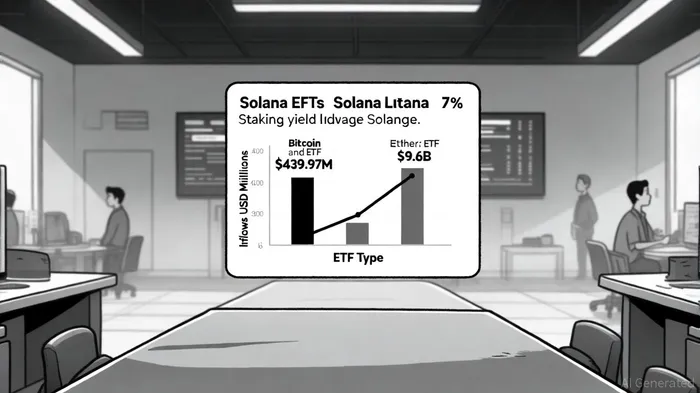
The U.S. Federal Reserve's anticipated shift from quantitative tightening (QT) to easing in early 2025 has injected a risk-on sentiment into global markets. By Q3 2025, analysts projected the Fed would resume Treasury purchases at a pace of $35 billion monthly, stabilizing yields and encouraging capital flows into high-risk assets like crypto, according to a Coinotag article. This liquidity injection has directly benefited Solana's ecosystem, where institutional adoption has surged. For instance, the Bitwise Solana Staking ETF (BSOL) attracted $55.4 million in trading volume on its debut day in 2025, the highest for any crypto ETF that year, as Coinotag reported. Cumulative inflows into Solana ETFs reached $439.97 million by October 30, 2025, driven by staking yields averaging 5.73% annually, according to Coinpaper.
The Fed's easing cycle has also amplified demand for altcoins over BitcoinBTC--. EthereumETH-- (ETH) and BNBBNB-- surged by +68.5% and +57.3%, respectively, in Q3 2025, while Bitcoin faced outflows as investors rotated into higher-yield assets, according to Coingecko's Q3 report. This trend aligns with historical patterns where Fed easing cycles have historically triggered altcoin rallies, as seen in 2020–2021, as Coinpaper reported.
Technical Momentum and On-Chain Activity
Solana's technical indicators and on-chain metrics underscore its role as a leading altcoin in the rotation. While the 14-day RSI for SOLSOL-- stood at 47 in late October 2025-a neutral reading-the network's real economic value (REV) of $223 million in Q3 2025 signaled robust utility-driven demand, per RSIHunter data. This REV, which excludes speculative trades, outperformed Bitcoin and Ethereum, reflecting genuine transactional activity.
Stablecoin growth on Solana further reinforced its technical strength. The network's stablecoin market cap surged to $14.1 billion by Q3 2025, driven by USDCUSDC-- and PYUSD, according to Messari's State of Solana. This liquidity expansion coincided with a 32.7% quarter-over-quarter increase in DeFi TVL to $11.5 billion, led by protocols like KaminoKMNO-- and JupiterJUP--, as the Messari report noted. Meanwhile, Solana's staking yields-averaging 7.03% APY in October 2025-provided a compelling alternative to traditional fixed-income assets in a low-interest-rate environment, according to Barchart.
Altcoin Rotation and Institutional Adoption
The Q3 2025 altcoin rotation was characterized by a shift from Bitcoin dominance to a diversified portfolio of high-yield assets. Solana's ETFs, including Grayscale's GSOL, attracted $155 million in inflows by October 2025, with analysts predicting $5 billion in total inflows by year-end, as Coinpaper reported. This momentum was fueled by structural developments such as the launch of ETHETH-- & SOL digital asset treasuries and a wave of crypto IPOs, which broadened institutional access, according to Coin Metrics' wrap-up.
In contrast, Bitcoin and Ether ETFs faced outflows as investors sought higher returns in Solana's staking ecosystem. The altcoin season index, which measures altcoin interest relative to Bitcoin, reached a 12-month high in Q3 2025, with Solana ETFs outperforming their Bitcoin counterparts, as Coinotag reported. This rotation was further supported by regulatory clarity from the SEC on proof-of-stake (PoS) activities, which reduced legal uncertainties around staking and incentivized institutional participation, as Coinotag earlier noted.
Strategic Implications for Investors
The interplay between macroeconomic factors and technical momentum presents a compelling case for strategic asset reallocation into Solana-based products. For investors, the key considerations include:
1. Yield Arbitrage: Solana's 7% staking yields offer a competitive edge over traditional fixed-income assets in a low-rate environment.
2. Liquidity Dynamics: Fed-driven liquidity injections are likely to sustain altcoin rotation, particularly for networks with strong on-chain fundamentals like Solana.
3. Regulatory Tailwinds: The SEC's guidance on PoS activities has created a favorable regulatory environment for staking-focused ETFs, reducing barriers to entry for institutional capital.
However, risks remain. While Solana's TVL and stablecoin growth are robust, active addresses on the network declined by 30% in Q3 2025, signaling potential throughput challenges, according to Ventureburn's price forecast. Additionally, volatility in the broader crypto market-marked by swings between greed and fear indices-could disrupt momentum if macroeconomic conditions deteriorate.
Conclusion
Solana's Q3 2025 performance exemplifies the transformative power of macroeconomic catalysts and institutional-grade product innovation in the crypto space. As the Fed's easing cycle gains traction, Solana ETFs and staking yields are poised to attract further inflows, reinforcing the network's role in the altcoin rotation. For investors, the combination of technical strength, regulatory clarity, and yield advantages makes Solana a strategic asset in a post-Fed policy environment.






Comentarios
Aún no hay comentarios