
Solana's ETF Filing Momentum and Institutional Adoption: A Catalyst for Digital Asset Integration
The integration of digital assets into traditional portfolios is accelerating, driven by a confluence of regulatory clarity, technological innovation, and institutional demand. SolanaSOL-- (SOL), a high-performance blockchain platform, has emerged as a focal point in this evolution, with its ETF filing momentum and institutional adoption metrics signaling a paradigm shift in how crypto assets are perceived and utilized.
ETF Filings: A Strategic Bridge Between TradFi and Blockchain
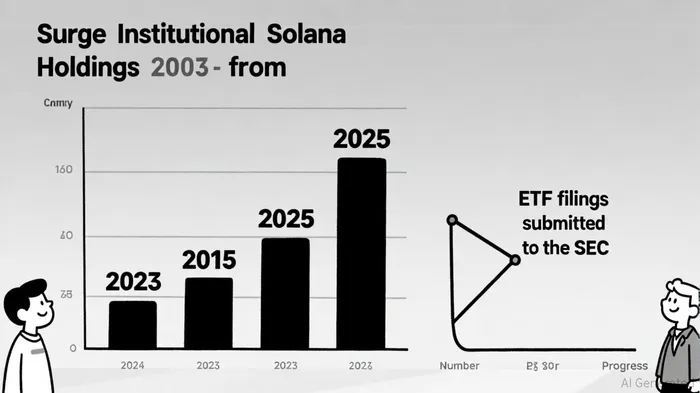
The U.S. Securities and Exchange Commission's (SEC) recent regulatory initiatives, such as Project Crypto, have created a more favorable environment for crypto ETF approvals. By late 2025, seven major asset managers—including Franklin Templeton, Grayscale, VanEck, Fidelity, and Bitwise—have submitted S-1 filings for Solana ETFs, with some incorporating staking provisions to generate yield[1]. These filings reflect a strategic alignment between traditional financial instruments and blockchain-native features. For instance, REX-Osprey's Solana + Staking ETF (SSK) combines price exposure with yield generation through liquid staking tokens (LSTs) like JitoSOL, offering investors a novel structure that diverges from conventional ETF models[3].
The synchronized nature of these filings has raised the probability of approval to 90%, according to Bloomberg analyst James Seyffart[2], while Polymarket prediction markets reflect an 82% likelihood of clearance by year-end 2025[1]. If approved, these ETFs could unlock $3–$6 billion in institutional capital inflows, significantly boosting Solana's market visibility and adoption[1].
Institutional Adoption: Scaling Infrastructure and Yield Generation
Public companies are increasingly allocating capital to Solana, with institutional treasuries holding approximately 5.9 million SOL—equivalent to 1% of the circulating supply—generating staking yields of up to 7.3%[1]. This trend is underpinned by Solana's technical advantages: its ability to process 65,000 transactions per second at sub-penny fees, coupled with the Alpenglow consensus upgrade, which enhanced validator efficiency and network security[2].
The integration of staking into ETF structures is a critical innovation. Fidelity's proposed Solana ETF, for example, plans to stake a portion of its holdings, addressing concerns about token availability while generating yield[3]. This approach notNOT-- only aligns with blockchain's decentralized ethos but also mirrors traditional portfolio strategies that seek income generation through dividends or interest.
Regulatory and Structural Innovations
The SEC's openness to staking mechanisms marks a pivotal shift in regulatory posture. Franklin Templeton and Fidelity have amended their S-1 filings to address concerns around in-kind redemption processes, ensuring compliance while enhancing transparency[3]. These adjustments signal a constructive dialogue between asset managers and regulators, with analysts like Nate Geraci of the ETF Store suggesting approvals could arrive by mid-October 2025[3].
Structural innovations, such as LSTs, further differentiate Solana ETFs. By allowing investors to trade staked assets without liquidity locks, LSTs bridge the gap between yield generation and liquidity, a feature absent in traditional ETFs[3]. This flexibility is particularly appealing to institutional investors seeking to optimize capital efficiency.
Expert Endorsements and Market Implications
While traditional financial institutions like the CFA Institute have not explicitly commented on Solana ETFs, the active participation of major asset managers underscores growing institutional confidence. VanEck's Head of Digital Assets Research, Matthew Sigel, has praised Solana as “the fastest, cheapest, decentralized database project”[2], a sentiment echoed by market forecasts predicting a 75%+ approval probability[1].
The potential approval of a U.S. spot Solana ETF would not only validate Solana's role in traditional portfolios but also set a precedent for other crypto assets. As Grayscale's proposed 2.5% fee structure—paid in SOLSOL-- tokens—demonstrates, blockchain-native fee models are gaining traction, aligning with the decentralized principles that underpin digital assets[2].
Conclusion: A New Era for Digital Asset Integration
Solana's ETF filing momentum and institutional adoption metrics highlight a broader trend: the convergence of traditional finance and blockchain technology. With regulatory clarity, yield-enhancing structures, and institutional infrastructure maturing, Solana is poised to become a cornerstone of diversified portfolios. As the SEC's review process nears its climax, the approval of these ETFs could catalyze a new era of digital asset integration, redefining how investors access and utilize crypto assets in the years ahead.






Comentarios
Aún no hay comentarios