
Solana's Emerging Role in Stablecoin and Tokenization Markets: Institutional Adoption and Infrastructure Efficiency
Solana (SOL) has emerged as a pivotal player in the tokenization and stablecoin markets, driven by a confluence of institutional adoption and its high-performance blockchain infrastructure. From 2023 to 2025, the platform has attracted a wave of corporate treasuries, venture capital firms, and payment giants, all seeking to leverage its technical capabilities for scalable, cost-effective solutions. This shift marks a critical inflection point for blockchain's integration into mainstream finance.
Institutional Adoption: From Speculation to Strategic Treasury Management
Institutional interest in SolanaSOL-- has evolved from speculative token holding to structured, infrastructure-aligned strategies. A $1.25 billion initiative by Pantera Capital, for instance, has established a Solana-focused public treasury, allocating capital to delegated staking, validator support, and ecosystem development, a Forbes report notes. Similarly, Galaxy DigitalGLXY--, Multicoin Capital, and Jump Crypto co-founded Forward IndustriesFORD-- (NASDAQ: FORD), which acquired and staked over 6.8 million SOLSOL--, positioning itself as a public treasury firm, as reported by Forbes. These entities are notNOT-- passive holders; they actively participate in governance, validator delegation, and DeFi liquidity provisioning, creating a feedback loop of capital and innovation (Forbes coverage).
By mid-2025, corporate treasuries collectively held 17.11 million SOL, valued at over $4 billion, representing nearly 3% of Solana's circulating supply, according to a Cointelegraph report. Companies like Upexi and DeFi Development Corp. (DFDV) have staked their holdings, generating annual yields of 6–8%, as documented by Stablecoin Insider. This trend reflects a broader shift toward institutional-grade digital asset management, where Solana's low fees and high throughput (over 100,000 transactions per second) enable efficient yield generation and cross-border settlement, per a McKinsey report.
Infrastructure Efficiency: Solana's Competitive Edge
Solana's appeal lies in its ability to bridge the gap between traditional finance and blockchain. Its architecture-optimized for high-frequency trading, tokenized asset settlement, and decentralized finance (DeFi)-addresses key pain points for institutional players. For example, PayPal and Visa expanded their stablecoins (PYUSD and USDC) to Solana, capitalizing on its low latency and sub-cent transaction costs, as reported by Cointelegraph. This integration has positioned Solana as a backbone for next-gen payment systems, where tokenized cash can rival legacy networks in speed and scalability, as noted by McKinsey.
The rise of stablecoins on Solana further underscores its infrastructure efficiency. USDCUSDC--, the dominant stablecoin on the network, accounted for over 70% of on-chain transfers in 2025, according to Stablecoin Insider. Regulatory clarity and improved infrastructure have accelerated adoption, enabling payment institutions to process cross-border transactions at a fraction of traditional costs, as Cointelegraph reported. As Wormhole Foundation's Robinson Burkey notes, these partnerships are not just about user growth-they're about future-proofing institutional offerings in a rapidly tokenizing world (Cointelegraph coverage).
Tokenization and the Future of Institutional Capital
The tokenization of real-world assets (RWAs) on Solana is another frontier. By mid-2025, corporate treasuries and DeFi firms are deploying capital into scalable Layer 1 assets, leveraging Solana's deflationary tokenomics and robust smart contract capabilities, per Stablecoin Insider. This trend is particularly evident in sectors like remittances and treasury management, where tokenized cash can streamline liquidity and reduce intermediation costs, as McKinsey has explored.
However, challenges remain. While stablecoin transaction volumes have grown exponentially, they still lag behind legacy systems in absolute terms, as McKinsey cautions. Institutions must also navigate evolving regulatory frameworks, particularly as tokenized assets gain traction in traditional markets.
Conclusion: A Strategic Bet on Blockchain's Mainstream Future
Solana's institutional adoption and infrastructure efficiency position it as a linchpin in the tokenization and stablecoin ecosystems. With corporate treasuries committing billions to its network and payment giants expanding their footprints, the platform is poised to redefine how value is transferred and stored. For investors, this represents a unique opportunity to capitalize on a blockchain that is not just technically superior but strategically aligned with the future of finance.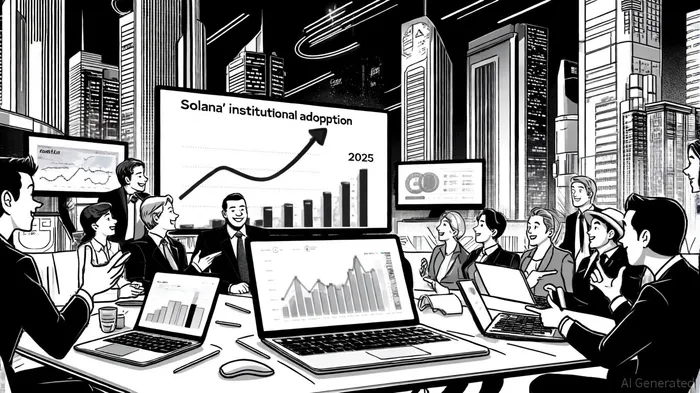





Comentarios
Aún no hay comentarios