
Solana's Emergence as Crypto's Financial Bazaar and the Investment Potential of High-Growth Tokens Like Snorter
The Rise of SolanaSOL-- as a Financial Ecosystem
Solana's transformation from a high-performance blockchain to a decentralized financial bazaar has accelerated in 2025, driven by robust DeFi adoption, institutional-grade RWA tokenization, and a disinflationary token model. According to a QuickNode H1 2025 report, the Solana DeFi sector captured 43% of global decentralized exchange (DEX) volume in the first half of 2025, processing over $1.05 trillion in cumulative trading volume. Total Value Locked (TVL) surged 18% quarter-on-quarter to $8.9 billion, bolstered by liquid staking protocols locking 51.7 million SOLSOL-- (~13% of staked SOL).
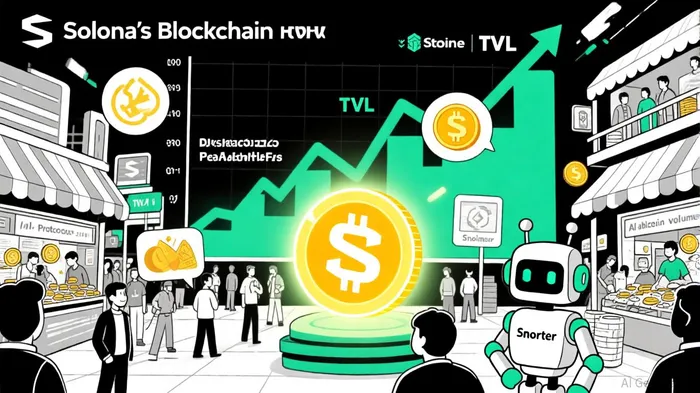
The network's appeal extends beyond DeFi. Solana's stablecoin ecosystem has grown to $11.2 billion in total supply, with 264 million stablecoin transfers worth $59.2 billion recorded in January 2025 alone; the QuickNode report attributes much of this growth to alternative stablecoins like USDY and syrupUSDC expanding the ecosystem beyond traditional USDCUSDC-- and USDTUSDT--. Meanwhile, real-world asset (RWA) tokenization has surged 150% in H1 2025, with tokenized assets reaching ~$418 million. Institutions like BlackRockBLK--, Apollo GlobalAPO--, and Franklin Templeton have launched tokenized funds (e.g., BUIDL, ACRED, FOBXX) on Solana, leveraging its sub-400ms finality and Token-2022 extensions for institutional-grade infrastructure, as noted in the same QuickNode report.
Institutional Adoption and Network Resilience
Solana's institutional adoption is further solidified by its technical resilience. The network has maintained 18+ months of perfect uptime, processing 162 million daily transactions at an average fee under $0.01, according to the QuickNode H1 2025 report. Upcoming upgrades like Firedancer and Alpenglow aim to push finality to sub-400ms by 2026, enhancing scalability for institutional use cases. An Analytics Insight report notes that pending spot Solana ETF applications by VanEck and 21Shares could attract billions in institutional capital, mirroring Ethereum's ETF-driven rally.
The tokenomics of SOL itself are structured to balance growth and scarcity. As of April 2025, Solana's disinflationary model reduces inflation annually by 15%, targeting a long-term rate of 1.5%. Additionally, 50% of transaction fees are burned, creating a deflationary tailwind. However, large token unlocks—such as the planned 11.2 million SOL release—pose short-term volatility risks, according to an OKX tokenomics guide. Despite these challenges, Solana's price has surged ~5% in October 2025, with analysts projecting a $222 target by December 2025, as reported by Analytics Insight.
High-Growth Tokens: Snorter and the AI Trading Bot Revolution
Among Solana's emerging projects, Snorter Token ($SNORT) stands out as a high-growth opportunity. Built on Solana's AI-powered infrastructure, Snorter offers MEV protection, honeypot detection, and multi-DEX integration, addressing pain points for both retail and institutional traders. As of mid-October 2025, the project has raised over $4.7 million in its presale, with early adopters earning staking yields of up to 113% APY, according to a Cryptonomist article. Analysts like Jacob Crypto Bury argue that Snorter's fusion of memeMEME-- coin hype and utility could drive 100x returns, leveraging Solana's fast, low-cost network for real-time trading (as reported by Cryptonomist).
Snorter's success reflects a broader trend: Solana's ecosystem is no longer just a DeFi hub but a platform for advanced applications like AI trading bots and RWA tokenization. This diversification creates a feedback loop of innovation and liquidity, attracting developers and capital. For instance, the network's Chain GDP surged 213% quarter-on-quarter to $840 million in Q4 2025, while DEX volume hit $3.3 billion daily, according to the Analytics Insight report.
Risks and Opportunities in a Dynamic Market
While Solana's fundamentals are compelling, investors must navigate risks. Large token unlocks from FTX and Alameda Research could introduce selling pressure, and macroeconomic headwinds remain a concern. However, the network's institutional partnerships (e.g., Stripe, PayPal, Visa) and regulatory clarity in the U.S. crypto market provide a counterbalance, according to a Redstone RWA report.
For high-growth tokens like Snorter, the risks are amplified by their speculative nature. Yet, their integration into Solana's expanding ecosystem—where memecoins and DePIN projects coexist with institutional-grade RWAs—suggests a fertile ground for innovation. As CoinWy highlights, Solana's ability to support AI-driven applications like Snorter underscores its role as a "Layer-1 for the future of finance."
Conclusion: A Bullish Outlook for Solana and Its Ecosystem
Solana's emergence as crypto's financial bazaar is underpinned by its technical superiority, institutional adoption, and a thriving ecosystem of DeFi, RWAs, and AI-driven dApps. While challenges like token unlocks and macroeconomic volatility persist, the network's disinflationary tokenomics, infrastructure upgrades, and growing TVL position it for long-term dominance. High-growth tokens like Snorter exemplify the innovation driving this trajectory, offering investors exposure to Solana's next phase of growth.
As the crypto market enters a historically bullish Q4, Solana's ecosystem—anchored by projects like Snorter—presents a compelling case for both risk-tolerant and institutional investors. The key will be balancing the network's technical and institutional strengths with the inherent volatility of emerging tokens.





Comentarios
Aún no hay comentarios