
Is Solana in the Early Stages of a Bullish Breakout Despite Validator Concerns?
The cryptocurrency market has long been a theater of volatility, but SolanaSOL-- (SOL) has emerged as a standout contender in 2025, drawing attention from both retail and institutional investors. With technical indicators suggesting a potential bullish breakout and institutional adoption accelerating, the question remains: Is Solana poised for a sustained rally despite structural challenges like validator centralization and operational costs?
Technical Resilience: A Foundation for a Breakout
Solana's price action in late 2025 has shown signs of technical strength. The Relative Strength Index (RSI) currently sits at 42.5, indicating a neutral but balanced market sentiment. Meanwhile, the Moving Average Convergence Divergence (MACD) remains in positive territory, signaling growing upward momentum. These indicators, combined with Solana's recent rebound from key support levels, suggest a constructive short-term outlook.
A critical price level to watch is the $260 resistance mark. A decisive breakout above this threshold could trigger a rally toward $300, with potential extensions into the $350–$500 range. Conversely, support zones at $115 and $50 act as critical cushions, with the latter representing a stronger floor if bearish pressure intensifies.
A 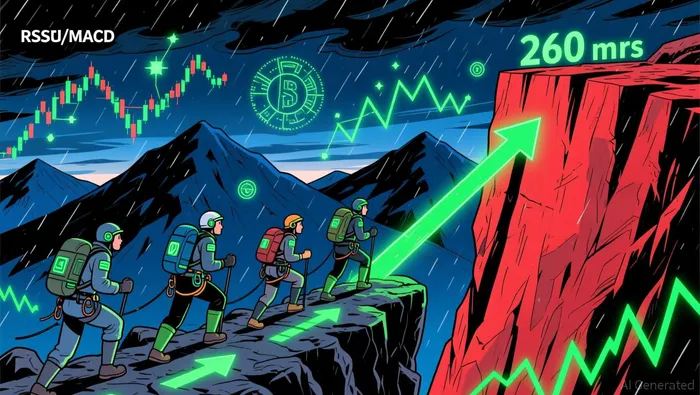 chart, such as this, can help traders and investors visualize the potential for a bullish move.
The 200-day Exponential Moving Average (EMA) also plays a pivotal role. Solana's price has been attempting to clear a key resistance band, and a sustained breakout above the 200-day EMA-paired with robust trading volume-could propel the asset toward $150–$160, aligning with the Federal Reserve's December 2025 policy meeting. Such a move would validate the asset's technical resilience and attract further speculative and institutional capital.
Institutional Adoption: A Catalyst for Growth
Beyond technicals, Solana's fundamentals are gaining traction. The network's recent upgrades, including the Firedancer validator client and Alpenglow consensus protocol, have significantly improved transaction speed and cost efficiency. These innovations have attracted institutional capital, with the Total Value Locked (TVL) in Solana's DeFi ecosystem rebounding to $8.8 billion.
A notable development is the Bitwise Solana Staking ETF, which has further bolstered demand for staking yields. High staking returns, coupled with the network's energy-efficient proof-of-stake model, position Solana as an attractive asset for institutional portfolios seeking both yield and scalability. Additionally, the Breakpoint 2025 conference-a key event for the Solana ecosystem-has drawn significant attention, with on-chain volume and derivatives open interest expected to surge during this period.
Structural Challenges: Validator Concerns and Centralization Risks
Despite these positives, Solana faces structural headwinds. The validator count has plummeted by 68% over three years, dropping from over 2,500 in 2023 to approximately 800 in 2025. This decline is attributed to a deliberate "pruning" policy introduced in April 2025, which targets underperforming validators, often termed "Validators in Name Only" (VINO). While pruning aims to enhance network quality by enforcing stricter uptime and hardware standards, it has raised concerns about decentralization and network resilience.
Centralization risks are another pressing issue. Entities like Teraswitch and Latitude now control 43% of staked tokens, while JitoJTO-- operates 88% of validator nodes. This concentration exposes the network to governance bottlenecks and potential manipulation. High operational costs, including hardware and network expenses, have also contributed to the exodus of smaller validators.
However, the Solana community is not standing idle. Proposed solutions like BLS signature aggregation and rotating voting committees aim to reduce consensus overhead and lower validator costs. These innovations could mitigate centralization risks while maintaining the network's high throughput and low latency.
To better understand the validator landscape, consider the in the broader ecosystem, which could offer insights into decentralization metrics.
Balancing the Factors: A Bullish Outlook with Caution
Solana's technical indicators and institutional adoption trends paint a compelling case for a bullish breakout. The RSI and MACD suggest upward momentum, while key resistance and support levels offer clear price targets. Institutional upgrades and staking yields further reinforce the asset's fundamentals.
Yet, validator concerns cannot be ignored. While pruning has improved network quality, the decline in validator count and centralization risks pose long-term challenges. Investors must weigh these structural issues against Solana's technical and institutional strengths.
For now, the data suggests that Solana is in the early stages of a bullish phase. Traders should monitor on-chain volumes, exchange flows, and derivatives open interest for confirmation during key events like Breakpoint 2025. However, structural risks remain, and a diversified approach is advisable for those seeking to capitalize on Solana's potential.






Comentarios
Aún no hay comentarios